Facebook
 Google
 GitHub
 Linkedin
Principles of High-Voltage Transmission
This article explores the fundamental principles of high-voltage power transmission, focusing on its advantages for efficient long-distance energy delivery, and examines the impact of voltage levels on current, power losses, conductor sizing, insulation requirements, and the environment.
Power transmission refers to the bulk movement of electrical energy from generating stations to substations located near demand centers. It forms a critical link in modern power systems, ensuring that electricity produced—often far from populated areas—is reliably delivered to homes, businesses, and industries. As electricity is fundamental to economic development and quality of life, the efficiency and stability of power transmission directly impact the performance and cost-effectiveness of the entire electrical grid.
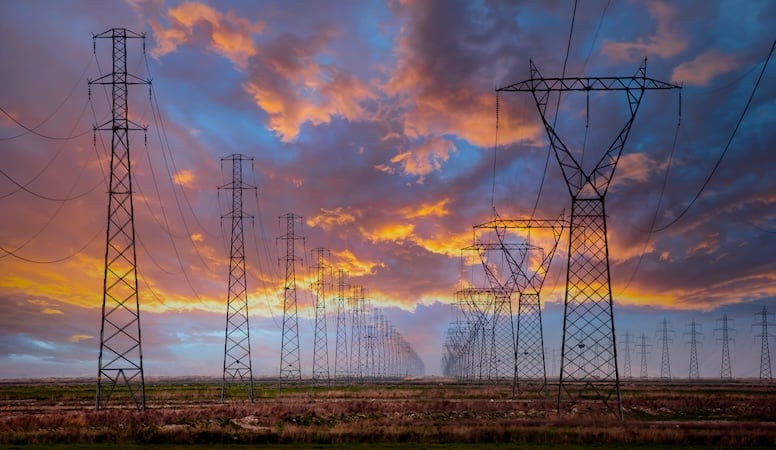
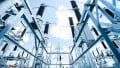
Image used courtesy of Adobe Stock
One of the core challenges in power transmission is transporting electricity over long distances without incurring significant energy losses or excessive infrastructure costs. Conventional low-voltage transmission is impractical over vast distances due to high power losses and the need for large, costly conductors. As a result, engineers have long sought solutions to improve efficiency and reduce losses in long-distance energy transport.
High-voltage transmission addresses this challenge by enabling electricity to be transmitted with lower current, thereby minimizing resistive losses (I²R losses) and reducing the required conductor size. This not only enhances the overall efficiency of the power system but also reduces capital and operational expenditures. Throughout this article, we’ll explore the fundamental principles behind high-voltage transmission and how it plays a pivotal role in modern electrical infrastructure.
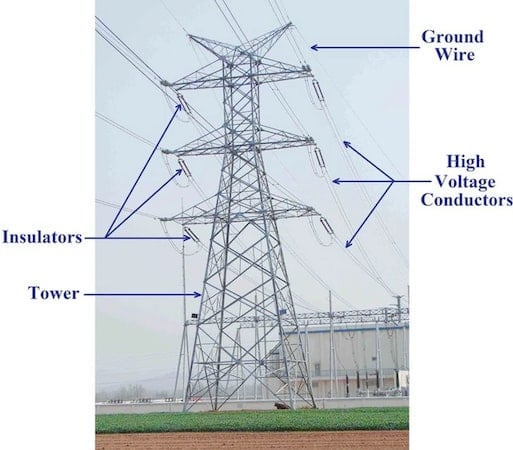
Figure 1. Typical High Voltage Power Transmission System. Image used courtesy of Springer Nature Link (open access)
The Physics Behind High-Voltage Transmission
Understanding the need for high-voltage transmission begins with the fundamental physics that govern electrical power flow. At the core are several basic power equations that reveal how voltage, current, and resistance interact in a power system.
Basic Power Equations
In alternating current (AC) systems, the real power delivered to a load is given by:
\[P=VIcos\theta\]
Where:
P is the real (or active) power in watts (W),
V is the root mean square (RMS) voltage in volts (V),
I is the RMS current in amperes (A),
cos is the power factor, representing the phase difference between voltage and current.
This equation highlights that for a given power factor and real power demand, voltage and current are inversely proportional. This relationship is key when deciding transmission parameters.
Power Loss in Conductors
The power lost due to resistance in transmission lines, often referred to as resistive or I²R losses, is calculated by:
\[P_{loss}=I^{2}R\]
Where:
Ploss is the power loss in watts
I is the current
R is the resistance of the conductor
These losses, proportional to the square of the current, manifest as heat, reducing system efficiency; even small increases in current can lead to significant power dissipation. Conversely, reducing current drastically minimizes losses.
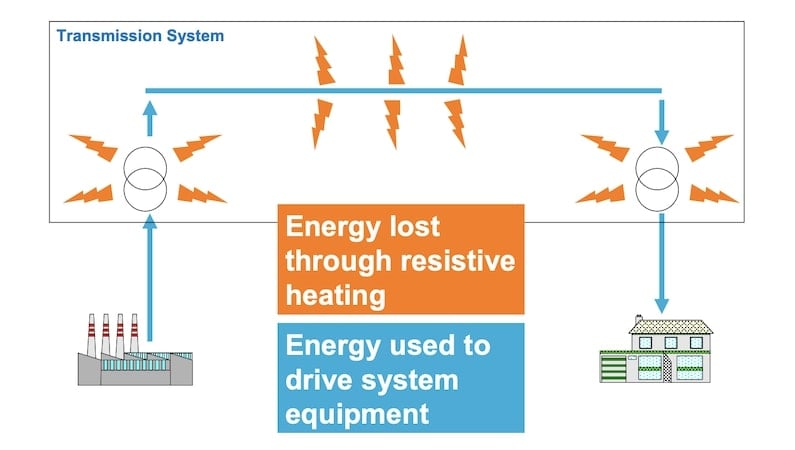
Figure 2. Resistive heating losses in transmission lines reduce system efficiency. Image used courtesy of SSEN
Power vs. Voltage vs. Current
Now, consider a system where the power demand (P) is constant. From the real power equation:
\[P=VIcos\theta\]
Solving for current:
\[I=\frac{P}{Vcos\phi}\]
This shows that if power and power factor remain unchanged, increasing the voltage (V) leads to a proportional decrease in current (I).
Voltage Increase → Current Reduction → Loss Reduction
As current decreases, the impact on resistive losses is quadratic due to the I²R relationship. For example:
If voltage is doubled, current is halved.
If current is halved, I²R losses are reduced by a factor of four (since 1/22=1/4).
This is the fundamental reason why high voltages are used in transmission systems — they allow the same amount of power to be transmitted with lower current, smaller conductor sizes, and dramatically reduced energy losses. By optimizing the balance between voltage and current, transmission systems can efficiently deliver electricity across vast distances without excessive heat generation or material costs.
Why Transmit at High Voltages?
Transmitting electric power at high voltages is a fundamental principle of modern power systems, driven by technical and economic considerations. The benefits stem from the ability to reduce current for a given power level, which brings a cascade of advantages in terms of energy efficiency, infrastructure requirements, and overall system performance.
Reduction of Transmission Losses
The most direct and impactful reason for using high voltage in transmission systems is loss minimization. As previously discussed, power loss in transmission lines is given by:
\[P_{loss}=I^{2}R\]
Reducing current through higher voltage operation significantly reduces these losses due to the square-law relationship. For instance:
Halving the current leads to one-quarter of the original losses.
Reducing losses enhances the overall efficiency of power delivery, allowing more of the generated power to reach the end-users rather than being dissipated as heat along the transmission lines.
This increased efficiency is especially critical over long-distance transmission, where cumulative losses can otherwise be substantial.
Smaller Conductor Sizes
Lower current in high-voltage transmission systems not only minimizes energy losses but also permits the use of smaller conductors, as the current-carrying capacity (ampacity) of a conductor dictates its required size. When current is reduced, the thermal stress on the conductor diminishes, meaning thinner conductors can be used without exceeding temperature limits. This leads to significant reductions in both the weight and cost of conductors, which in turn enables the use of lighter support structures such as towers and poles. These structural components can be designed with reduced mechanical strength requirements, further decreasing material and installation costs.
For instance, while copper offers superior conductivity, it is considerably more expensive and heavier than aluminum. In many high-voltage applications, utilities opt for Aluminum Conductor Steel Reinforced (ACSR) cables, which combine aluminum’s lightweight, cost-effective properties with the mechanical strength provided by a central steel core. Thanks to the reduced current in high-voltage lines, the lower conductivity of aluminum becomes acceptable, and its economic advantages can be fully leveraged. This strategic use of materials significantly enhances the feasibility and affordability of constructing and maintaining long-distance transmission lines without sacrificing electrical performance.

Figure 3. Physical and cross-sectional views of Aluminum Conductor Steel Reinforced (ACSR) transmission line segment. Image used courtesy of Research Gate
Economic Benefits
The economic advantages of high-voltage transmission are both immediate and long-term, reaching far beyond the savings achieved through smaller conductors. One major benefit lies in reduced infrastructure costs. Since smaller and lighter conductors impose lower mechanical loads, utilities can install smaller towers, use narrower rights-of-way (ROW), and require less land, all of which contribute to construction and maintenance cost savings. Additionally, by transmitting electricity at high voltages with lower currents and minimal losses, utilities can operate more efficiently. This reduces the need to generate excess power to compensate for losses during delivery, leading to lower operating expenses and more sustainable use of energy resources.
For consumers, this enhanced efficiency can result in lower electricity bills, as the cost savings for utilities often translate into more competitive energy pricing. While initial investments in high-voltage infrastructure—such as transformers, advanced insulation, and switchgear—are significant, the lifetime savings in energy and infrastructure can offset these costs many times over. Throughout a transmission line’s lifespan, which typically spans several decades, the cumulative savings can reach millions of dollars, making high-voltage transmission not only a technical necessity but a strategic economic investment.
Improved Voltage Regulation
High-voltage transmission also enhances voltage regulation, a critical factor in maintaining power quality at the point of consumption. Over long distances, the voltage drop along a conductor can be significant, especially at high current levels. By reducing current, high-voltage systems experience lower voltage drops, ensuring:
Stable voltage levels at substations and end-users.
Improved reliability and reduced risk of equipment damage or malfunction due to voltage fluctuations.
Maintaining voltage within tight tolerances is essential for the safe and efficient operation of sensitive loads, such as industrial equipment, data centers, and residential electronics.
Quantitative Loss Analysis
To truly appreciate the impact of high-voltage transmission, a numerical comparison helps illustrate how voltage levels affect current, power losses, and overall transmission efficiency. Let’s consider a simplified example: transmitting 100 MW over 200 km using two different voltage levels—11 kV and 220 kV. Assume the total resistance of the transmission line is 0.05 Ω/km, giving a total line resistance of:
\[R_{total}=0.05\times200=10\]
Case 1: Transmission at 11 kV
First, calculate the current:
\[P=VI\Rightarrow I=\frac{P}{V}=\frac{100\times10^{6}}{11\times10^{3}}\approx9090.91A\]
Now, calculate power loss:
\[P_{loss}=I^{2}R=(9090.91)^{2}\times10\approx827\times10^{6}W=827MW\]
This value is enormous—the losses are several times higher than the power being transmitted, which is clearly impractical.
Case 2: Transmission at 220 kV
Calculate current:
\[I=\frac{100\times10^{6}}{220\times10^{3}}\approx454.55A\]
Calculate power loss:
\[P_{loss}=(454.55)^{2}\times10\approx2.07\times10^{6}W=2.07MW\]
Here, only about 2.07 MW is lost, meaning 97.93 MW is delivered. Now compute efficiency:
\[\eta=\frac{P_{delivered}}{P_{generated}}\times100\%=\frac{97.93}{100}\times100\%\approx97.93\%\]
This example highlights a dramatic reduction in I²R losses when voltage is increased. At 11 kV, losses exceed the transmitted power, making it infeasible, whereas at 220 kV, losses are minimal, and efficiency is nearly 98%.
High-Voltage Transmission for Efficiency, Reliability
Understanding the principles of high-voltage transmission is essential for designing efficient and reliable power systems capable of meeting modern energy demands. By reducing current and minimizing losses, high-voltage transmission enables the delivery of electricity over long distances with improved efficiency, lower infrastructure costs, and enhanced grid stability. These principles are crucial for integrating remote renewable energy sources, supporting urban load centers, and ensuring sustainable and resilient energy systems for industrial, commercial, and residential applications.