Facebook
 Google
 GitHub
 Linkedin
Is Rooftop Solar Making Cities Hotter?
Research shows that temperatures could rise in cities with many rooftop solar panels. What are the impacts?
Rooftop solar panels have undergone widespread adoption in many parts of the world, even in locations with more rain than sun. While these solar panels provide significant renewable energy to urban environments, they also increase the local temperature in cities.
The cost of rooftop solar panels is decreasing while their power conversion efficiencies (PCE) are increasing, making them more accessible to more regions worldwide. However, they could change urban microclimates due to localized heat. Moreover, a higher local temperature around the solar cell (especially in humid environments) reduces their PCE and environmental impact.
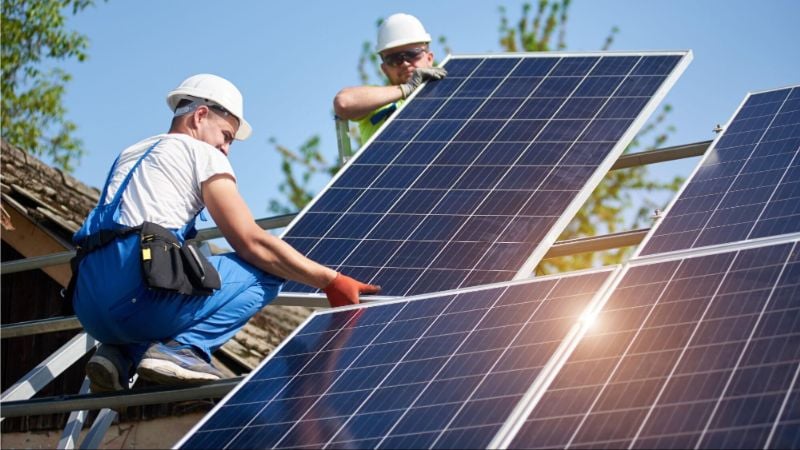
Installing solar panels. Image used courtesy of Adobe Stock
Rooftop Solar Panels Generate Heat During Operation
When solar cells are installed on roofs, they absorb energy from the sun because they have a low albedo (the amount of light a surface reflects). However, much of that heat is absorbed when this energy gets converted into electricity. This heat is then released into the surrounding environment, increasing the local temperature around the solar panels. This creates heat on the panel’s surface, where the sun is shining directly onto the panel, but also on the underside, where thermal convection occurs between the panel and the roof surface. When air moves over these surfaces, it is heated up more than if it had just passed across the bare roof. Areas with many rooftop solar panels have been shown to have higher daytime air temperatures than areas without rooftop panels.
_releases_heat_into_the_surroundings,_creating_heat_islands.jpg)
Adding solar panels (right) releases heat into the surroundings, creating heat islands. Image used courtesy of Barron-Gafford et al.
Study Address City-Wide Temperature Changes
No previous studies have examined rooftop solar panels’ impact on the wider urban environment. Previous research has not studied multiple cities, using only local experiments and simulations to draw conclusions. Many studies have also not considered the heat convection between the panel and the roof.
Researchers in the U.S., India, Belgium, China, and Australia collaborated to create a model using the latest weather research and forecasting data with building effect parameterization in tropical cities with high local temperature and humidity. This model was validated against an experimentally validated model to examine city-scale effects of rooftop solar panels.
The study considered numerous parameters, including boundary layer dynamics, near-surface meteorological fields, surface energy budgets, and sea breeze circulations. The primary research was performed in Kolkata, India. To assess the impacts in different climates, the researchers also investigated rooftop solar panels’ impact in Austin (U.S.), Sydney (Australia), Athens (Greece), and Brussels (Belgium).
Differences Between Night and Day
The study showed the efficiency of rooftop solar panels decreased by around 0.5–0.8% for each 1°C rise above standard conditions (25°C). Rooftop coverage of 100% in peak summer months caused a significant increase in temperature during the day due to the low albedo and the airflow above and below the panels, amplifying the heating effect. For example, the researchers observed a 3.2°C increase in air temperature between the panel and the roof during the day. However, 100% coverage also decreased the temperature at nighttime because the solar panels provided radiative and convective cooling.
| City | Daytime Change (°C) | Nighttime Change (°C) |
| Kolkata | +1.5 | -0.6 |
| Sydney | +1.9 | -0.8 |
| Austin | +1.8 | -0.7 |
| Athens | +1.2 | -0.4 |
| Brussels | +1.1 | -0.3 |
Changes in daytime and nighttime temperatures across the five cities studied. Data used courtesy of Khan et al.
Alongside an increase in temperature, the solar panels’ heat effect would reduce most renewable energy’s benefits at 100% roof coverage. In the Sydney study, around 40% of the electricity generated by the solar panels was used to prevent the panels from overheating via additional cooling loads, such as air conditioning. During peak summer periods, the solar panels’ surface reached up to 70°C, which naturally affected the local environment around the panels. The researchers also speculated that large numbers of rooftop solar panels across a city could impact the local microclimate.
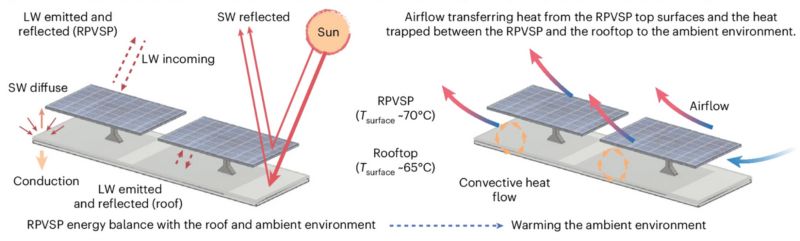
Heat between the panels and roofs warms the surrounding environment. Image used courtesy of Khan et al.
Stopping Rooftop Solar is Not the Solution
While solar cells could be responsible for changing local microclimates under large-scale adoption, they are among the most important renewable technologies we have for transitioning away from fossil fuels. The researchers stated that removing the panels is not the solution. Instead, they recommend reflective materials for rooftops (to reflect more heat away from the panel) and greenery (to act as heat sinks) in cities. These measures would help lower any potential temperature increases. The solar cells could also be integrated with water-based thermal collection systems to absorb excess heat from the panels’ surface for hot water production.