Facebook
 Google
 GitHub
 Linkedin
Is a Novel Oxide Material the Key to Clean Hydrogen?
Researchers at POSTECH and Seoul National University have discovered a class of oxide materials that can efficiently produce hydrogen using only solar heat.
Hydrogen could be a cornerstone of the decarbonized energy economy, but conventional production pathways remain carbon-intensive. Thermochemical water-splitting cycles offer an alternative route: splitting water molecules using high-temperature redox reactions powered by concentrated solar heat, without direct combustion or electricity input. The key barrier, however, has been materials. Only a handful of oxide-based redox materials offer the thermal stability, reactivity, and cycling performance required to make these processes viable.
A POSTECH and Seoul National University research team has overcome that barrier. Using a high-throughput thermodynamic screening methodology, they have identified a ferrite-based oxide that demonstrates exceptional performance in solar-driven hydrogen production.
This material exhibits high redox activity, thermal resilience, and record-breaking hydrogen yield per cycle, achieved without producing carbon emissions. The work, published in Advanced Science, validates a new material for thermochemical hydrogen production and demonstrates a computational approach that can screen thousands of candidates in a fraction of the time conventional methods require.
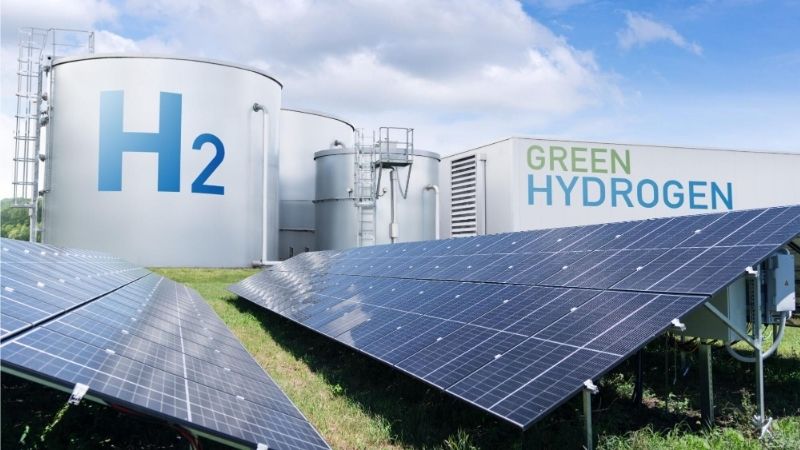
Scientists have discovered an oxide that could help create hydrogen from solar heat. Image used courtesy of Adobe Stock
Accelerated Discovery via Thermodynamic Screening
Traditional experimental workflows for discovering redox-active oxides can take days to weeks to characterize a single composition under varied conditions. The POSTECH-SNU team built a computational pipeline integrating thermodynamic databases with machine-accelerated simulations to perform more than 1,000 material-condition evaluations in under 24 hours, representing a 7,000-fold speed increase over baseline methods.
This allowed them to quickly narrow down the most promising candidates based on two key thermochemical criteria: the material’s ability to release oxygen at high temperatures, and its capacity to reabsorb that oxygen at lower temperatures during water reoxidation (i.e., hydrogen release). The computational predictions were then experimentally validated to confirm that their ferrite-based oxide met the thresholds and exceeded known benchmarks for hydrogen output and reaction reversibility.
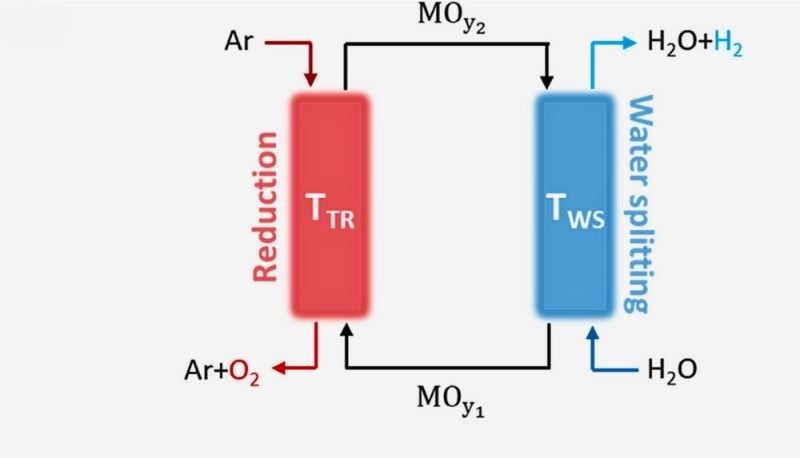
Schematic representation of the two-step thermochemical H2 production cycle. Image used courtesy of Lee et al.
By avoiding reliance solely on AI pattern recognition, which often struggles with high-dimensional phase diagrams, the researchers demonstrated the effectiveness of physics-based computation in tackling complex material design challenges.
Performance Characteristics and Broader Applications
The newly discovered ferrite demonstrates high structural stability across redox cycles, a critical factor for practical deployment. In many oxide materials, repeated cycling under high thermal gradients causes phase degradation, reducing yield and making the material non-reusable.
In contrast, the researchers’ ferrite-based oxide maintains performance across multiple thermochemical cycles, with no significant loss in redox activity. The team reports a hydrogen production rate that rivals or exceeds cerium oxide, the current standard for two-step water-splitting reactions, while potentially offering lower material cost and easier scalability.
Beyond hydrogen production, the high-throughput screening framework can be applied to identify redox-active materials for methane reforming, battery recycling, and metallurgical processes. In these systems, as in solar thermochemistry, the ability to control oxidation and reduction behavior precisely at high temperatures is essential. Materials that demonstrate fast kinetics, thermal durability, and predictable behavior under oxygen partial pressure gradients are valuable across energy-intensive sectors.
POSTECH’s Professor Hyungyu Jin emphasizes that this breakthrough provides a near-term material candidate and a framework for accelerated discovery and reducing the time to commercialization.