 Facebook
 Google
 GitHub
 Linkedin
Hydrogen-Electric Truck Braces for a Finnish Winter in Road Tests
Finland’s harsh winter conditions will put the Sisu hydrogen-electric truck’s long-haul capabilities to the test.
A hydrogen-electric truck is gearing up for winter road trials in Finland, where researchers will test how the battery and fuel-cell powertrain handles long distances, heavy loads, and harsh cold weather.
Developed under the European Union-funded Escalate research program, the Sisu Escalate test vehicle is designed to complete a journey of about 550 kilometers (342 miles) without stopping to charge or refuel. The truck runs primarily on battery power, with a hydrogen fuel cell generating additional electricity to extend its range during longer trips.
VTT Technical Research Centre of Finland is leading the pilot, which will track the truck's energy use, reliability, and operating costs. During the monitoring period, researchers will measure how weather, driving patterns, and energy demand affect the truck's operation. The results will help identify charging requirements and other infrastructure needs along freight routes.
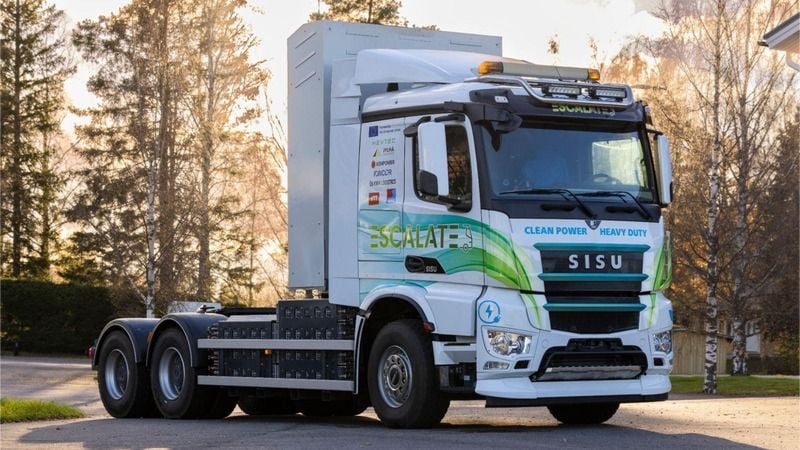
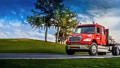
Sisu Escalate hydrogen-electric truck. Image used courtesy of VTT
Inside the Hydrogen-Electric Powertrain
Manufactured by Finland's Sisu Auto, the hybrid vehicle combines a 650-kWh lithium-ion battery with a hydrogen fuel cell range extender. The pilot limits the truck-and-trailer combination to a maximum weight of 68 tonnes, substantially heavier than the typical 40-tonne articulated trucks common across much of Europe. Finland and Sweden permit combinations reaching 76 tonnes, making the Nordic market a demanding test of the Sisu Escalate's electric powertrain performance.
Ioncor supplies the truck's Energy Pack battery system, which uses a modular design to support high energy density while efficiently using available space. Kempower is providing the megawatt charging infrastructure, while Hevtec handles the vehicle-side charging equipment and electric drivetrain integration.
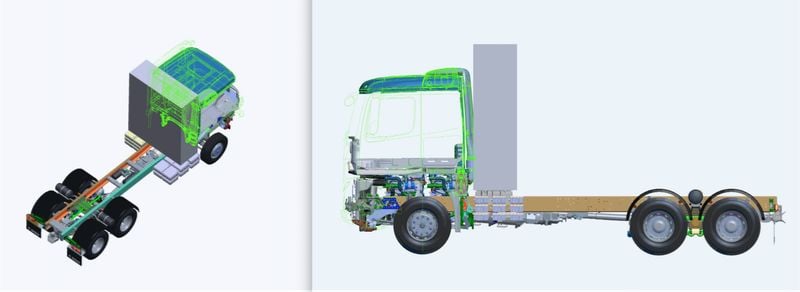
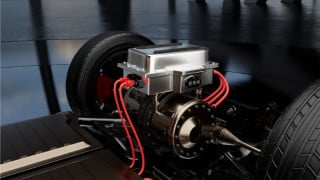
Renderings of the Sisu truck. Images used courtesy of Escalate
The truck operates primarily on battery power. A Ballard hydrogen fuel cell with a maximum electrical output of 120 kW generates additional electricity during longer trips, easing demand on the battery and extending the distance between stops. Four high-pressure tanks hold up to 58 kg of gaseous hydrogen at 700 bar.
Ioncor estimates that the truck could travel up to 500 km using battery power alone, increasing to 750 km with assistance from the hydrogen fuel cell. The vehicle also supports both combined charging system and megawatt charging system connections and is designed for charging at up to 1,000 kW.
The electric drivetrain uses two Danfoss motors and inverters. Its design also incorporates camera-based driver assistance and regenerative braking. Some components come from Sisu's established Polar line of heavy-duty trucks, a range engineered for demanding Nordic routes. Its chassis is longer than a conventional tractor unit to accommodate the battery system and hydrogen tanks.
The Escalate project is also developing digital twins, thermal management systems, and standardized electric drivetrain parts. A digital twin of the vehicle will be used alongside onboard measurements to examine energy consumption, system behavior in different conditions, and overall reliability during routine trips.
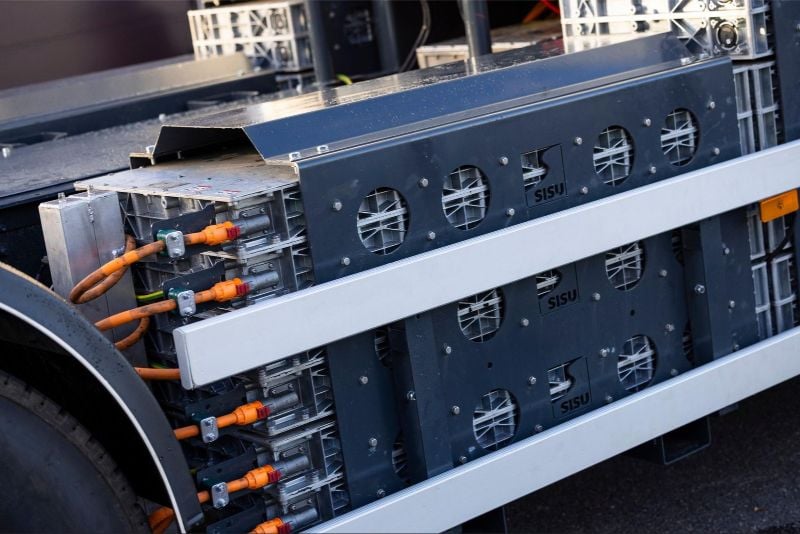
Sisu Escalate. Image used courtesy of VTT
Winter Route Trials in Finland
The Sisu truck is one of five vehicle concepts in Escalate, a European Union-funded program focused on zero-emission heavy-duty transport and the logistics infrastructure needed to support it. Four pilots involve physical trucks, while the fifth is a virtual demonstrator. The program is evaluating several zero-emission powertrain configurations, including battery-electric trucks and hydrogen fuel-cell vehicles.
Escalate also works alongside H2Haul, a separate European project that has tested hydrogen trucks and refueling facilities in France, the Netherlands, Germany, and Belgium. In Finland, logistics company Rauanheimo tested a fully electric Sisu configuration earlier this year, providing operational experience before the hydrogen hybrid version's longer-distance trial.
Learn more about the electric-hydrogen truck. Video used courtesy of POLIS Network
Jylhä Logistics is scheduled to operate the updated truck between Helsinki's Vuosaari harbor and Jyväskylä in central Finland. The planned daily round trip covers about 540 km (336 miles) or about 270 km (168 miles) each way. The truck will also perform regional distribution work around metropolitan Helsinki.
The route crosses urban, suburban, and rural roads, exposing the vehicle to a diverse mix of speeds, traffic patterns, and road surfaces. The trial will focus mainly on winter performance, when heating demands and battery temperature management can affect driving range.
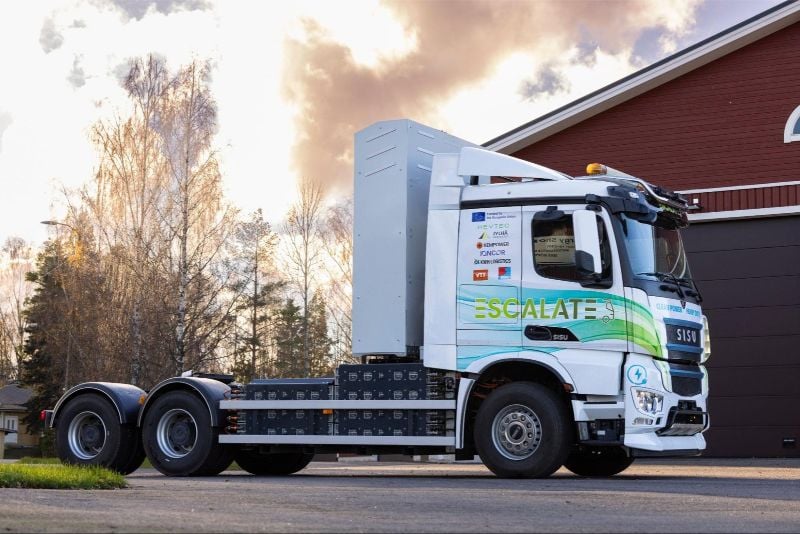
Sisu Escalate hydrogen + battery hybrid truck. Image used courtesy of VTT
Charging is available on both ends of the route, while a megawatt-scale charging installation is planned along the corridor. The truck can also refuel with hydrogen at a station in Jyväskylä. Researchers will compare electricity and hydrogen consumption, charging strategies, and operating costs with diesel freight operations to determine where each energy source makes economic sense.
Winter runs are planned through the project's conclusion in March 2027. Sisu Auto plans to use the findings to improve energy management systems and maximize battery-electric driving, reducing reliance on the more expensive hydrogen fuel.
Related Content