Facebook
 Google
 GitHub
 Linkedin
Zero-Prototyping Tipping Point: From Physical to Virtual EV Testing
The rising use of digital twins and advanced simulation is reducing the need for traditional prototyping.
The automotive industry is pushing boundaries in electric vehicle (EV) design, driven by rapid technological advancements and shifting consumer demands. In particular, automakers are experiencing a tipping point in engineering, where the increased use of digital twins and advanced simulation is dramatically reducing the need for traditional physical prototypes, saving time, money, and resources.
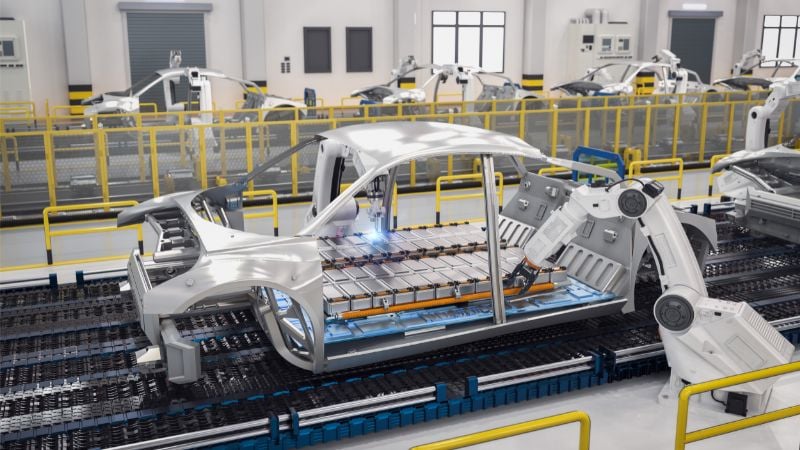
EV manufacturing and assembly. Image used courtesy of Adobe Stock
The movement away from the traditional, resource-heavy process of physical prototyping and testing toward a fully digitized approach to testing, coined “zero-prototyping,” has been something automakers have been working towards for years. By using simulations to replicate how an EV will perform across different scenarios, manufacturers can increasingly avoid the most costly phases of prototyping, saving time, money, and resources. In other fields like aerospace, where zero-testing is a goal, automotive engineers are pushing toward a similar standard, seeking to validate digital models with enough confidence to sideline several rounds of physical testing. We have the technology necessary to deliver a "zero prototyping" future, where all testing can be done virtually; however, manufacturers need to continue to educate themselves on their options and develop more confidence in these solutions.
Digital Twins and Simulations
Digital twins virtually replicate physical assets, systems, or processes. These digital models enable engineers to simulate and analyze countless factors for EVs, from motor efficiency and battery heat management to noise, vibration, and harshness challenges. With multiple digital twins, automakers can replicate the lifecycle of an EV, capturing real-time data on every performance aspect, from heat and noise profiles to energy consumption under different driving conditions.
While it's impossible to make a virtual replica of every possible environment and scenario in the physical world, manufacturers are finding that digital twins offer a virtual platform for testing a much broader range of conditions, including variations in pressure, temperature, air quality, and impact forces. Running these simulations enables them to predict and prevent performance issues more safely and cost-effectively before they arise in real-world applications. Manufacturers are accelerating the entire manufacturing workflow by adding virtual assessments into their processes to help minimize production delays often caused by costly errors.
One critical issue in EV design is battery thermal management. The massive amount of energy stored in EV batteries generates heat, which, if unchecked, can lead to premature battery wear or even safety hazards like fires. A digital twin can simulate battery performance across various temperature ranges, identifying cooling requirements and improving thermal management. This reduces the need for physical testing, leading to more accurate designs and fewer physical prototypes while mitigating risks associated with overreliance on simulations alone.
EV battery pack on a production line. Image used courtesy of Adobe Stock https://stock.adobe.com/images/ev-battery-pack-automated-production-line-equipped-with-orange-robot-arms-modern-electric-car-smart-factory-row-of-advanced-robotic-arms-inside-bright-plant-assemble-battery-for-automotive-industry/661397600
Automakers who implement simulation technology also use data from actual driving behavior, such as braking and acceleration patterns, to feed back into a simulation, providing insights into potential failures and informing future design and predictive maintenance. For example, engineers can predict when specific parts might wear out and address issues before they escalate. These insights are fed into generative design, allowing engineers to make more informed decisions about materials and design elements, enhancing durability, efficiency, and safety in subsequent models.
AI-Driven Simulation to Scale Testing
Artificial intelligence is pivotal in advancing zero-prototyping for EVs. Engineers would find it impractical to simulate thousands of real-world scenarios manually. However, by feeding simulation data into AI algorithms, manufacturers can increase the number of testing scenarios. AI tools can identify patterns, predict outcomes, and even simulate scenarios that may not have been initially considered. For example, AI can simulate wear-and-tear over decades of driving in minutes, revealing insights about component longevity and environmental impact.
This level of testing far exceeds the capacity of physical prototypes, enabling manufacturers to optimize designs for long-term performance, energy efficiency, and safety in a virtual setting.
Building Trust in Simulation Technology
The backbone of zero-prototyping is trust in the simulations run with digital twins. To utilize digital twins and simulation technology, there needs to be confidence that virtual tests reflect real-world conditions. However, achieving such trust is not easy. Until recently, limited computing power and basic simulation software restricted what engineers could replicate virtually. High-performance computing (HPC) and cloud-based server farms are changing that. Advanced cores now enable simulations to be run at scale and speed; for instance, tasks that once took a day to complete can now run in a few minutes on servers with hundreds of processing cores.
Simulations must be rigorously validated to ensure accuracy, meaning simulation quality must match the rigor of physical tests. To address EVs' real-world complexities, leading manufacturers are investing in computational accuracy and exploring a broader spectrum of variables, from extreme weather to dynamic driving conditions. As accuracy improves and testing using virtual prototypes becomes more commonplace, automakers are increasingly comfortable abandoning the old processes and reducing the number of physical tests needed.
Even though simulation accuracy is improving, a complete departure from physical testing remains unlikely in the foreseeable future. The U.S. government and global regulatory agencies mandate certain physical crash tests and durability checks before EVs can be released to the public. Additionally, for high-level management, the leap to trusting a fully virtual prototype without physical validation can be daunting, particularly for end-product testing. While digital twins can predict component behavior with impressive precision, achieving trust for the entire vehicle, which integrates countless parts and systems, remains challenging.
To bridge this trust gap, EV manufacturers often adopt a hybrid approach, supplementing simulations with reduced physical prototyping. Instead of ten physical prototypes, a manufacturer might rely on three to five, leveraging digital twin insights to zero in on areas of highest concern. This method facilitates faster governmental approval processes, as regulators can review comprehensive simulation data alongside physical test results.
The Future Sustainable EV Ecosystem
Beyond performance and safety, the move toward zero prototyping aligns with sustainability goals. By reducing physical prototyping, manufacturers can minimize material scrap and emissions associated with producing and transporting prototypes. This aligns with the larger push to reduce the environmental impact of EV production. Additionally, manufacturers can more efficiently explore end-of-life recycling options by leveraging lifetime digital twins, helping address the growing need for EV battery disposal solutions.
While zero-prototyping remains an aspirational goal, the technologies driving it accelerate progress toward a more sustainable, efficient, and cost-effective EV production model. The road to a fully digital prototyping process will be gradual, with incremental steps in building confidence in digital twins, achieving regulatory acceptance, and incorporating real-world data. But the foundation laid by AI, digital twins, and simulation technologies sets the stage for an era where digital and physical realities seamlessly integrate, redefining the future of EV manufacturing.