Facebook
 Google
 GitHub
 Linkedin
How Can Redox Flow Batteries Prevent Power Outages?
Redox flow battery microgrids could be the answer to disaster-caused outages.
Natural disasters like wildfires cause emergency and rotating power outages. When power outages occur, local grids implement countermeasures to supply power from their storage batteries to specific critical load distribution boards. However, more extensive countermeasures are needed to provide more power to wider areas. Redox flow batteries could be the solution.
How do redox flow batteries work? Video used courtesy of Sumitomo Electric
The New Energy and Industrial Technology Development Organization (NEDO) and Sumitomo Electric have operated a redox flow battery (RFB) microgrid project in California since 2015. The project collaborates with the California government and San Diego Gas & Electric Company (SDG&E). The RFB system’s operator, Sumitomo Electric, was awarded the International Smart Grid Action Network (ISGAN) Award 2024 for the project's success.
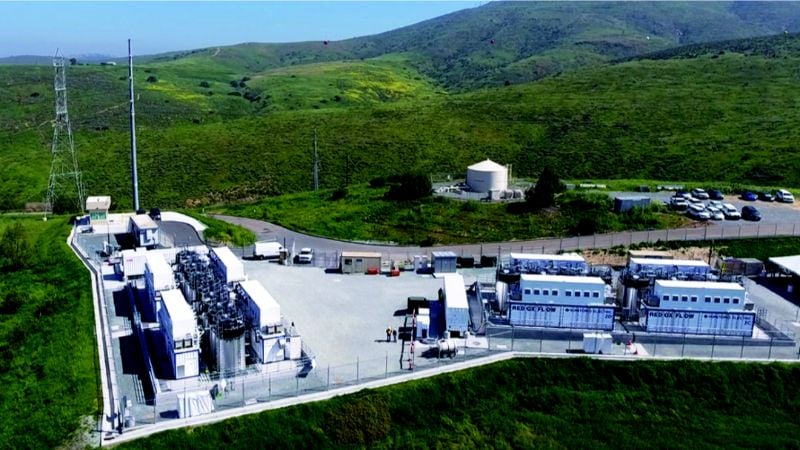
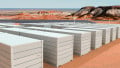
Redox flow battery system in San Diego. Image used courtesy of NEDO
What Are Redox Flow Batteries?
RFBs work via a redox (reduction and oxidation) reaction, in which vanadium ions circulate in an electrolyte around the battery and undergo oxidation and reduction to discharge and charge. The valence state of the vanadium ions changes during this process.
During discharge, the oxidation reaction causes the vanadium ions to lose electrons at the negative electrode (which then enters the external circuit). These electrons travel to the positive electrode, are accepted, and undergo a reduction reaction. This process generates an electric current. During charging, the process is reversed, as is the current direction, which allows energy to be stored in the system because the vanadium ions on the negative side of the cell store the extra electrons by changing their valance state. Positively charged hydrogen ions balance the system, maintaining charge neutrality.
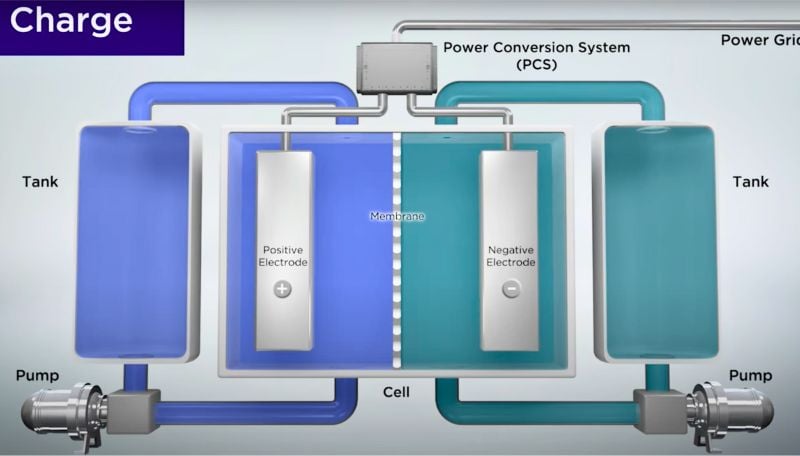
Redox flow battery structure. Image used courtesy of Sumitomo Electric
In RFBs, the electrolyte and active materials are pumped through porous electrodes (often made of graphite), with an ion-separator membrane separating the two electrodes. Because of this architecture, RFBs are bulkier systems because they require two chemical tanks to house the electrolyte solution containing the vanadium ions.
However, since the process doesn’t involve intercalation or de-intercalation of ions but relies on changing valence states, electrodes experience little damage. This makes RFBs a long-life energy storage medium. The batteries also use noncombustible and fireproof materials, so battery fire chances are low. The state of charge (SOC) is measurable, and altering the electrolyte amount can easily change the power output (kW) and power capacity (kWh).
Sumitomo Redox Flow Battery Installed in California
Between 2015 and 2021, Sumitomo installed a 2 MW/8 MWh battery in California that could power up to 1,000 homes for four hours. The RFB was installed at an SDG&E substation to investigate the flexibility and reliability of the RFB microgrid approach.
The project has shown that the RFB microgrid can supply power to areas experiencing blackouts. The RFB batteries could be used as an independent power source in pre-planned and emergency situations and generate revenue via electricity market transactions during normal operation scenarios. The project is the first in the U.S. or Japan where a microgrid has operated on a commercial distribution network using storage batteries as the primary power source.
The project also demonstrated that the RFBs could stabilize the voltage and frequency of power distribution lines through either charging or discharging energy based on supply and demand at different times. It could also help to stabilize the fluctuations in solar energy generation in microgrids. The RFBs could seamlessly shift from a grid-connected state to being independent, allowing them to start without needing any auxiliary power during a black start and ensuring that any grid users did not experience any power loss during blackouts.
The RFBs only had a small decrease in energy capacity, even when charged and discharged fully between 0% and 100% SOC. RFBs can maintain their rated energy capacity of 8 MWh for at least 20 years. The project also validated that the RFBs underwent very little degradation, with no major system failures and an availability rate of 99%.
Key Features of the Sumitomo Redox Flow Battery
Sumitomo’s RFBs were chosen for the California project because they contain several advantages for high grid resilience and protection from power outages (beyond the ability to transition between operating states).
The vanadium sulfate compounds used in the RFB are not flammable, so even if the liquids on the positive and negative sides of the battery mix, they will not cause a fire. Flame-retardant materials are used in other parts of the battery. RFBs are also more eco-friendly because the electrodes don’t undergo degradation―such as dissolution or deposition―during charging and discharging, so they can last longer. The electrolyte solutions can also be recycled and reused.
Because there is no degradation, the RFBs can be used for long periods, leading to lower life cycle costs. The ability to recycle the electrolyte also keeps life cycle costs down.
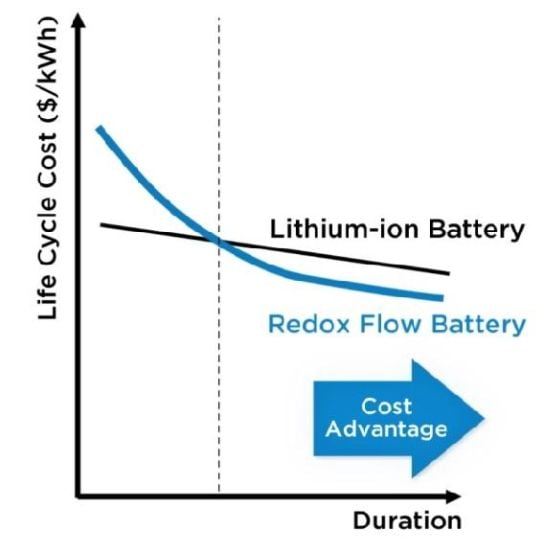
RFB vs. lithium-ion battery life cycles. Image used courtesy of Sumitomo Electric
Finally, the operation and design are straightforward. RFBs don’t require complex systems to operate or to change the power output, and multiple cell stacks can be built into a battery container to change the output power. Each stack is designed independently, so more or less stacks can be added to easily change the output power. Because the state of charge is the same for all cells, it’s easy to determine the remaining charge of each independent cell stack.
Looking To Japan and the US
The U.S. and Japan have their fair share of natural disasters, and both are key test sites for RFB systems to enhance grid resilience. After the California project’s success, NEDO and Sumitomo have said they will continue to work toward enhancing grid resiliency.