Facebook
 Google
 GitHub
 Linkedin
Proof of Concept: A High-Voltage eFuse for EV Apps
This article introduces the proof of concept for a new eFuse system, which achieves a short-circuit detection response time of below 160 ns under the test conditions at 650 A of short-circuit current in an 800 V system.
This article is published by EEPower as part of an exclusive digital content partnership with Bodo’s Power Systems.
Fuses are a well-known and common solution for protecting electric machine systems and are relatively robust against overcurrent. However, the accuracy and response time of conventional fuses may not be sufficient to protect SiC and GaN-based power semiconductor devices used in onboard chargers from surge currents, such as short circuits that occur in microseconds. The eFuse system can precisely detect these surge currents within nanoseconds and cut off the current, making it a key component for protecting the system in next-generation electric vehicles (EV).
Thermal Fuse Challenges
There are some challenges to consider in protecting the system from overcurrent.
- Fuses can interrupt the current within tens of milliseconds, and fusing current is inaccurate.
- A surge-like current, such as a short circuit, may damage the device before the fuse blows.
- Once the fuse blows, the system cannot resume normal operation until the fuse is replaced.
EV systems are composed of relatively robust components against overcurrent, including power semiconductor devices that are susceptible to damage from surge currents such as short circuits.
Thermal fuses, which are still widely used today, interrupt the overcurrent by melting an internal conductor when the overcurrent occurs. However, due to their operating principle, melting fuses require a few milliseconds to several tens of milliseconds from the occurrence of a surge current to cut off the current. Therefore, it is difficult to protect semiconductor power devices from damage caused by surge currents that occur in the order of microseconds, such as short circuits. It is necessary to consider and design for a margin to protect components other than power devices since the fusing current is subject to variations and temperature dependency.
Once a fuse blows, the system cannot return to normal operation, so even temporary and rare surge currents, such as lightning or short-through currents, will not allow the system to resume until the fuse is replaced. A protection system with semiconductor switches that solves the challenges of conventional fuses is preferable for the protection of next-generation EVs.
The Proof of Concept eFuse System
In this proof of concept, Asahi Kasei developed an eFuse system that solves fuse issues and provides:
- Fast and precise surge current detection
- Accurate setting of current cut-off thresholds and response time to cut-off
- Current interruption and recovery operation using semiconductor switches
The eFuse system is designed to handle different modes of operation, i.e., short circuit and overcurrent, and generates current cut-off triggers in three circuits: short-circuit detection, dI/dt detection, and overcurrent protection (Figure 1). These circuit configurations allow better current turn-off controls for different operating modes, resulting in a more flexible protection system than fuses.
Fast and accurate current detection is necessary to protect SiC, GaN, and other semiconductor power devices against damage due to short-circuit currents and other causes. Here, we adopted the CZ39xx series current sensor from Asahi Kasei Microdevices (Figure 1), which is ideal for this application. Its 4 MHz bandwidth, less than 100 ns of response time, and fast settling from switching noise make it suitable for this application. In addition, thanks to the III-V compound semiconductor Hall element technology, it is robust against a strong magnetic field of over several hundred milli-Tesla.

Figure 1. eFuse system diagram including the CZ39xx series current sensor. Image used courtesy of Bodo’s Power Systems [PDF]
These circuits employing the CZ39xx series current sensor, peripheral circuits including control logics, and semiconductor switches composed of SiC power devices are mounted on a single compact PCB. This has resulted in eFuse, a resettable protection device that doesn’t require the replacement of any components and has cut-off characteristics that match the cause of abnormal currents, such as short circuits or overcurrents.
Result of Proof of Concept
Figure 2a shows an actual proof of concept board of the eFuse system. The SiC FET is adopted for switching devices, and the circuit is designed for 800 V reinforced isolation and a short-circuit current up to 1 kA. Figure 2b shows a characteristic curve of the eFuse system. The measurement results of response time from when the current exceeds the threshold to when the detection trigger occurs is plotted in red, and the response time to when the current is shut down to 0 A is plotted in blue. The eFuse system achieves a response time of less than 250 ns for a surge current of over 80 A for short-circuit mode. On the other hand, the response time for an overcurrent of less than 80 A is designed to be slower than the response time for surge current detection to avoid an unnecessary shutdown.
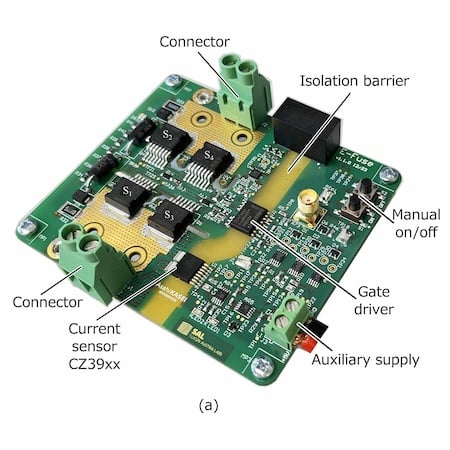
Image used courtesy of Bodo’s Power Systems [PDF]

Figure 2. (a) Proof of concept board of eFuse system and (b) characteristic curve of eFuse system. Image used courtesy of Bodo’s Power Systems [PDF]
Figure 3 shows the measurement result of a short-circuit current detection. Focusing on the output voltage waveform of the current sensor, the response time from the trigger point of overcurrent detection to the generation of the current cut-off trigger is less than 160ns. As a result, the eFuse system achieves faster current detection and current interruption than was possible with conventional thermal fuses.
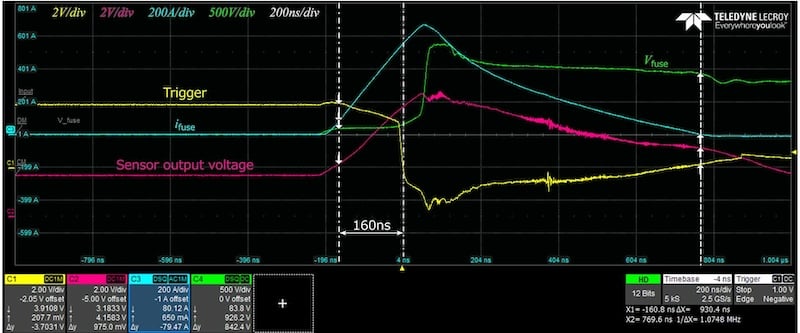
Figure 3. Short-circuit protection measurement. Image used courtesy of Bodo’s Power Systems [PDF]
Solving Conventional Fuse Challenges
This newly developed proof of concept realizes a new eFuse system, which solves the challenges of conventional thermal fuse-only protection systems. With a fast and accurate current detection solution, the eFuse system can provide the overcurrent protection needed for next-generation EV systems. Additionally, the current sensor employed in the eFuse not only supports its function but can control the current in connected subsystems such as DC/DC or OBC converters.
This article originally appeared in Bodo’s Power Systems [PDF] magazine and is co-authored by Thomas Langbauer, Team Leader Architectures & Topologies, Silicon Austria Labs; Thomas Feibel, Senior Research Engineer, Silicon Austria Labs; Zhen Huang, Junior Scientist, Silicon Austria Labs; Ichiro Okada, Lead Expert Magnetic Sensor Products, Asahi Kasei Microdevices; and Takahisa Shikama, Manager, Field Application Engineer, Asahi Kasei Microdevices Europe.