Facebook
 Google
 GitHub
 Linkedin
Tiny Changes Could Lead to Cheaper Green Hydrogen
Smoltek has completed a 1,000-hour durability test on hydrogen electrolyzers using less iridium, making them a more feasible option for large-scale green hydrogen production.
A global shift away from fossil fuels has prompted the development and commercialization of renewable technologies. Many renewable energy technologies exist today, but the transition to a largely fossil-free society will rely on various renewable energy solutions implemented worldwide. Green hydrogen is a promising route for large-scale energy production, as it uses water and has more accessible water resources than any other compound or material on Earth.
Green hydrogen production relies on splitting water into hydrogen and oxygen. A proton exchange membrane electrolyzer is one of the most common ways to achieve this splitting. The most critical component of the electrolyzer is the cell, where the water meets the electricity and where the reaction occurs to split the water into its atomic constituents. Electrolyzers are expected to grow significantly as green hydrogen ramps up in the coming years.
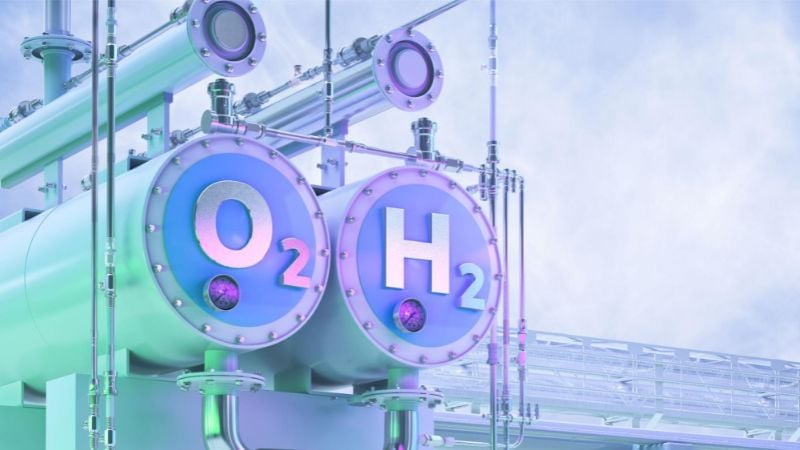
Concept of electrolysis for green hydrogen. Image used courtesy of Adobe Stock
Iridium Costs Cause Large-Scale Bottleneck
Iridium is widely used in proton exchange membranes (PEM) as the catalytic material to split the water molecules. Still, its costs are high because its natural abundance is much lower than many other metals. Iridium costs today regularly fetch over $150,000 per kg, with the highest prices in recent years reaching over $200,000 per kg. These costs could quadruple by the decade’s end because the prices back in 2020 were much lower at $50,000 per kg. Ten years ago, the prices were as low as $14,000 per kg.
The cost of iridium is often considered the bottleneck for many PEM electrolysis applications, making it difficult to scale them up and meet the needs of the renewable energy sector. Therefore, the amount of iridium required in these electrolyzers must be reduced.
Swedish-based Smoltek, which focuses on nanotechnology technologies, has been leading the charge in this area. Smoltek has developed PEM electrolyzer cells using very little iridium, making them more commercially feasible. Smoltek has just finished long-term testing of its nanofiber-based material for the porous transport layer (PTL) in PEM electrolyzer cells.
Past Promise of PEM Cells
In 2023, Smoltek developed a vertical nanofiber-based material for the anode PTL in its PEM electrolyzer cells. The PEM material comprises a sintered porous titanium layer with carbon nanofibers, a conformal platinum corrosion protection coating, and a thin nanoparticle layer of iridium.
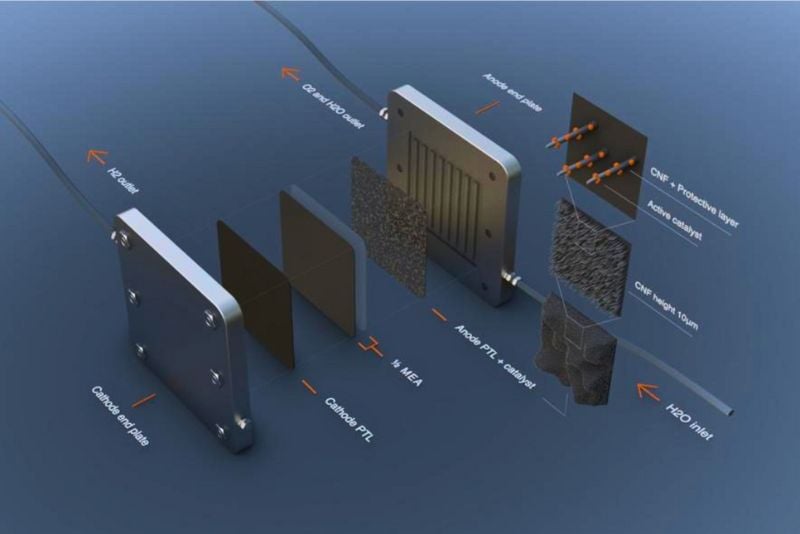
Smoltek’s electrolyzer. Image used courtesy of Smoltek
Smoltek’s electrolyzer incorporates multiple cells into a stack to facilitate the water-splitting reaction. Smoltek found its prototypes could produce as much hydrogen as a standard material containing 2.5 mg cm-2 of iridium using only 0.5 mg cm-2 of iridium—a reduction of 80% and an increase in the active surface area by two to three times. Based on these prototypes, Smoltek set a goal to create electrolyzer cells that only used 0.2 mg per cm2, which they achieved this year.
Success With Long-term Testing Results
In less than a year, Smoltek has reduced the iridium in the anode and has tested the cells for 1,000 hours to show long-term stability and durability. During the 1,000 hours of continuous testing at 2 A cm-2 and 60°C, the cell produced hydrogen without degradation in the nanostructure. The thin layer of platinum protects the carbon nanofibers from corrosion and is the driving force behind the cell’s long-term stability and durability.
Ellinor Ehrnberg, President of Smoltek Hydrogen, stated that the platinum-coated carbon nanofibers create a durable, stable anode electrode, providing an ample surface area for iridium catalysts in the electrolyzer.
During the testing, the fuel cell performance measurements showed the cells performed comparable to conventional systems but used only one-tenth of the iridium. This advancement builds on the company’s 2023 success with reduced iridium.
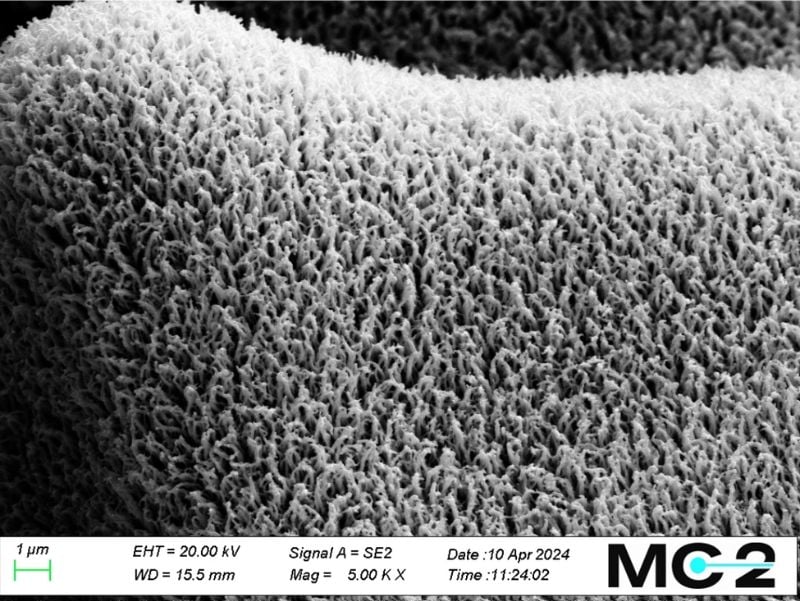
After 1,000 hours of testing, the nanostructure of Smoltek’s anode electrode remained intact. Image used courtesy of Smoltek
During the test’s first 10 hours, the voltage rose slightly from 2.1 to 2.5 volts and then increased marginally. Fabian Wenger, Head of Development at Smoltek Hydrogen, stated that the process was not unusual for lab conditions. He said the next step was to experiment with ruthenium and other variations of iridium.
While Smoltek has already managed to reduce the amount of iridium in these cells from 2.5 mg cm-2 to 0.5 mg cm-2 and then further to 0.2 mg cm-2, they hope to reduce the amount further in future prototypes. Smoltek has set an ambitious target of 0.1 mg cm-2 of iridium in the cell which aligns with the hydrogen industry’s goal to scale up the production of electrolyzers to meet demands for large-scale production of green hydrogen.
Lower Costs Bring More Scalability
If the green hydrogen industry intends to scale up its production, the reliance on efficient and cheaper electrolyzer cells will become more important. Green hydrogen use is predicted to increase by 100 times by 2030, and the global electrolyzer market will increase from $0.4 billion to $65 billion by 2030.
Few low-cost solutions are available today. Smoltek is paving the way toward reducing dependence on high amounts of iridium while producing cheaper electrolyzers to help meet the increasing demand for renewable energy worldwide. As electrolyzers become less expensive, they will spearhead much more green hydrogen production processes and wider commercial adoption. This will help to phase out fossil fuel much faster and will positively impact everyone on the planet.