Facebook
 Google
 GitHub
 Linkedin
Can Green Hydrogen Power Long-Haul Semi Trucking?
A green hydrogen facility—the largest in the U.S.—will supply emissions-free hydrogen fuel for long-haul trucks.
Electric batteries have proven impractical for the freight industry, but new efforts to produce affordable hydrogen fuel for combustion engines are underway.
The trucking industry is a major contributor to global carbon emissions. The MIT Climate Portal notes that the billions of tons of cargo transported yearly ultimately constitute 8% of global carbon emissions. Given its significant contribution to global pollution, the trucking industry must innovate to stay on par with the electric vehicle industry’s clean energy advancements.
What are the advantages of hydrogen-fueled trucks? Video used courtesy of Air Products
For semi-trucks, lithium-ion batteries (Li-ion) prove stubbornly impractical. To provide enough power for a semi-truck, the battery weight becomes prohibitive. Moreover, persistent charging challenges adversely impact long-distance truckers. The best short-term solution might be to keep combustion engines in these trucks and use green hydrogen to power them. Making green hydrogen accessible and cost-effective as a fuel source has been problematic, but that could soon change.
In Texas, two companies are partnering to build the largest green hydrogen fuel production facility in the U.S. The mega-scale facility may propel the trucking industry into a net-zero emissions future.
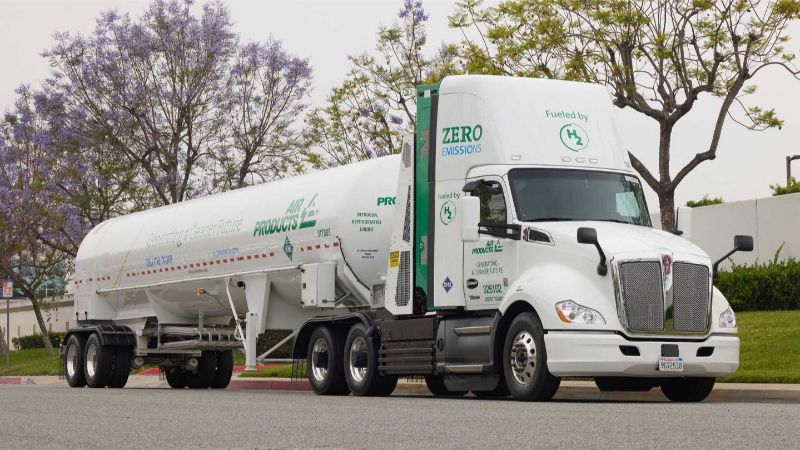
Hydrogen-powered semi-truck. Image used courtesy of Air Products
The Problem With Li-Ions and Semis
Unfortunately, taking Li-ion tech from passenger EVs and applying it to larger vehicles is not a simple proposition. Equipping large semi-trucks with Li-ions is particularly challenging, primarily due to energy density and weight limitations. Li-ion batteries provide about 250-300 Wh/kg, which, while suitable for light vehicles, cannot power heavy-duty trucks. A massive battery pack—up to 8-11 tons—would be required to power a large semi-truck over long distances. This weight load significantly reduces the truck's payload capacity, affecting its economic viability.
While energy density is improving steadily, Li-ion batteries cannot support a semi-truck.
Additionally, charging infrastructure for large Li-ion-powered trucks is underdeveloped. Even fast-charging such massive battery packs would require significant grid power, leading to longer charging times and increased downtime compared to refueling with diesel. For long-distance truckers, dramatically increasing downtime slashes efficiency and profit margins.
Further compounding this issue is the high cost of Li-ion batteries. The battery cost for a semi-truck could exceed $100,000, contributing to a higher upfront cost compared to diesel trucks. The costs are prohibitive since 95% of trucking companies are very small, with a fleet of fewer than 10 trucks. Combined with range limitations and longer refueling times, large-scale adoption of Li-ion-powered semi-trucks is commercially impractical for long-haul freight.
Green Hydrogen as a Li-Ion Alternative
Given all these drawbacks of Li-ions in semi-trucks, researchers and industry leaders have sought out hydrogen as a clean fuel alternative for the combustion engine. Because hydrogen releases no carbon when burned, it is ideal from an environmental standpoint.
Turning hydrogen into a fuel source depends on electrolysis, which is the process of splitting water by running an electric current through the water to break chemical bonds.
Burning hydrogen in a combustion engine involves mixing hydrogen gas with air and igniting it. Burning hydrogen reacts with oxygen to produce water as the primary byproduct, releasing energy in the form of heat. This heat drives the engine's pistons, similar to gasoline combustion. Hydrogen has a high energy density and burns cleanly, emitting no carbon dioxide.
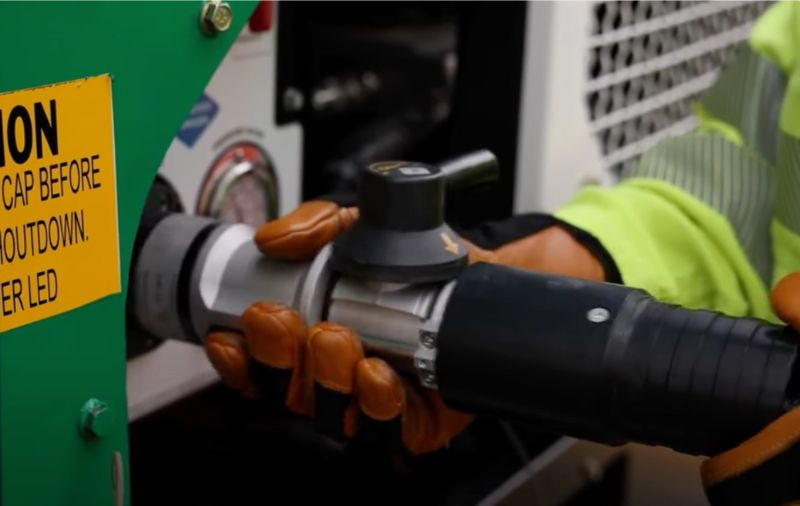
Refueling a hydrogen truck. Image used courtesy of Air Products
However, splitting water into hydrogen and oxygen requires a great deal of electricity, so one hurdle is the availability of enough solar and wind power to complete the process.
A Solution for Green Hydrogen
AES Corporation and Air Products, a hydrogen supplier, believe they have the answer to green hydrogen production. They’re developing a facility in Texas that will deploy significant wind and solar resources to become the first mega-scale green hydrogen production facility.
The project will power the electrolyzer with 1.4 GW of solar and wind power. The facility will be able to produce more than 200 metric tons of green hydrogen daily. Commercial operations are set to begin in 2027.
Targeted for use in heavy-duty trucks, the green hydrogen will eliminate about 1.6 million metric tons of carbon dioxide emissions yearly compared to diesel fuel.
Storing Green Hydrogen
Storage is another challenge when trying to harness the power of green hydrogen. Hydrogen is the lightest element, so storing it requires highly pressurized tanks or cryogenic temperatures to keep it liquid. Both options are costly and energy-intensive; because hydrogen has a low volumetric energy density, a larger storage infrastructure is needed than for fossil fuels.
Researchers at the Russian Academy of Scientists are already making significant headway on this issue by investigating materials and composites that can improve storage. They found that cesium and rubidium compounds have been found to improve the hydrogen storage process. This could lead to a practical transportation solution.
While green hydrogen is not yet ready to scale as fuel for the combustion engines of large semi-trucks, advancements are quickly leaping over the hurdles that inhibit its widespread use.