Facebook
 Google
 GitHub
 Linkedin
Vanadium Boosts Battery Power: A New Outlook for Li-Ion in EVs
Adding vanadium to EV battery cathodes could increase efficiency and stability.
Lithium-ion (Li-ion) batteries are expected to deliver higher energy densities at low costs in electric vehicles and energy storage systems. Numerous cathode materials are used today―such as lithium iron phosphate and nickel cobalt manganese oxide―but balancing cost and performance is often a challenge.
With demands increasing, lithium-rich manganese oxides (LRMOs) cathodes have been presented as a high-capacity alternative. However, efforts to use them have been stalled due to their rapid voltage decay and low initial Coulombic efficiency. LRMOs have a low cost, so if their issues can be addressed, they could become a cathode option in future Li-ion batteries. Chinese researchers have tried adding vanadium into LRMO cathodes to address these challenges.
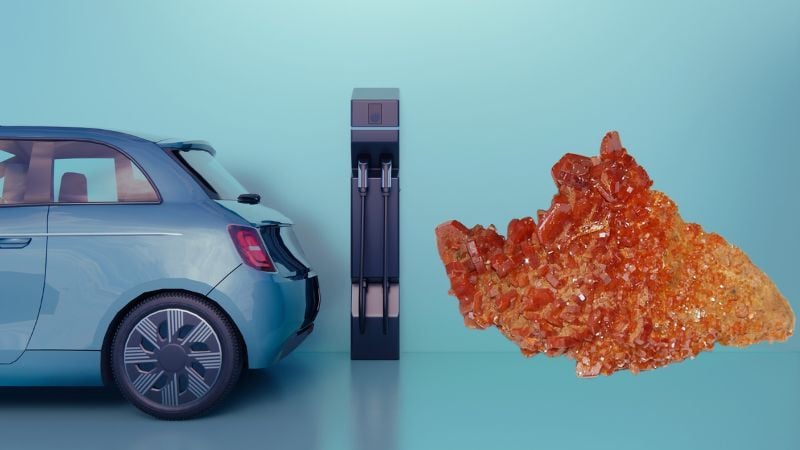
Can vanadium improve EV batteries? Image used courtesy of Canva and Wikimedia Commons
LRMO Cathode Design Challenges
LRMO cathodes contain a high amount of manganese and low nickel content, and unlike many EV batteries, they do not contain cobalt. Their structure uses lithium transition-metal oxides and lithium-rich manganese oxide (Li2MnO3) domains at the micro- and nanoscales. LRMOs’ high capacity has been attributed to the charge compensation mechanisms between the unbonded oxygen electrons in the Li–O–Li bonds within the Li2MnO3 domains.
However, oxygen anions at the cathode’s surface can become over-oxidated at high voltages, forming oxygen gas. This process, known as irreversible oxygen release, significantly lowers the initial Coulombic efficiency of the cathode, putting it below the commercially required threshold of 90%.
This release of oxygen also causes the Mn–O bonds to break and the Li–O–Li bonds to become destabilized. This reduces the transition metal ions’ migration energy barrier, causing them to occupy a site in the lithium layer and the oxygen ions to infiltrate the bulk phase. These ion migrations cause an increase in electrolyte degradation and cause surface-interface reactions.
The continuous detrimental cycle causes a low initial Coulombic efficiency and fast voltage decay. Preventing this is only possible by inhibiting the irreversible oxygen release and improving the stability of oxygen redox reactions.
Adding Vanadium Into the Cathode
The Guangdong University of Technology researchers chose to use vanadium to stabilize LRMO cathodes. A vanadium-doped layered-spinel coherent layer was introduced to the LRMO cathode’s surface.
The vanadium layers possess 3D ion channels that promote lithium diffusion efficiency, prevent surface-interface reactions, and suppress irreversible oxygen release. Additionally, the vanadium ions are simultaneously introduced into new electron states in the bandgap. This approach provides extra electrons to the neighboring oxygen atoms, causing a decrease in the Bader charge of the nearby oxygen atoms (the point between two atoms in a molecule where the charge density reaches a minimum and is the natural charge separation point between the atoms). This process creates a strong V-O bond that stops oxygen atoms from over-oxidating so they aren’t released, thus stabilizing the oxygen redox reaction.
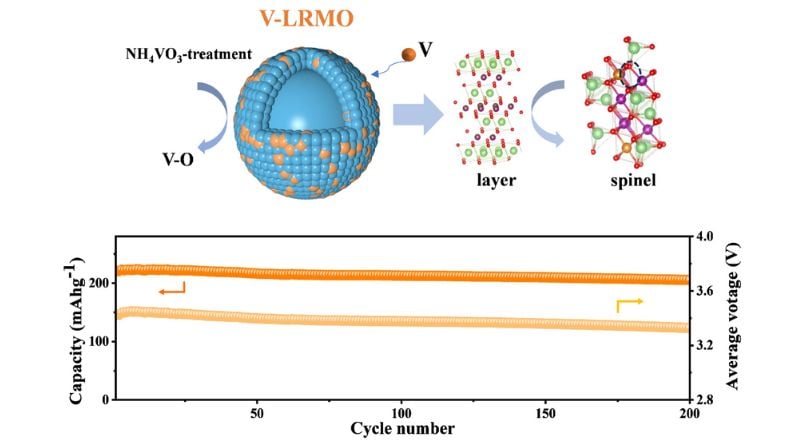
The LRMO cathode modified with vanadium. Image used courtesy of Tan et al.
The vanadium-enhanced LRMO cathode showed a much-improved initial Coulombic efficiency of 91.6%―compared with 74.4% of an untreated LRMO cathode. This surpasses the threshold required for commercial use, unlike LRMO cathodes before it. The cathode also showed a capacity retention rate of 91.9% after 200 cycles and a small voltage decay of 0.47 mV per cycle. The fabrication approach is a relatively straightforward molten salt method that could help to push LRMO cathodes into high-energy Li-ion batteries as it solves the main technical challenges plaguing their commercialization today.
Numerous Applications Could Benefit
Inexpensive and high energy-density Li-ion batteries are needed to meet the power needs of numerous applications. LRMO cathodes’ potential for higher density could make Li-ion batteries suitable for more demanding and higher-power applications, such as EVs, consumer electronics, and renewable energy systems.