Facebook
 Google
 GitHub
 Linkedin
EIA: US Renewable Energy Consumption Rose Slightly in 2022
How did renewable energy fare in last year’s energy consumption data? A new report from the U.S. Energy Information Administration reveals the details.
The U.S. Energy Information Administration (EIA) recently unveiled new data on the country’s energy mix in 2022, showing that about one-fifth of energy consumption came from non-fossil fuel sources such as renewables and nuclear power. While renewables grew slightly and nuclear declined, petroleum, natural gas, and coal still comprise the bulk of U.S. energy use, claiming a 79% share.
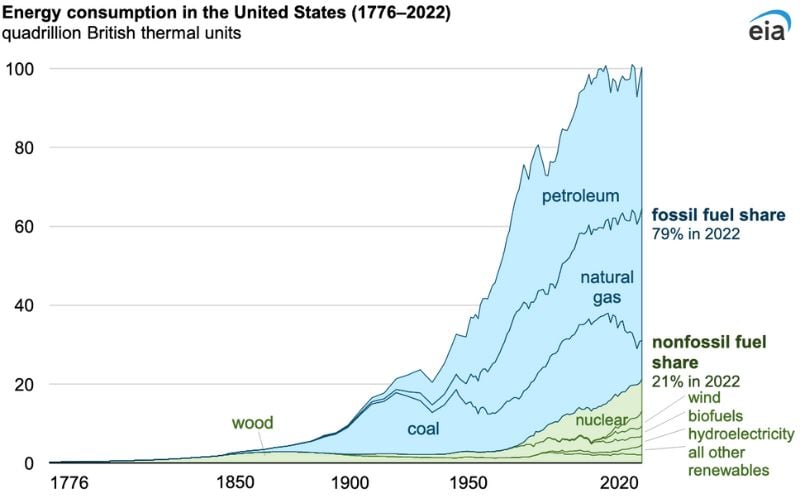
The U.S. Energy Information Administration’s Monthly Energy Review shows a growing share of non-fossil fuels in the country’s energy consumption. Image used courtesy of the EIA
The new data covers primary energy consumption, defined as the sum of consumption values across fossil fuels, nuclear electric power, renewables, and net electricity imports. This figure grew by 3% in 2022 to 100.4 quadrillion British thermal units (or quads). Nuclear and renewable energy sources claimed 21% of that total, a slight jump from 20% in 2021. This share matches 2020 and represents the highest level since the early-1990s.
Renewable consumption rose from 12.1 to 13.2 quads, a trend the EIA attributed to increased wind and solar penetration. Wind power, which first surpassed hydroelectricity’s share in 2019, was the dominant source of renewable consumption in 2022.
Among fossil fuels, petroleum maintained its leading share of energy consumption with 35.8 quads, driven mainly by use in the transportation sector as the main fuel source for cars, trucks, and airplanes. Coal consumption dropped from 10.5 to 9.8 quads, marking the second-lowest level in six decades and declining by over half since its 2005 peak, primarily due to reduced coal use in the electric power sector and a growing uptake of renewables.
Meanwhile, natural gas totaled 33.4 quads last year, the highest on record, up from 31.7 quads in 2021. The EIA says this is primarily due to increased consumption in the electric power industry, which uses more natural gas than any other sector.
Wind & Solar Top 2022 Renewables Growth
Renewable energy consumption grew across the board in 2022. Wind registered the steepest increase, from 3.3 to 3.8 quads, and accounted for about 28% of all renewables. Solar was a close second, rising from 1.5 to 1.9 quads (~14% of renewables). Hydroelectric jumped from 2.2 to 2.3 quads, while geothermal registered only a slight uptick from 0.20 to 0.213 quads.
Biomass still claims a large share of the renewable energy consumption mix, growing from 4.8 quads to 4.9 quads in 2022. Biofuels accounted for about half of that total, followed by wood (42%) and waste (less than 1%).
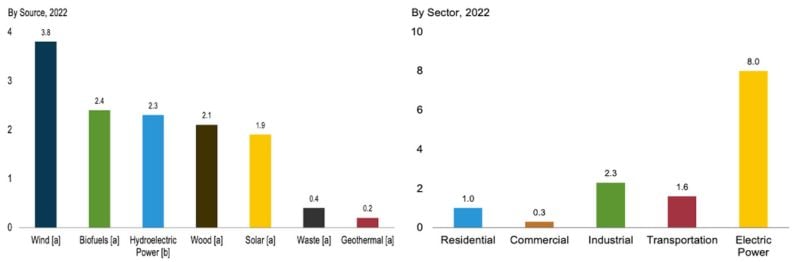
The EIA’s June 2023 monthly energy review charts the rise of renewable energy consumption in 2022. Image used courtesy of the EIA (page 188)
The electric power sector is the leading consumer of all renewables, totaling about 8 quads, followed by industrial (2.3), transportation (1.6), residential (1), and commercial (0.3).
Nuclear Declines Slightly
Nuclear energy consumption fell slightly from 8.1 quads in 2021 to 8 last year, with the EIA citing the May 2022 closure of the 51-year-old Palisades nuclear plant on Lake Michigan.
Holtec International, a Florida-based supplier of electrical equipment for nuclear reactors, completed its purchase of the plant soon after its closure and applied for federal funding from the Civil Nuclear Credit (CNC) to keep it open. The $6 billion program, funded through the Bipartisan Infrastructure Law, provides credits for plants economically at risk for closure amid tight competition from the natural gas and renewable energy markets. Holtec was later denied CNC funding in late-2022, with a company spokesperson acknowledging the challenges of restarting a shuttered nuclear plant.
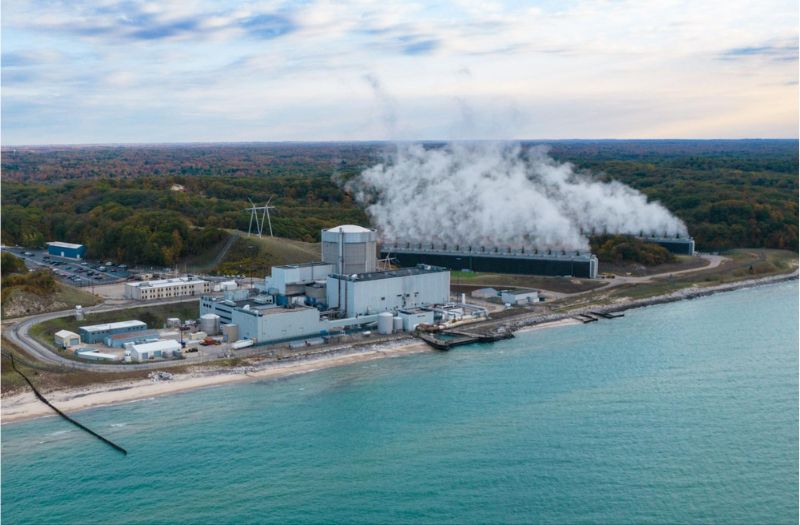
Michigan’s Palisades nuclear power plant closed in mid-2022 and is in the process of being decommissioned. Image used courtesy of Holtec International
Michigan state is pitching in on the effort to restart the Palisades plant, recently setting aside $150 million in its $82 billion budget. According to the EIA, nuclear energy has historically claimed about 30% of the state’s electric generation mix. Palisades’ net generation totaled 7 terawatt-hours (TWh) in 2021, its last full year in operation.
According to the U.S. Nuclear Regulatory Commission, there are 21 power reactors undergoing decommissioning nationwide. Financial pressures from competitive wholesale power markets are the leading cause of retirements. The Diablo Canyon Power Plant in California, which supplies about 17% of the state’s clean energy and 9% of its total electricity mix, was rescued last year as the first facility to receive $1.1 billion from the CNC program to stay open. It was initially scheduled to decommission in 2024 and 2025.
However, nuclear energy development hasn’t slowed entirely: Georgia’s Vogtle units 3 and 4 mark the first reactors to come online in decades. Once completed later this year, the new reactors will make the four-unit facility the largest nuclear power station in the U.S.