Facebook
 Google
 GitHub
 Linkedin
First US Onshore Wave Energy Project Launches in LA
Eco Wave Power has launched the first-ever U.S. onshore wave energy installation in Los Angeles.
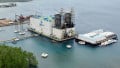
Eco Wave Power has installed the first onshore wave system in the U.S. at the Port of Los Angeles. The patented system attaches floaters to existing marine structures, harnessing wave motion to drive hydraulic cylinders that channel pressurized fluid to a land-based unit for electricity generation.
While not grid-connected, the pilot project presents an opportunity for Eco Wave Power to showcase its technology in U.S. waters over the next two years. It will support environmental monitoring and regulatory processes in partnership with local initiatives and serve as an educational hub for industry partners and potential customers.
The installation comes at a critical time in California, as the state senate has recently proposed Senate Bill 605, calling for a comprehensive wave energy roadmap.
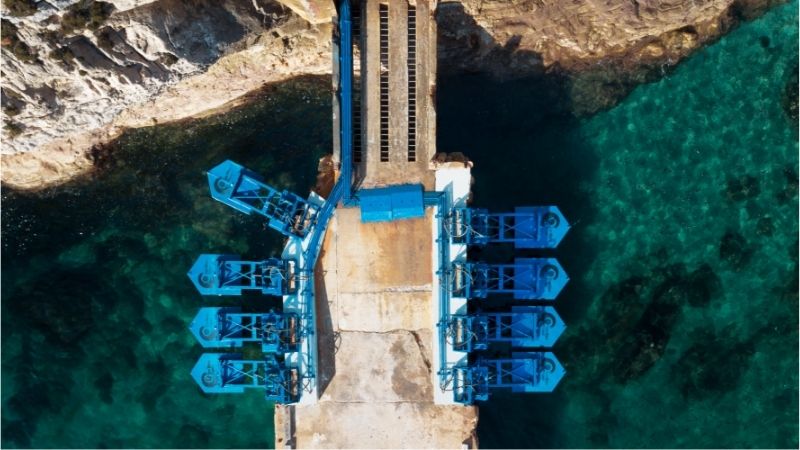
Eco Wave’s wave energy technology. Image used courtesy of Eco Wave Power
The Case for Onshore Solutions
Wave energy technology is not a new renewable energy source, but most focus has been on offshore development. In 2023, the wave energy off the U.S. coasts was estimated at 2.62 trillion kWh. Promising sites for wave energy generation include the U.S. West Coast, Europe, Japan, and New Zealand. Developers have tested a range of offshore technologies, from surface-based devices to systems anchored on the seafloor, to capture and convert wave power into electricity.
However, Eco Wave Power says offshore systems are not without their challenges. High capital costs stem from the need for ships, divers, moorings, and underwater cables for installation and maintenance. Reliability is low, as the machinery must endure harsh ocean conditions with waves reaching 20 meters high. These risks, combined with high costs, make securing insurance difficult.
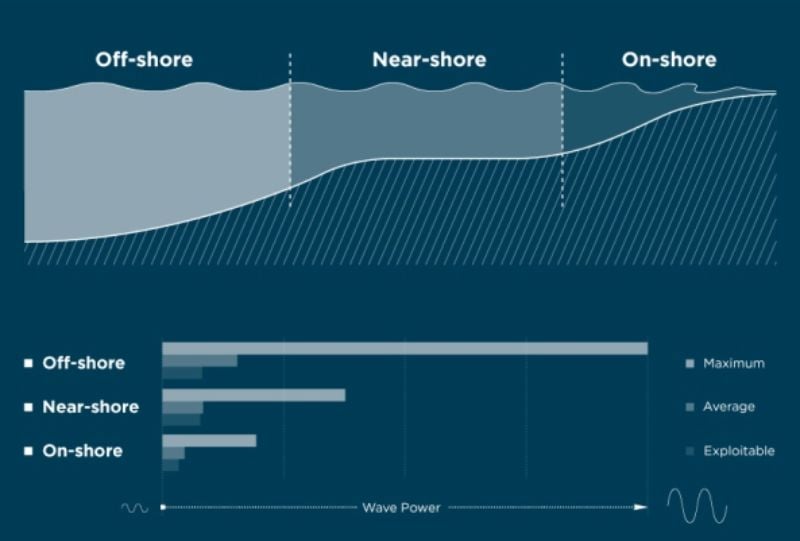
Wave power variations relative to proximity to the shore. Image used courtesy of Eco Wave/Texas A&M
Environmental concerns also pose barriers. Mooring to the seafloor can disrupt marine habitats and migration, prompting opposition from environmental groups. These financial, technical, and ecological hurdles have hindered offshore systems’ commercialization, so Eco Wave Power has chosen to focus on onshore technologies.
Onshore wave power systems provide greater security and reliability in energy generation. Using existing structures like ports or wharves reduces installation costs and material needs. While offshore sites may capture higher maximum wave power, Eco Wave Power notes that nearshore wave profiles are more predictable and highly exploitable as waves align and move in consistent directions.
How the Eco Wave Power System Works
The Eco Wave Power system is modular, low-maintenance, and designed to minimize environmental impact while attaching to existing structures without compromising their structural integrity.
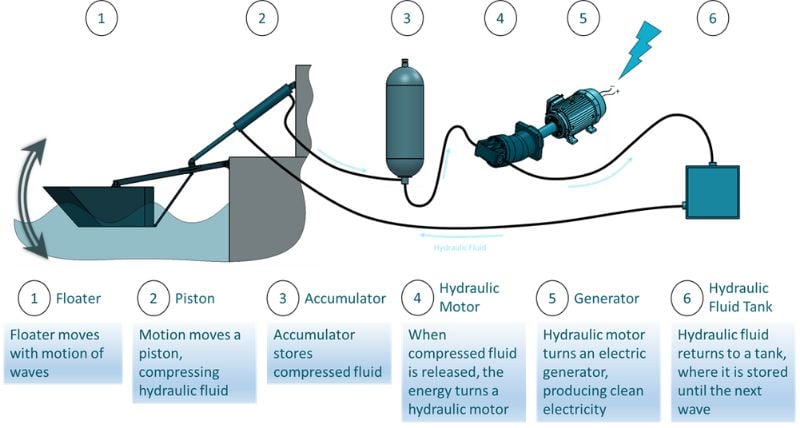
Eco Wave Power Onshore System. Image used courtesy of Eco Wave Power
The floaters capture energy from incoming waves by converting their vertical motion into electricity. As the floaters move, they compress and decompress hydraulic pistons, sending biodegradable fluid into land-based accumulators where pressure builds. This pressure drives a hydraulic motor connected to a generator, and the resulting electricity is fed into the grid through an inverter.
The decompressed fluid flows back into the hydraulic tank, where the pistons reuse it, creating a closed-loop system. Electricity production begins at wave heights as low as 0.5 meters. The entire process is managed by a smart automation system, which also protects the equipment during storms; when waves become too high, the floaters automatically rise above the water and remain elevated until conditions stabilize, after which they return to normal operation.
In Los Angeles, EcoWave collaborated with AltaSea and Shell Marine Renewable Energy. The company also has projects in Taiwan, India, and Portugal.