
 Facebook
 Google
 GitHub
 Linkedin
Battery Studies Tackle Dendrites, Zinc, and Lithium Recycling
Studies from MPI-SusMat, the University of Maryland, and Rice University target distinct bottlenecks across the battery stack.
As the world electrifies and power demand increases, engineers are expecting more and more from batteries. Researchers are responding by exploring new materials and perfecting designs to increase battery life, performance, and safety.
In the latest research, researchers have identified the mechanical mechanism behind dendrite-induced short circuits in solid-state cells, reformulated aqueous electrolytes for zinc metal batteries, and demonstrated a water-based leaching chemistry that recovers metals from spent lithium-ion cathodes in minutes.
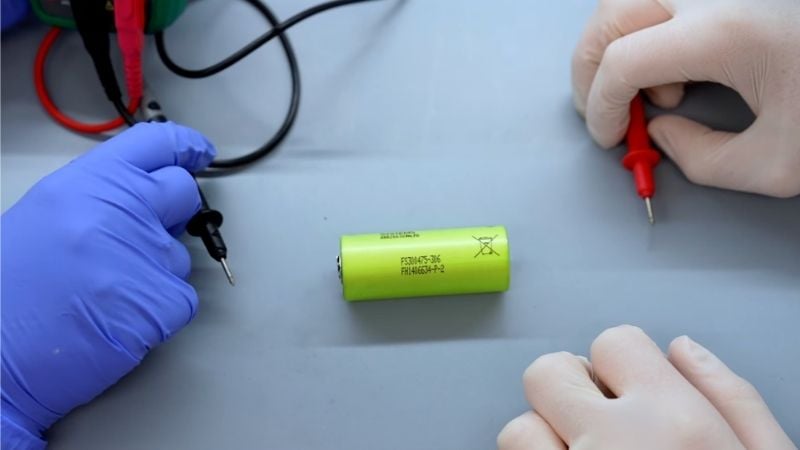
Battery research. Image used courtesy of Rice University
Why Solid-State Cells Short-Circuit
Researchers from the Max Planck Institute for Sustainable Materials have resolved a long-running debate over how soft lithium metal manages to crack a stiff ceramic. They confirmed that hydrostatic stress inside the dendrite drives brittle fracture of the garnet electrolyte, ruling out the competing electronic-leakage hypothesis.
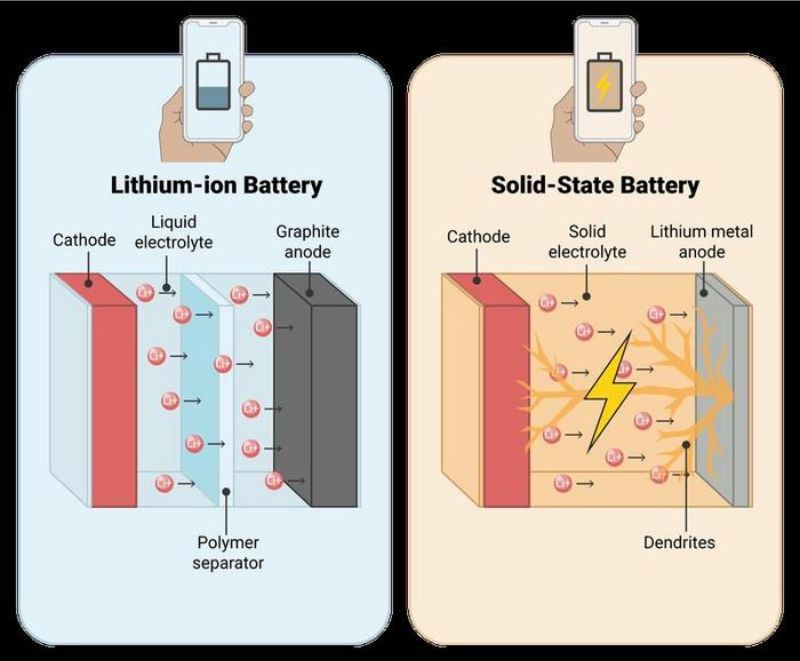
Lithium-ion battery vs. solid-state battery. Image used courtesy of P. Mehta/Max Planck Institute for Sustainable Materials
To isolate the mechanism, the team prepared and characterized samples entirely under vacuum and at cryogenic temperatures, eliminating interference from oxygen, water, and electron-beam damage. Phase-field simulations and electron backscatter diffraction measurements showed no lithium accumulation ahead of the dendrite tip, evidence that the metal advances under continuous mechanical pressure rather than electrochemical nucleation.
The researchers concluded that soft lithium metal can penetrate the ceramic electrolyte, comparing it to a water jet hitting a rock.
Three mitigation routes follow directly from the finding: tougher electrolytes that resist crack initiation, engineered microscopic voids that deflect dendrite growth, and protective coatings on the lithium electrode that suppress dendrite formation in the first place. Each route is now a target for follow-on work at MPI-SusMat.
The MPI-SusMat paper appeared in Nature.
Aqueous Zinc Gets a Longer Leash
University of Maryland and Brookhaven National Laboratory researchers have developed a water-based electrolyte that delivers 99.99% Coulombic efficiency over 1,000 cycles and energy densities near 130 Wh/kg in zinc metal cells.
Aqueous zinc batteries are attractive for grid energy storage because they avoid flammable organic solvents and rely on abundant materials, but water-driven side reactions and dendrite formation have kept cycle life short.
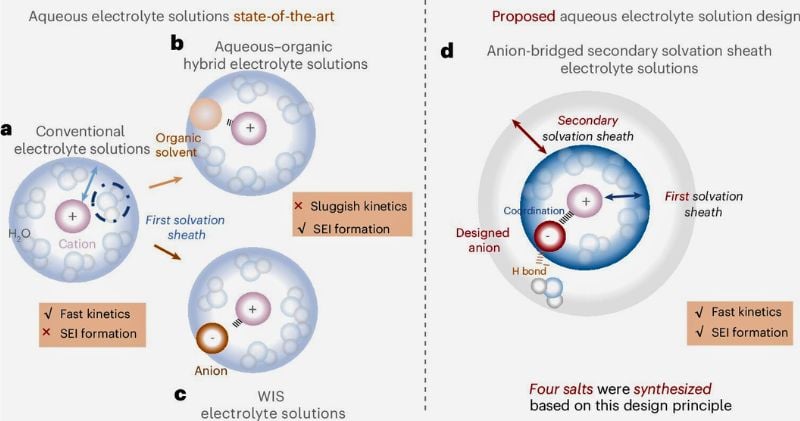
The various aqueous electrolyte solutions. Image used courtesy of Dong et al.
The team designed electrolytes containing fluorinated anions that interact with both Zn2+ and the surrounding water molecules, producing what the authors call an anion-bridged secondary solvation sheath. The structure shields the zinc surface from parasitic water reactions, supports a stable solid-electrolyte interphase, and preserves ionic transport.
The team identified a quantitative design rule, finding that salts with donor numbers above 18 reliably promote the protective solvation structure, giving electrolyte chemists a measurable target. The next steps will focus on scaling cell formats and validating performance at conditions relevant to stationary storage.
The paper was published in Nature Nanotechnology.
A Faster Route Through Battery Waste
Rice University's Department of Materials Science and Nanoengineering has created a hydrometallurgical recycling method that extracts roughly 65% of the key metals from spent lithium-ion cathodes in one minute at room temperature, with several elements exceeding 75% recovery under slightly longer treatment.
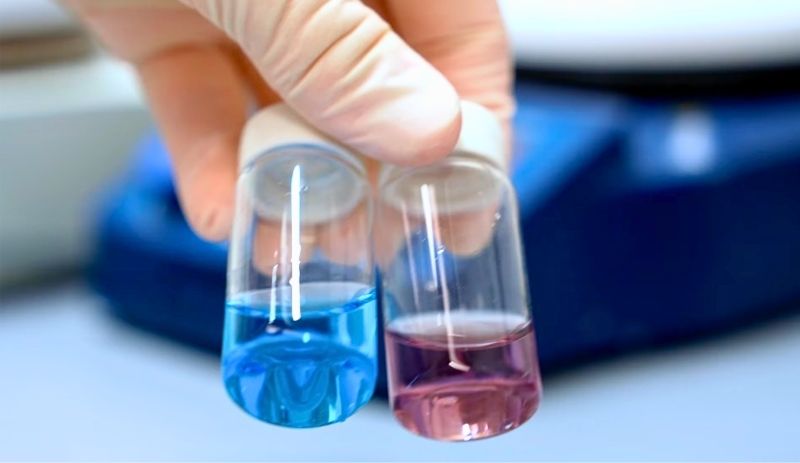
Aqueous solvents. Image used courtesy of Rice University
The team tested a class of aqueous amino chloride salts as alternative lixiviants against mineral acids and high-temperature deep eutectic solvents. Hydroxylammonium chloride (HACl) recovered the most metal of the salts they tried. The researchers attribute the effectiveness to its redox-active nitrogen center, which reduces transition metals in the cathode rather than relying solely on acidity and chloride coordination.
The chemistry runs at room temperature and sidesteps the energy and corrosion costs of pyrometallurgical and acid-leach routes.
Open questions include:
- Selectivity between cobalt, nickel, manganese, and lithium during downstream separation
- Electrolyte regeneration after multiple recycling cycles
- Economics at industrial throughput
The paper was published in Nature.











If you are searching for the best Copper Bonded Earth Electrode Manufacturer, then SG Power Copper Bonded Earth Electrode
offers premium-quality grounding solutions for electrical safety and lightning protection systems. Their electrodes provide excellent conductivity, corrosion resistance, and long operational life. Earthing systems play a major role in preventing equipment damage and electrical hazards. SG Power’s products are ideal for industrial plants, residential buildings, solar installations, and telecom infrastructure. Very informative article and useful details about earthing technology.