Facebook
 Google
 GitHub
 Linkedin
Less Power Loss Through Optimized Design
Learn how Mersen analyzed the eco-balance of its passive components, finding that weight reduction can impact energy efficiency and sometimes have negative ecological effects.
This article is published by EEPower as part of an exclusive digital content partnership with Bodo’s Power Systems.
Against the backdrop of climate change, the industry must reduce its ecological impact and take environmental criteria into account as early as the product design phase. Life cycle analyses are an important tool for improving the environmental compatibility of electronic products.
The eco-design and sustainability of power electronic components are therefore the focus of several new research projects. However, the environmental impact of power electronics as a whole is being analysed, but not that of individual passive components.
As a manufacturer of these products, Mersen believes it has a responsibility to further reduce its ecological footprint. In an ecodesign study, the company has therefore analysed the environmental impact of its components.
Life Cycle Assessment is an Important Measuring Tool
The preferred method for assessing the environmental impact of passive components is the life cycle assessment. It enables a better understanding of the critical points and shows the corrective measures that need to be taken to reduce the overall environmental impact. The life cycle assessment of products takes into account their weight, energy consumption, the composition of the materials, and the waste generated during production.
Co-operation with the users of the products is also important: They can provide important information on distribution channels and how the components are used in practice. Mersen used the EIME software to create the life cycle assessments. With its help, environmental impacts can be analysed either on the basis of life cycle phases or by individual components.
Life Cycle Analysis of a Laminated Bus Bar
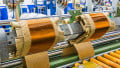
One of the product groups analysed in the ecodesign study was the laminated bus bar. Consisting of an arrangement of conductive and insulating layers, bus bars distribute the current between different points. As the current density is different at the individual points of the circuit, hot spots occur – the losses due to the Joule effect can be considerable here.
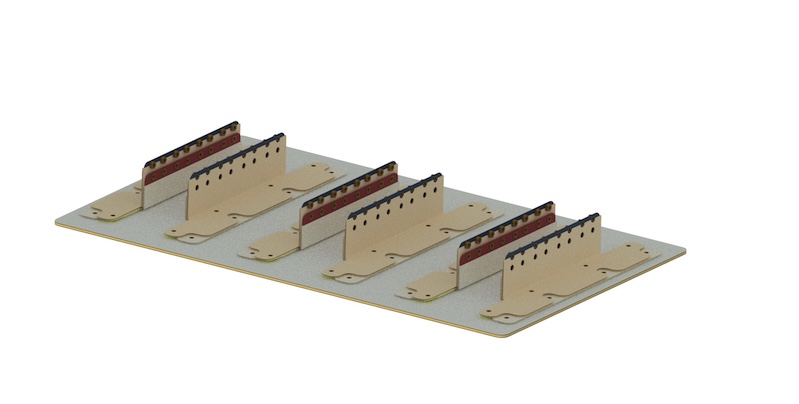
Figure 1. Laminated bar bus for a power conversion application in wind energy. Image used courtesy of Bodo’s Power Systems [PDF] and Mersen
For the eco-design study, a representative bus bar was analyzed: a piece dedicated to a wind turbine, with dimensions of approximately 500 mm x 1000 mm and a total weight of 42.9 kg. 94 percent of the bus bar consists of copper conductors with a thickness of 1.5 mm. The result of the bus bar analysis: 5,235 kg of CO2 equivalent are emitted over the entire service life.
By converting electrical energy into thermal energy, a maximum temperature rise of 14 °C is achieved, as the experts found out using a thermoelectric simulation with the COMSOL Multiphysics software. This corresponds to 14.2 MWh of losses during the product’s service life. What was also determined: the use phase of products has by far the greatest environmental impact in terms of most of the indicators analysed, such as global warming.
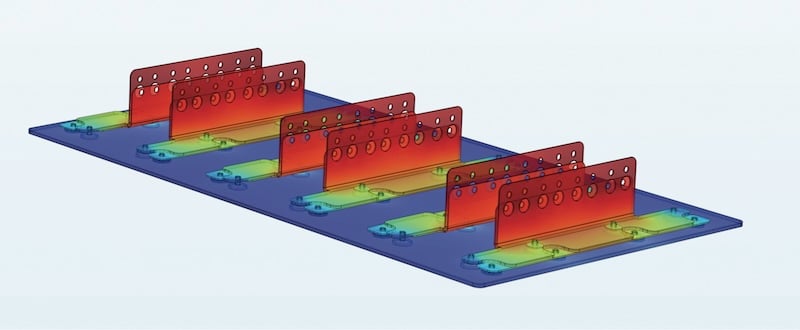
Figure 2. Thermoelectric simulation of the heating of a laminated bar bus (1.5 mm thick) during a nominal current flow. Image used courtesy of Bodo’s Power Systems [PDF] and Mersen
The end-of-life phase, on the other hand, has the greatest impact on the indicator for freshwater eutrophication (PEF-Epf) and metal depletion (PEF-ADPe). This is due to the copper recycling phase.
The study also identified a number of potential improvements, including optimising energy efficiency. Mersen has already investigated changes to the design of the bus bar: by increasing the conductor thickness, the power loss (Joule effect) has been reduced and a significant reduction in climate impact has been achieved.

Figure 3. Laminated busbars from Mersen ensure the transmission of generated energy in IGBTs and capacitors in wind turbines, among other things. Image used courtesy of Adobe Stock
22% Less C02 Emissions
Passive components are subject to high stress during the utilisation phase, as they have a high power loss and a long service life. However, this applies less to the belay devices, which dissipate less energy. Reducing the weight of these products, therefore, becomes a real challenge, which has a significant impact on the overall CO2 footprint.
Mersen investigated the carbon footprint of its belay devices and then optimised their design. While the weight of the original product was 63 g, the eco-designed version weighed only 46 g thanks to optimised plastic and metal components. This corresponds to a weight reduction of 26 per cent and a reduction in CO2 equivalents of 22 per cent compared to the material extraction phase. With 4 million of these products manufactured by Mersen every year, this means a total reduction in environmental impact of 356 tonnes of CO2 equivalents.
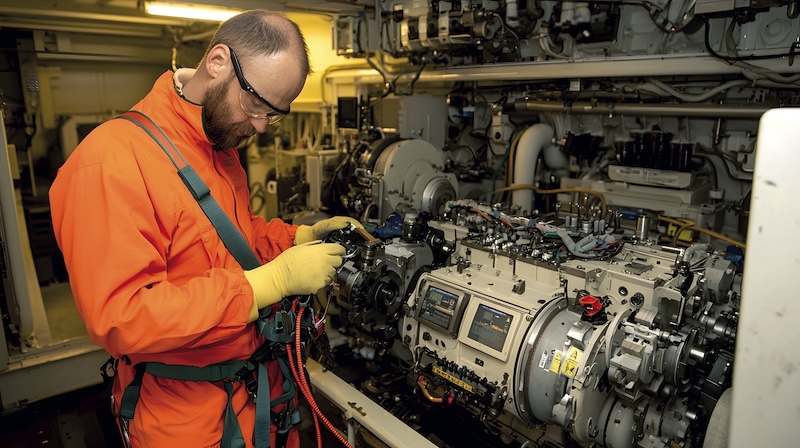
Figure 4. An engineer works on the generator of a wind turbine, which converts mechanical energy into electricity. Image used courtesy of Adobe Stock
Higher Output Despite Weight Reduction
When optimising the design of a fuse, however, the reduction in weight did not result in any savings in CO2 equivalents. The opposite was the case: although the weight was reduced from 920 g to 810 g, the power emitted by the fuse increased from 3300 MJ to 3600 MJ over its 20-year service life. In the overall balance of the fuse, the increase in performance led to an increase in CO2 equivalents of 8 per cent.
The example of the fuses shows that material savings do not lead to a reduction in CO2 emissions for every passive component. However, the weight reduction did have one advantage: the environmental impact of raw material extraction was reduced by 50 per cent.
Replace Copper with Aluminium
In the case of bus bars, the ecodesign study revealed significant savings in CO2 equivalents by increasing the conductor thickness. However, if the bus bars are made of copper, a greater thickness means a considerable increase in costs. One alternative here is to replace copper with aluminium. If the temperature rise is equivalent to that of copper, the use of aluminium makes it possible to significantly reduce the weight of the bus bar.
At the same time, using a 2.5 mm thick aluminium conductor instead of a copper version reduces the impact on global warming from 5.3 t CO2 equivalents to 4.7 t CO2 equivalents – that is a reduction of 10 percent. However, the study did not take product costs into account. It is true that aluminium is a more economical metal than copper. However, the effort required to provide aluminium with corrosion protection is high.
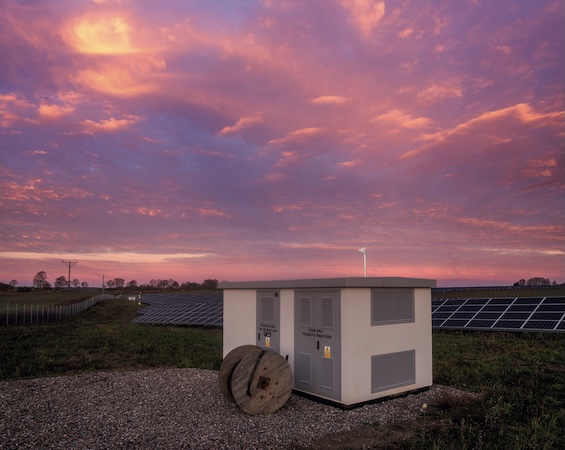
Figure 5. Laminated busbars from Mersen are also used in many photovoltaic systems. Image used courtesy of Adobe Stock
Ecodesign Reduces Environmental Impact
Life cycle analysis is an important tool for assessing the environmental impact of products. The results of Mersen’s latest ecodesign study clearly show that there are many options for reducing the ecological footprint of passive components. However, a comprehensive consideration of the electrical system is necessary. In the case of the bus bar, this is the prerequisite to compensate for an increase in weight due to thicker conductors, for example, through a lighter cooling system or energy savings during the service life of the product. Not to forget, the impact transfer is also a key parameter during ecodesign activities.
This article originally appeared in Bodo’s Power Systems [PDF] magazine.