Facebook
 Google
 GitHub
 Linkedin
Battery Breakthroughs: CATL, Samsung Increase Range, Performance
Samsung is developing a battery with a solid-state electrolyte that enables a 600-mile range, and CATL is releasing a bus battery with a one million-mile lifespan.
Battery technology is crucial in facilitating electric vehicle adoption. The more battery performance is optimized, the easier EV ownership will be. Samsung has entered the testing phase for a solid-state electrolyte battery with a higher energy density that could extend the range between charges. It is lighter and has a much longer battery life than the typical lithium-ion on the market.
Worldwide battery manufacturer CATL has rolled out a battery for electric buses with a substantial leap in battery lifespan and range. This battery innovation uses electrolyte formulation adjustments with an additive molecular design to improve performance.
Samsung’s and CATL’s milestones show that battery technology is still evolving and redesigning electrolyte formulas that can make EVs the modern standard on the road.
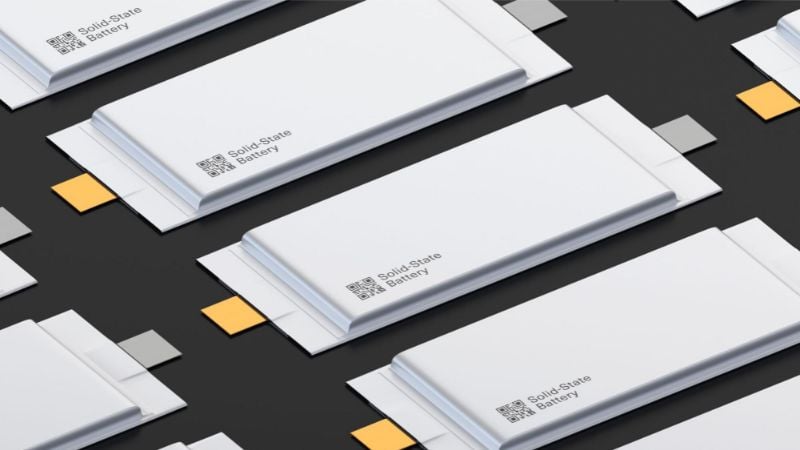
Solid-state batteries. Image used courtesy of Adobe Stock
The Solid-State Struggle: Manufacturing and Ionic Conductivity
If solid-state batteries offer superior energy density, safety, and space-saving benefits compared to liquid electrolyte lithium-ions (Li-ions), why aren’t they the market standard? There is virtually no battery diversity, with most commercially sold EVs all using Li-ion battery backs supported by nickel-cobalt chemistry and a liquid electrolyte.
Several challenges prevent the widespread solid-state tech adoption. One key issue is manufacturing complexity and costs. Solid-state electrolytes are more difficult and expensive to produce at scale. The precise layering and integration of solid materials require advanced fabrication techniques that aren't yet fully optimized for mass production. Researchers estimate that solid-state batteries would need up to a 50% cost decrease for mass adoption.
Another challenge is achieving consistent performance at room temperature. Solid-state electrolytes, particularly sulfide and oxide-based ones, often exhibit lower ionic conductivity than liquid electrolytes in lower temperature conditions, adversely impacting overall battery performance. This inhibited ionic conductivity limits solid-state batteries’ operational efficiency, particularly for EVs that need reliable performance in various climates.
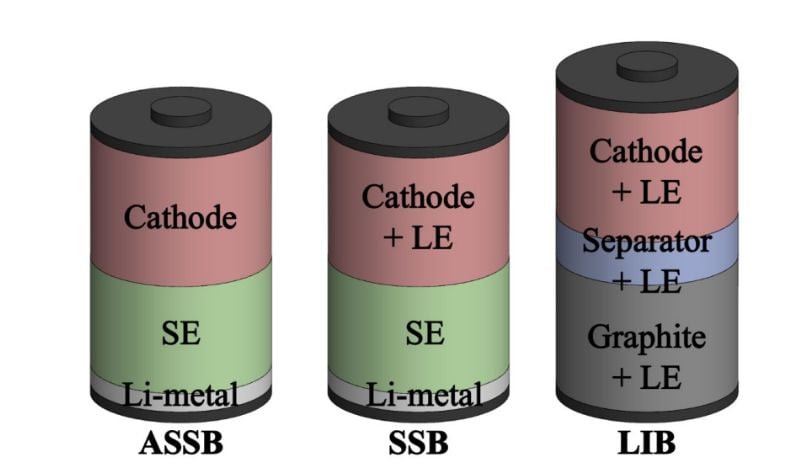
Solid-state battery designs. Image used courtesy of Sandia National Laboratories
Additionally, the interface between the solid electrolyte and electrodes poses challenges, such as mechanical stress and dendrite growth, which can shorten the battery’s lifespan and reduce cycle stability. These issues must be resolved before solid-state batteries can fully compete with liquid electrolyte lithium-ion technology.
Higher Energy Density, Better Range, Longer Lifespan
Samsung has made significant progress toward resolving these challenges. The company has doubled the energy density of conventional Li-ions currently used. Most EV batteries cap out at 270 Wh/kg, but the Samsung battery has pushed energy density to 500 Wh/kg.
Solid-state electrolytes can significantly inhibit dendrite formation, a major advantage over liquid electrolytes in traditional Li-ions. Dendrite formation can be dangerous and inhibits lifespan. The new Samsung battery has a 20-year lifespan, far surpassing current Li-ion longevity, which typically ranges between 8 to 15 years or about 500 to 1,500 charge cycles, depending on the application and usage conditions.
CATL’s new bus battery boasts similarly impressive stats on battery performance. The company has improved energy density by 22% compared to the previous generation. This battery, currently known as the Tianxing Bus version, has a lifespan of 932,000 miles, thus giving it the moniker “the million-mile battery.” CATL explained it used an additive molecular design, which helps aid film forming.
The pilot line is already operational for Samsung, and testing has begun.
EV Progress
Using a standard 110 V home outlet still produces long charge times of up to eight hours, so every battery innovation inch the market closer to optimized performance, which will undoubtedly hasten mass adoption.