Facebook
 Google
 GitHub
 Linkedin
Protecting Nuclear Cybersecurity at the Quantum Level
Researchers have used quantum secure communications to protect a nuclear reactor against cyberattacks.
Nuclear energy’s future lies in advanced reactors, such as microreactors and fission batteries, that promise reliable, abundant power for remote and isolated regions. These technologies are especially suited for locations lacking dependable infrastructure, including developing countries, military outposts, and remote research or industrial sites.
However, the increasing complexity and autonomy of next-generation small modular reactors, particularly those deployed in isolated locations, introduce significant cybersecurity challenges that threaten public safety and energy security. Their dependence on constant data exchange and remote control makes them more vulnerable to cyberattacks, which are becoming increasingly sophisticated due to advances in automation, more complex instrumentation and control systems, reduced on-site staffing, and expanded remote access.
To address these risks, researchers from Purdue University’s School of Nuclear Engineering, in collaboration with the U.S. Department of Energy’s Oak Ridge National Laboratory and Toshiba, have successfully demonstrated the use of quantum secure communications within a nuclear reactor to eliminate threats that arise in a growing quantum computing era.

Purdue University Reactor Number One. Image used courtesy of Purdue University
Quantum Security for Nuclear Power
The quantum security demonstration was a three-year project funded by the DOE’s Nuclear Energy University Program. Purdue University Reactor Number One (PUR-1) is the first nuclear reactor in the U.S. to be fully operated and controlled using modern digital systems instead of traditional analog controls. Its status as the country’s only fully digital reactor, equipped with advanced instrumentation and licensed by the US Nuclear Regulatory Commission, made it an ideal candidate for testing Toshiba’s Long Distance Quantum Key Distribution (QKD) technology.
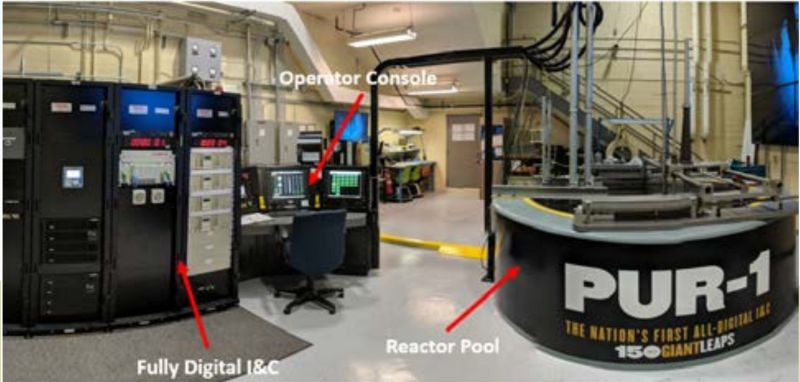
PUR-1 reactor room. Image used courtesy of Gkouliaras et al.
QKD is a physical-layer cybersecurity method using the principles of quantum mechanics to ensure ultra-secure communication between computer systems. Already used in the banking sector and gaining interest in power grid and defense applications, QKD generates truly random encryption keys transmitted over two channels: a quantum channel for sending single photons and a classical channel for standard data exchange. Because the security comes from quantum laws, any attempt to intercept the photons alters their quantum state, causing detectable errors and offering protection against previously untraceable external attack attempts.
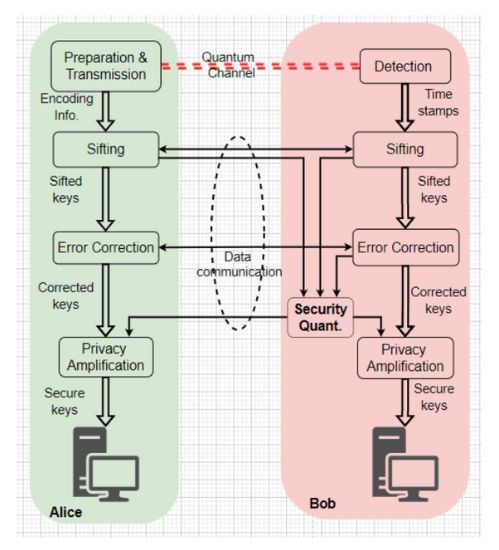
QKD key distillation procedure, showcasing “Alice” and “Bob,” the names researchers used in their experiments. Image used courtesy of Gkouliaras et al.
QKD Ensures Unbreakable Security
The system testing with the PUR-1 successfully encrypted and decrypted thousands of signals in real time over long distances using fiber optics. Highly secure quantum keys maintained secure communications over distances up to 135 km. The connection remained stable and fast with low error rates, showing it can handle high volumes of signals without slowing down. It also included a backup key system to stay secure even during outages.
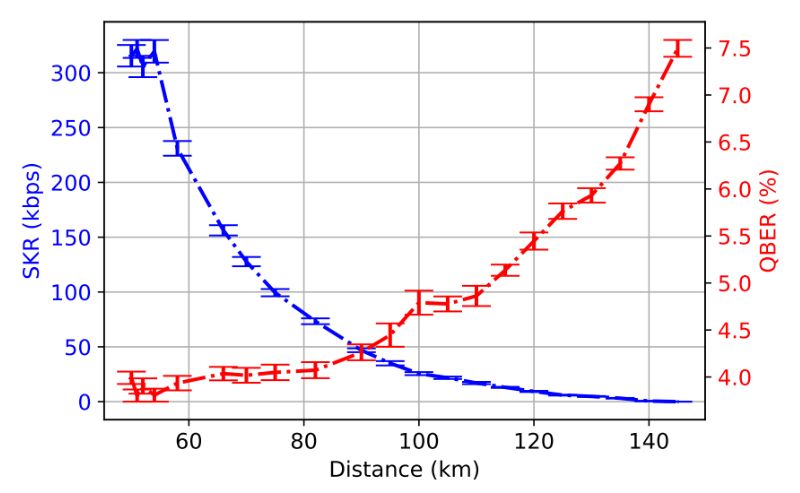
Average Secret Key Rate (SKR) and Quantum Bit Error Rate as a function of distance. Image used courtesy of Gkouliaras et al.
Integrating QKD into advanced reactors provides a cybersecurity level that is immune to both current and future decryption threats, including those posed by quantum computers. This system generates encryption keys through quantum mechanics rather than relying on mathematical complexity, ensuring secure data transmission from the reactor. Because any attempt to intercept the data disrupts the quantum state, such attacks are immediately detectable. This makes QKD a highly reliable and resilient method for protecting critical infrastructure like nuclear reactors in a quantum computing era.
Why Cybersecurity Is Vital
By the end of 2023, 413 nuclear reactors operated worldwide, with a combined capacity of about 372 GW. Under a high-growth scenario, global nuclear capacity could rise to 950 GW by 2050—more than 2.5 times today’s level. Small modular reactors are expected to account for about 25 percent of this expansion, 30 newcomer nations are exploring nuclear energy, and many countries with existing plants plan to extend their operational lifespans.
With nuclear generation facilities multiplying, cybersecurity will be necessary to keep energy flowing and nuclear fuel safe.