Facebook
 Google
 GitHub
 Linkedin
EV Battery Recycling Driving Critical Material Recovery
According to a new report, recovering valuable materials from used electric vehicle batteries and other electronics is vital to the supply chain.
Demand for critical materials for electronics is growing, and supply chains face mounting risks due to geopolitical restrictions and regional concentration of primary resources. Secondary materials, like those recycled from end-of-life products, could be a strategic way to meet material demands.
IDTechEx has released a report, Critical Material Recovery 2025–2045: Technologies, Markets, Players, which presents a detailed analysis of the global secondary-source recovery market. The report provides insights into emerging technologies for extracting and recovering critical materials.
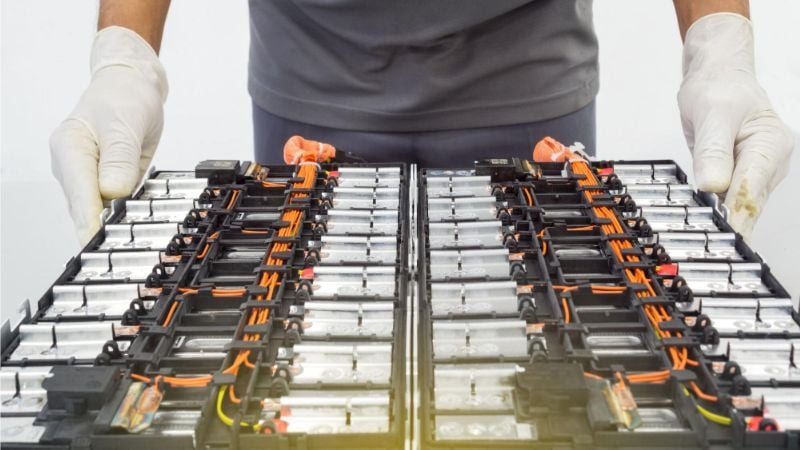
Used electric vehicle battery pack. Image used courtesy of Adobe Stock
Current State
According to the report, the global materials economy is entering a period where secondary sources of critical materials are expected to become a strategic supply pillar. With geopolitical tension, rising demand for decarbonization technologies, and concentrated mineral extraction markets, the global critical material recovery industry is projected to grow at a 12.7% CAGR through 2045, reaching a total value of $110.6 billion.
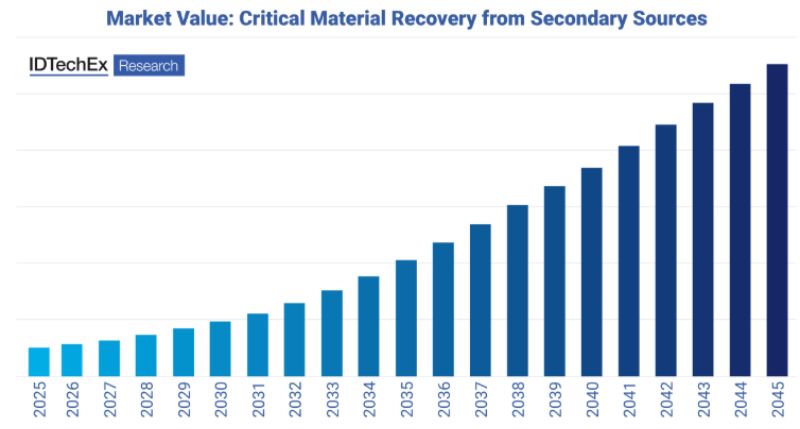
Projected annual growth of the critical material recovery market. Image used courtesy of IDTechEx
This shift is not speculative. By 2045, analysts forecast that over 3.3 million tonnes of critical materials like lithium, nickel, and cobalt will be extracted from anthropogenic sources such as electric vehicles and industrial waste. Whereas in primary mining, material concentrations are dispersed and environmentally intensive to extract, many secondary sources offer higher relative concentrations due to decades of industrial consolidation in batteries, magnets, semiconductors, and catalysts.
Technical Readiness and Economic Viability
Recovery technologies for critical materials are not new. Most originated in primary mining and metallurgy sectors, and they exhibit high efficiency and scalability. IDTechEx’s study evaluated hydrometallurgy, pyrometallurgy, ion exchange, solvent extraction, direct recycling, and eight more processes. The study contends that these technologies are technically mature but require adaptation to process heterogeneous waste streams containing adhesives, polymers, and low-value metals. The challenge lies in economically isolating and purifying target materials from complex composites.
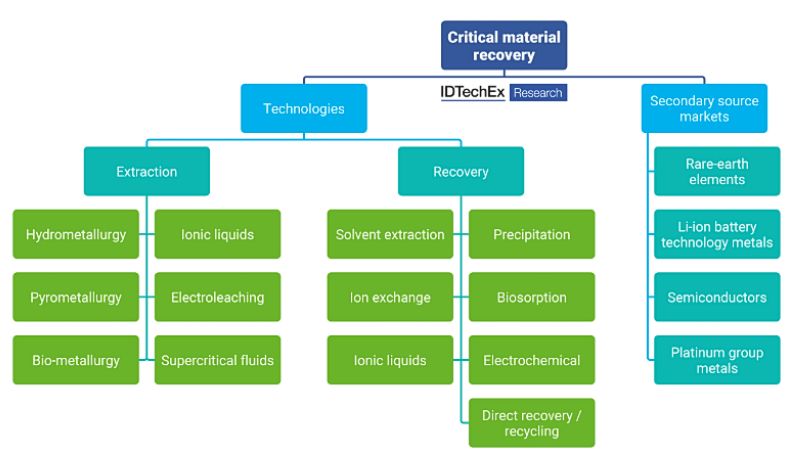
Critical material extraction and recovery technologies and market segments. Image used courtesy of IDTechEx
Europe, in particular, is accelerating deployment. In March 2025, the EU Commission funded ten critical material recycling projects to meet a strategic target of supplying 25% of raw materials via recycling by 2030. European projects are increasingly leveraging hydrometallurgical methods due to their lower energy input and higher recovery of battery-grade compounds compared to pyro-based techniques.
End-of-Life EVs and High-Value Streams
One of the most promising recovery streams lies in electric vehicle batteries and traction motors. As large EV fleets approach retirement, their batteries will become a rich source of materials that otherwise have volatile pricing and constrained supply chains. Motors further contribute rare earth elements such as neodymium and dysprosium.
The report suggests that battery metals alone could comprise a substantial share of recoverable value by 2045. The lithium-ion battery recycling market could reach $52 billion by then, especially as manufacturing scrap remains a significant near-term input and end-of-life packs gain volume over time.
Another high-value stream comes from platinum group metals, especially palladium, platinum, and rhodium. These have long been recovered from automotive catalytic converters due to their high per-kilogram value, which can exceed $10,000.
Semiconductor and Photovoltaic Pressure Points
Materials such as gallium, indium, tellurium, and germanium, used in optoelectronics, PV cells, and compound semiconductors, have become geopolitical pressure points. China’s recent export restrictions on tellurium and germanium have amplified European urgency to develop independent recovery capacity. IDTechEx estimates that germanium recycling from optical glasses already accounts for 20% of global supply.
The European context highlights the strategic stakes. In 2024 and 2025, China implemented layered export bans on materials critical for defense and renewable energy technologies, such as gallium, tungsten, and tellurium. The result is a direct impact on Western semiconductor and PV manufacturers, who must now turn to domestic recovery as a hedge against geopolitical volatility.
System-Level Barriers and the Collection Bottleneck
The physical availability of end-of-life equipment does not guarantee recovery. Collection infrastructure, logistics, and pre-processing capabilities are not uniformly developed, especially outside regulated regions like the EU. Recovery system efficiency depends on technological yield and upstream sorting and dismantling accuracy.
High-value, consolidated waste streams like EV batteries, industrial catalysts, and fiber-optic components dominate current recovery efforts. More diffuse waste, such as printed circuit boards and small-scale consumer electronics, remains a challenge due to inconsistent material composition and lower per-unit recoverable value. In these cases, economies of scale and automated material identification will become essential to improving process economics.
The Outlook
The report indicates that, over the next two decades, the economics of critical material recovery will hinge on material value density, processing cost, and policy support. Technologies exist, but market access and political will must converge to build resilient recovery supply chains.
Ultimately, the capacity to recover strategically important materials from waste streams will shape the economics of the renewable energy transition as well as the geopolitical contours of industrial sovereignty.