Facebook
 Google
 GitHub
 Linkedin
Massive 4 GWh Battery Project To Expand Grid Capacity
The grid-stabilizing project in Germany will use Fluence Energy’s modular Smartstack battery systems.
Europe's largest battery storage project is moving forward in Germany. The GigaBattery Jänschwalde 1000, targeted for the Jänschwalde power plant in Brandenburg, will support grid stability as renewable energy accelerates in the region.
Built around Fluence Energy’s Smartstack energy storage platform and rated at 1 GW/4 GWh, the system provides four hours of continuous discharge to support bulk shifting and firming capacity. That's roughly equivalent to the average four-hour electricity consumption of about 1.6 million households.
As more wind and solar capacity comes online across Europe, developers are pairing renewable projects with multi-hour battery systems to shift excess generation to demand peaks and support grid balancing. This type of storage is becoming a standard feature in regions facing growing congestion.

GigaBattery Jänschwalde 1000 site. Image used courtesy of LEAG
Smartstack: High-Density Storage Solution
Smartstack is a modular AC-based storage platform designed for high-density, grid-scale deployments. Fluence Energy states that Smokestack offers a 30% higher energy density than other AC-based offerings.
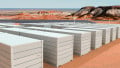
Units can deliver up to 7.5 MWh on-site when equipped with 300 Ah batteries. The product is available in several configurations, including two-, four-, six-, and eight-hour storage durations. The compact footprint requires only 32,000 square feet for a standard 100 MW/400 MWh project, according to Fluence Energy.
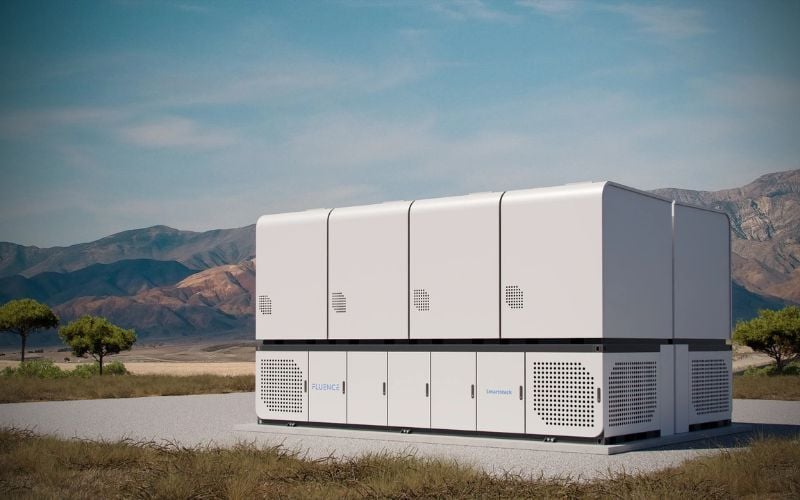
Smartstack battery storage system. Image used courtesy of Fluence Energy
The modular architecture includes a Smart Skid base to house the power controls, cooling, cabling, and monitoring infrastructure. Pods sitting above the Smart Skid hold the battery cells, compatible with multiple vendors for easy upgrades or swaps through maintenance. Locally deployed artificial intelligence features monitor performance and detect anomalies, and can trigger automatic recalibration to optimize operations.
The battery management system works alongside the Fluence OS to refine state-of-charge accuracy and monitor system health in real time. When a cell-level imbalance is detected, the passive balance resistors activate. Fluence's Nispera asset management software also integrates fleet-level diagnostics for state-of-health and state-of-balance metrics, and allows operators to predict cell degradation.
_and_SmartSkid_base_(right).jpg)
A Smartstack battery pod (left) and SmartSkid base (right). Image used courtesy of Fluence Energy
Fluence Energy emphasizes longevity, noting that extending operational life by five years can unlock $20-30 per kWh in added net present value for a 100 MW/400 MWh project. Through a recent testing campaign, the company confirmed its Gridstack Pro platform could reasonably operate for 25-35 years, beyond the typical 20-year life of battery storage systems.
Smartstack manufacturing started in September at an automated contract facility in Vietnam, with deliveries scheduled to start this quarter.
GigaBattery Jänschwalde 1000
The GigaBattery Jänschwalde 1000 project marks Fluence's largest single storage project worldwide, expanding upon its existing Gridstack and Ultrastack storage solutions. Fluence Energy has over 41 GWh of projects deployed, under management, or contracted globally.
LEAG reports that the GigaBattery Jänschwalde 1000 project will use lithium iron phosphate cells on a 10-hectare site southeast of the existing power plant. Siemens Energy will supply the switchgear for the 380 kV grid connection.
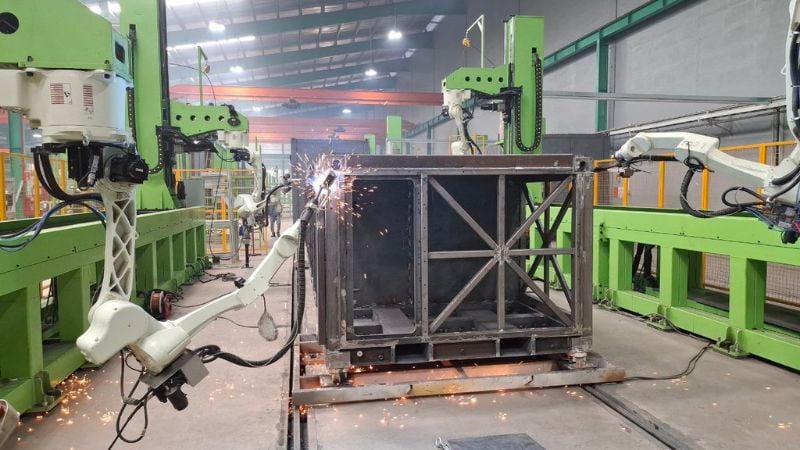
Fluence's Smartstack product is manufactured at a contract facility in Vietnam. Image used courtesy of Fluence Energy
LEAG Clean Power—part of one of Germany's largest electricity providers—is leading the project through its GigawattFactory program to turn former coal sites into integrated clean energy hubs combining wind, photovoltaic, utility-scale storage, and hydrogen-ready infrastructure.
LEAG reports the company is shifting away from coal mining operations (with a legally mandated phase-out by 2038) and building the GigawattFactory platform, combining renewables, battery storage, and hydrogen. LEAG currently operates a 54 MWh system at Schwarze Pumpe (operational since 2020) and has started building a 137 MWh installation at Boxberg, called BigBattery, with several additional gigawatt-scale storage sites in planning.