Facebook
 Google
 GitHub
 Linkedin
Temperature Sensing in Next Generation Power Electronics
SiC-based semiconductors can operate higher temperatures than silicon-based devices. Learn the unique challenges involved with monitoring and measuring temperature for next-gen power electronics.
This article is published by EEPower as part of an exclusive digital content partnership with Bodo’s Power Systems.
Sintering offers higher electrical and thermal performance. It is a very attractive alternative to soldering in power electronics applications to attach semiconductor chips and other relevant passive components such as sensors directly to substrates. This technology in combination with wide bandgap semiconductor materials such as Silicon Carbide allows application temperatures for power electronics of beyond 200 °C. This clearly surpasses the possible peak temperatures of soldered Silicon based components which is limited to only 150 °C [1].
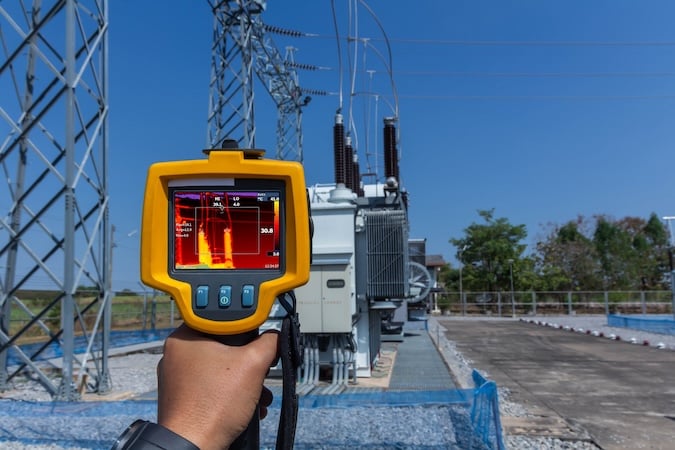
Image used courtesy of Adobe Stock
As application temperatures increase, overheating of the entire module becomes a concern and sensing this temperature as accurately and with as little time delay as possible is crucial. In this article the influence of a temperature sensor position on the measurement in power modules is investigated. By simulating different layouts, the benefits of proximity of the temperature sensor to the power die are demonstrated. A proximity can be technically achieved by a specific temperature sensor design using a sinterable and electrically insulated Platinum-based SMD that does not require a separated contact area on the board. By eliminating the otherwise necessary etched trench the accuracy and response time of the sensor signal are improved significantly, supporting the design of more compact modules.
Background and Motivation
Power electronics are considered the heart of any electric vehicle: performance, pace and efficiency are determined by the layout and capabilities of the voltage converter and inverter units. Higher switching frequencies, higher power levels and the resulting operation at higher temperatures contribute to longer driving ranges and more dynamic driving modes. In addition to electric vehicles, other applications such as wind turbines and telecommunication infrastructure benefit from power components operating at higher frequencies.
New materials and new connection technologies are needed for higher operation temperatures. Silver-sinter processing is on the way to becoming the standard connection technology [2]. Process simplification occurs when components can be mounted in one process step using a single mounting technology. Furthermore, process simplification is enabled by components which can be mounted in a single process using the same production technology.
In all applications overheating is still a concern as it triggers a higher wear of electronic components and significantly reduces lifetime. Severe overheating conditions can even fully destroy components leading to catastrophic failure [3]. To prevent overheating the temperature in the system is controlled and typically a certain level of inaccuracy and delay in temperature reading are considered creating some safety margin. This safety margin leads to a lower performance of the module as its full potential can’t be used [4]. To increase performance a thermal management system needs a temperature signal that is as accurate as possible delivered with a delay as short as possible.
Methods and Approach
Bringing the temperature sensor close to the heat source is one way to ensure a faster signal response and a higher accuracy. The Nexensos sinterable temperature sensor in the SMD package (Pt1000 SMD-SC) is designed to address this challenge and to address multiple aspects of power module optimization. The electrical separation between the sensing layer on the top side and the backside metallization (Figure 1) allows positioning of the temperature sensor close to the heat source.
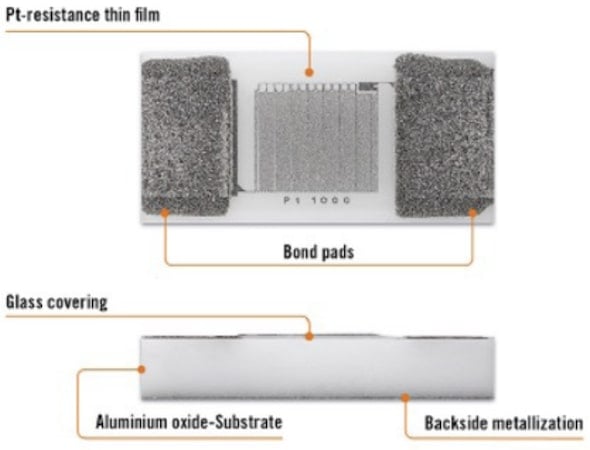
Figure 1. The Nexensos sinterable Platinum based temperature sensor. Bond pads on the top side (AgPt) are optimized for thin and thick wire bonding and the backside metallization (AgPd) for silver sinter processing. Image used courtesy of Bodo’s Power Systems [PDF]
Temperature measurement is faster, and more accurate. In addition, the substrate design can be simplified; the sensor and other components can be installed at the same electrical level, on the same substrate. A separate ‘island’ for the sensor chip can be omitted, which is required for other temperature sensor technologies such as sinterable NTCs (see Figure 2).
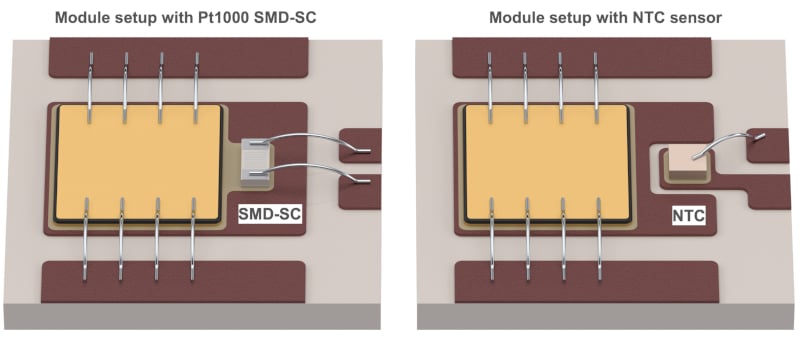
Figure 2. Left): Module design for electrically insulated (SMD-SC), Right): a top & bottom contacted temperature sensors (NTCs) on the right. Image used courtesy of Bodo’s Power Systems [PDF]
In order to understand in more detail the impact of sensor positioning on the board, a simplified model was employed to investigate heat distribution and response times in state-of-the-art silicon (Si) based power modules as well as next generation silicon carbide (SiC) based setups; the chosen design geometry is independent of the material selection, the material properties as well as the operating temperature have been adjusted to resemble Si and SiC based designs.
Modelling studies have been accomplished using the Comsol CFD modelling suite, material properties and parameters have been chosen to describe the setup of the temperature sensor. Effects like heat dissipation by bonding wires or of different potting compounds were not considered. The study focusses on the effects of the distance and the substrate layout and its impacts resulting from the distance between the heat source and the temperature sensors as well as an additional etched trench.
The junction operating temperature has been set to 150 °C for silicon-based power modules and to 200 °C for next generation wide band gap (WBG) materials such as the already mentioned SiC or Gallium Nitride (GaN). Heat production has been included by setting of the junction temperature. The power dies themselves, and the temperature sensor remained un-powered, omitting selfheating effects.
In Figure 3, different geometries resulting in varied distances between the temperature sensor and the heat source are compared: due to the sensor design, a flexible positioning of the sensor has been achieved where the sensor can be placed directly next to the power dies (Figure 3a); hereby, the distance has been modified to resemble currently employed options to position the sensor on the substrate. For comparison purposes the effect of the etched trench on the sensing accuracy as well as on the response time has been highlighted in the adapted model (Figure 3b). The etched trench is required as additional design element for through contacted components such as NTC-based sensor elements; this design ensures electrical isolation between the sensor and the power electronic substrates. Using a sinterable platinum based SMD sensor with both electrical contacts positioned on top eliminates the need for an isolating trench, greatly simplifying the board design and manufacturing process.
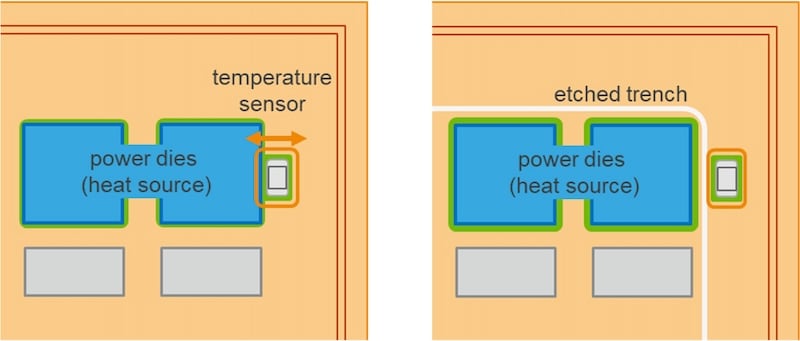
Figure 3. Substrate geometry and position of the sensor: a) Distance variations of the sensor and b) position of the sensor in substrate geometries providing an additional etched trench for insulated sensor positioning. Image used courtesy of Bodo’s Power Systems [PDF]
Results: Accuracy
The sensor position has a substantial influence on the accuracy of the temperature measurement. In the considered configurations, both at 150 °C and 200 °C operating temperatures, the spread between junction temperature and detected temperatures is heavily impacted by the distance between the sensor and the power die. Although the chosen model does not consider any specific potting materials and heat dissipation can take place across the entire surface the general trend is not affected: The almost linear dependency of the temperature drop on the distance for an operating temperature of 150 °C is clearly visible from Figure 4.
With increasing distance, the drop of temperature becomes more pronounced and the deviation from the junction temperature decreases the accuracy of the measured temperature.
For through-contacted temperature sensors that rely on the bulk resistance of the entire sensor cross section, an additional etched trench is required to mount the sensors in a potential-free manner. This additional design element further increases the distance between the heat source and the sensor position and impacts the accuracy. The temperature drop between the power die and the sensor chip is even more pronounced, leading to a non-linear drop at the chosen distance here. In Figure 5, the temperature distribution for an operating temperature of 200 °C is demonstrating, confirming the already observed trend.
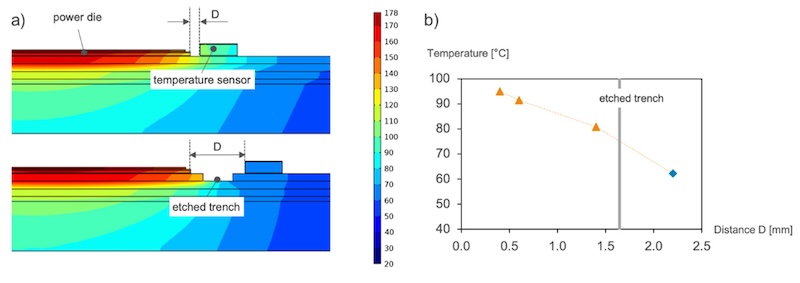
Figure 4. a) Temperature distribution in power modules operated at 150 °C junction temperature. Top: Substrate geometry without etched trench; Bottom: Additional etched trench for electrically insulated position of the temperature sensor. b) Detected temperature as function of the distance between power die and temperature sensor; the position of the additional etched trench is marked as grey double line. Image used courtesy of Bodo’s Power Systems [PDF]
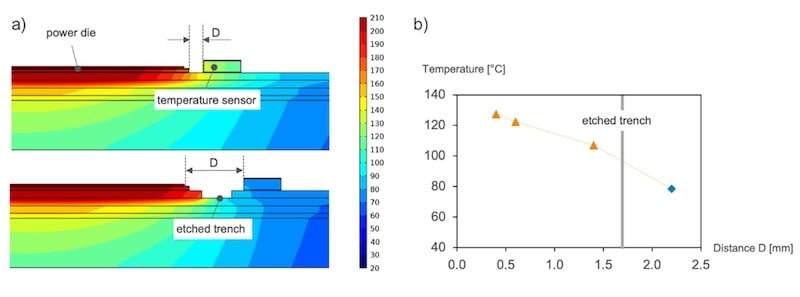
Figure 5. a) Temperature distribution in power modules operated at 200 °C junction temperature. The chosen parameters resemble a SiCbased configuration. Top: substrate geometry without etched trench; Bottom: Additional etched trench for electrically insulated position of the temperature sensor. b) Measured temperature as function of the distance between power die and temperature sensor; the position of the additional etched trench is marked as grey double line. Image used courtesy of Bodo’s Power Systems [PDF]
The non-linearity of the decay indicates the impact on the accuracy of the measured temperature and underlines the performance benefit that can be achieved by minimizing the distance from the temperature sensor to the heat source.
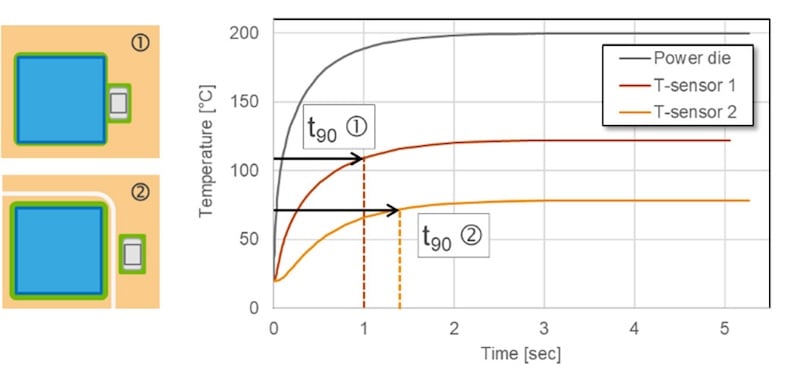
Figure 6. Dynamics of temperature sensing: temperature response on switch-on process of power dies. a) Temperature sensor is in proximity to power die and b) temperature sensor is separated from power die by etched trench. Image used courtesy of Bodo’s Power Systems [PDF]
Result: Dynamics
In addition to accuracy the response time can be improved by positioning the sensor closer to the power die. In Figure 6, the thermal response for two different sensor positions after powering the power die is monitored.
The temperature ramp-up curve of the power die and the sensor next to the die have almost identical slopes. The temperature measurement and response time is clearly improved by positioning the sensor close to the heat source as can be seen in Figure 6a. By adding the additional etched trench as described above, the position of the sensor moves further away from the power die, as can be seen in Figure 6b resulting in a substantially slower response and a pronounced delay after the switch-on step. The time to reach equilibrated conditions is best described by the delay to reach 90 % of the equilibrium temperature t90. Comparing the t90 times of with 1.0 and 1.3 seconds reveals a substantially more dynamic detection with a 30 % faster detection for the position close to the power die. The die itself reaches 90 % of the final junction temperature in about 0.72 s. Due to simulated cooling of the system on the backside the true junction temperature is not reached by either sensor or at any sensor position.
In conclusion, not only is the accuracy improved by the proximity of the Pt SMD-type temperature sensor to the heat source, but the time also to reach a useful threshold is significantly reduced, resulting in a much shorter temperature measurement response time. Overheating effects and temperature spikes can be avoided, and the overall life expectancy of the power module is significantly increased.
Conclusion
The sinterable platinum-based temperature sensor (SMD-SC) offers a variety of benefits for solving temperature sensing challenges in state-of-the-art and next generation power modules. The layout of the sensor, with an intrinsic isolation between sensing and contact layer allows for new designs and opens new approaches, as highlighted in Figure 1. As a result of the electrical isolation between the sensing area and the backside metallization optimized for sinter connections, the sensor can be placed on any available position on the power module board. The reduced distance between the heat source and the sensor element results in higher accuracy and significantly improved response time of up to 30 % of the temperature signal.
Connection of the sensor element can be achieved by standard thin- and thick-wire bonding; the connection to the board is feasible with standard silver sinter processing which allows for a seamless integration in standard production processes. The sinter connection is key to high temperature operation, opening the operation window far beyond 200 °C. While the Pt1000 sensor element is currently specified with an upper operating limit of 200 °C, on-going development activities target higher temperatures where the limits of sinter connections can be further utilized.
References
[1] Yan, H., Liang, P., Mei, Y., & Feng, Z. (2020). Brief review of silver sinter-bonding processing for packaging high-temperature power devices. Chinese Journal of Electrical Engineering, 6(3), 25-34.
[2] Schaal, M., Klingler, M., & Wunderle, B. (2018, September). Silver sintering in power electronics: the state of the art in material characterization and reliability testing. In 2018 7th Electronic system-integration technology conference (ESTC) (pp. 1-18). IEEE.
[3] Wu, R., Blaabjerg, F., Wang, H., Liserre, M., & Iannuzzo, F. (2013, November). Catastrophic failure and fault-tolerant design of IGBT power electronic converters-an overview. In IECON 2013- 39th Annual Conference of the IEEE Industrial Electronics Society (pp. 507-513).
[4] Baker, N., Liserre, M., Dupont, L., & Avenas, Y. (2014). Improved reliability of power modules: A review of online junction temperature measurement methods. IEEE Industrial Electronics Magazine, 8(3), 17-27.
This article originally appeared in Bodo’s Power Systems [PDF] magazine.