Facebook
 Google
 GitHub
 Linkedin
Infineon, Nvidia Team Up for 800 V Power in AI Data Centers
The companies will develop an entirely novel power architecture for future AI data centers.
Infineon and Nvidia will collaborate to reimagine power delivery in AI data centers. The two semiconductor giants will work together to transition from traditional decentralized AC architectures to centralized 800 V high-voltage direct current (HVDC) distribution.
The companies state that the centralized architecture aims to consolidate power generation at the data center level and enable direct power conversion at the GPU level within server boards.
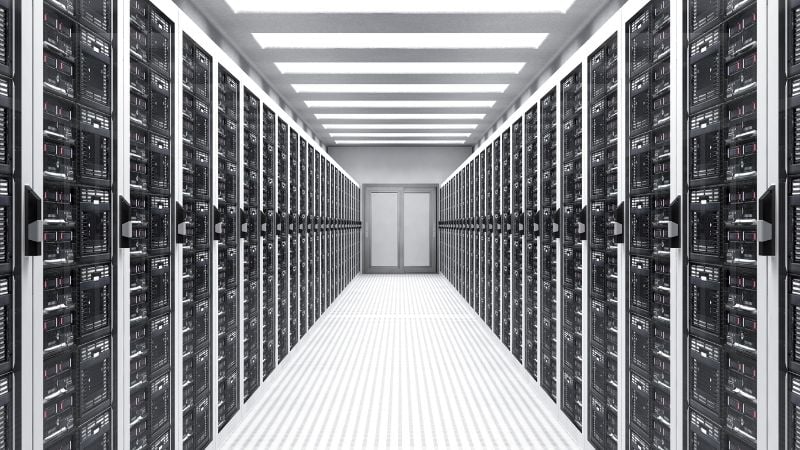
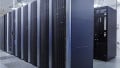
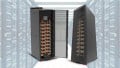
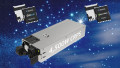
Infineon and Nvidia are reimagining the data center power architecture. Image used courtesy of Infineon
Infineon and Nvidia’s Reimagined Approach
Infineon and Nvidia aim to reduce conversion losses and infrastructure complexity for AI clusters exceeding 100,000 GPUs, where each rack is projected to consume one megawatt or more by the end of the decade. By replacing distributed PSUs with centralized high-voltage delivery, Infineon can reduce component redundancy and maximize the use of constrained rack space. This shift also improves thermal performance and facilitates the use of high-efficiency materials, including silicon carbide and gallium nitride.
Infineon’s end-to-end expertise across silicon, SiC, and GaN semiconductors will support this architectural overhaul. Their contributions to the architecture will span the entire power path to provide a unified and scalable solution. Meanwhile, the company will continue offering intermediate DCDC multiphase power solutions for hyperscalers during the transition to HVDC infrastructure.
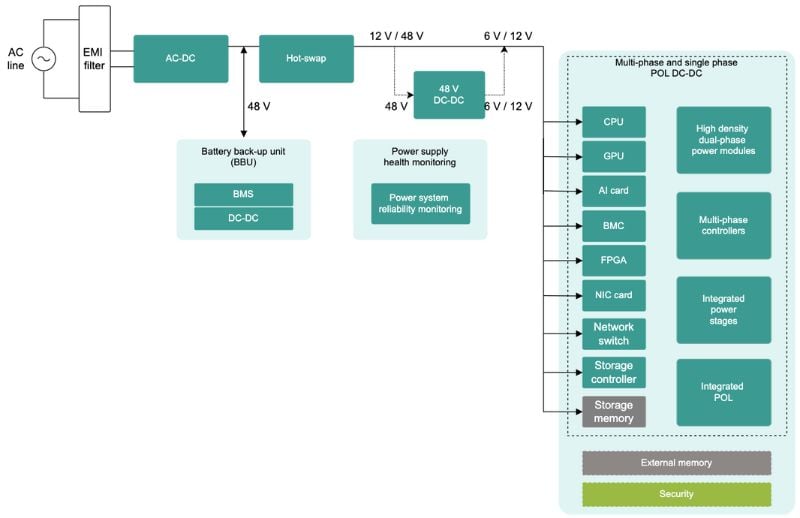
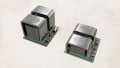
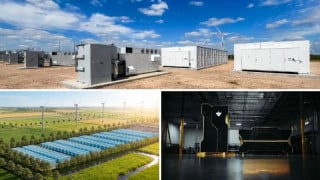
Infineon’s end-to-end data center solutions. Image used courtesy of Infineon
For NVIDIA, this architecture will improve energy efficiency while maintaining high-performance compute capabilities.
Limitations in Traditional Power Architectures
Conventional data center power architectures rely on decentralized low-voltage AC distribution, where each server rack includes redundant PSUs to convert AC to intermediate and then to point-of-load DC voltages. However, this architecture imposes inherent inefficiencies due to multiple power conversion stages, each introducing resistive losses and heat dissipation.
These losses compound as AI workloads demand higher current per GPU and denser server configurations. Conventional 12 V or 48 V distribution suffers from I2R losses over increasing cable lengths and cross-sectional constraints, requiring thicker conductors and extensive cooling infrastructure. As a result, the efficiency ceiling for end-to-end power delivery often plateaus well below 90%, while thermal constraints cap compute density per rack.
Decentralized PSUs also consume valuable physical volume within each rack and limit the number of accelerators that can be deployed per square meter. Furthermore, the distributed nature of power conversion complicates load balancing and voltage regulation, particularly under dynamic and burst-heavy AI workloads. Overall, these architectures fail to scale efficiently when rack-level power demand climbs toward or beyond one megawatt.
Centralized HVDC distribution can solve these challenges. By stepping up voltage to 800 V DC and relocating power conversion closer to the point of compute (i.e., directly on the server board), data centers can reduce conversion losses, minimize conductor bulk, and reclaim space for compute hardware. HVDC can improve performance and address systemic design limitations that constrain AI infrastructure.
Powering the AI Future
Through this collaboration, both companies could create a new standard for power architectures optimized for AI and accelerated computing. Infineon expects commercial deployment to begin before the decade closes, but availability will depend on ecosystem readiness and hyperscaler adoption timelines.