Facebook
 Google
 GitHub
 Linkedin
Next-Gen eVTOL Batteries: 4x the Flight Time
Researchers improve electric aircraft batteries to control power fade.
Battery researchers from the University of California-Berkeley and the University of Michigan have developed a corrosion-resistant electrolyte with enough power and energy density to sustain flights four times longer than conventional electric aircraft batteries.
eVTOL test flight. Video used courtesy of Joby Aviation
The prototype cell features a mixed-salt electrolyte designed for next-generation battery packs in electric vertical takeoff and landing (eVTOL) aircraft, which require a high power-to-energy ratio to hover, climb, cruise, and descend safely.
The universities partnered with 24M Technologies, a Volkswagen-backed battery startup, on a federally-funded project to validate high-power energy-dense lithium-metal pouch cells for eVTOL missions. The team explored an electrolyte with an ideal combination of lithium salts to unlock interphases with high power and low fade.
And Battery Aero, a 24M and ARPA-E spinoff, plans to test the prototype on a propeller stand under realistic flight sequences. Then, the pair will expand the design into a full-size battery—targeting 100 kWh of total capacity—for a flight test next year.
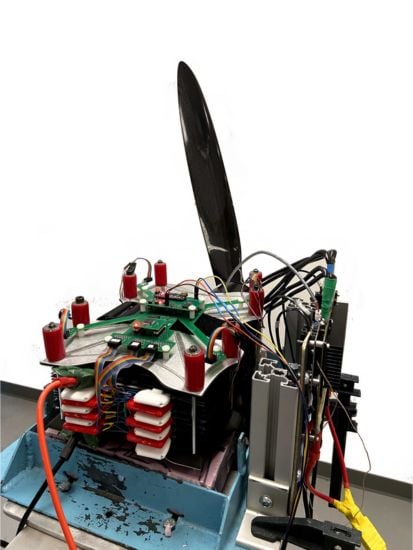
Prototype cell on a propeller stand. Image used courtesy of the And Battery Aero
Electrolyte-Interphase Omics Reveal Insights
Power and energy density are critical factors determining cell performance in extended electric aircraft flights. Lithium-metal batteries with nickel-rich cathodes meet density requirements for cargo and range. However, these cells undergo power fade over time, impacting the aircraft’s ability to land at a low state of charge.
Traditional electrolytes in electric vehicles struggle to manage power fade in energy-dense batteries designed for electric aircraft. On discharge, they use the cathode’s full capacity, making unmitigated cell impedance a significant challenge.
In a new study published in Joule, University of California-Berkeley and University of Michigan researchers worked with the Lawrence Berkeley National Laboratory’s Molecular Foundry to understand electrolyte-interphase structures, functions, and dynamics when cycling lithium metal cells. They adopted an omics perspective, referring to the biological sciences domain examining molecular connections in living systems. Omics is popularly applied in genomics, for example, to study DNA and gene expression.
Likewise, the researchers recycled the concept to understand chemical relationships between cathode-electrolyte interphase composition and changes in anion and solvent activity around the electrode-electrolyte interface.
Prior research attributed power fade to activity in anodes. However, the team discovered charges could be limited in cathodes, thus reducing efficiency as particles crack and corrode with time.
With this knowledge, the team found that mixing salts in the electrolyte could minimize reactivity at the cathode, creating a corrosion-resistant coating to extend battery life.
Electrode Design for High-Power Aircraft Batteries
The researchers used their omics perspective to guide an electrolyte design.
They mixed salt into locally superconcentrated electrolytes to achieve high density and power. 24M then built the electrolytes into large-format lithium-nickel manganese cobalt oxide (NMC)811 pouch cells at high power and voltages.
The best-performing electrolytes were found in cathode-electrolyte interphase chemistries. The team enriched the electrolytes with organofluoroethers to improve performance and suppress current leakage, cathode corrosion, and fracturing.
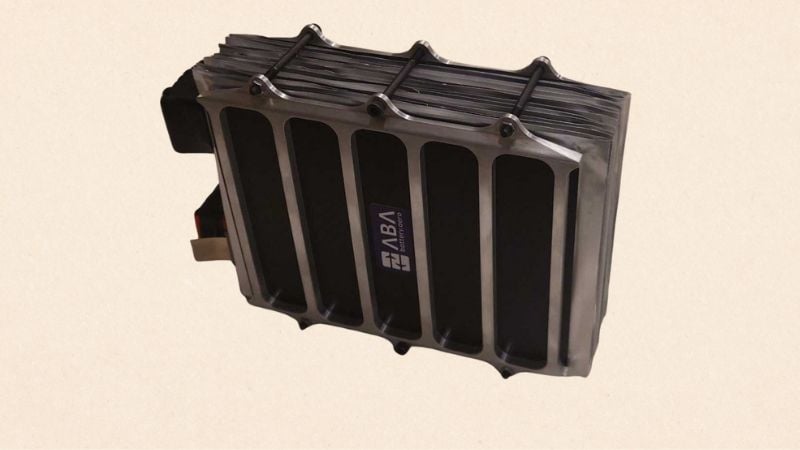
And Battery Aero’s prototype cell. Image used courtesy of And Battery Aero
The team used semi-solid NMC811 electrodes and a lean electrolyte, which retained power across more than 100 cycles in realistic vertical takeoff and landing tests. eVTOL flight dynamics models generated the cycling protocol, assuming a 20% packing burden and 200-mile cruising distance.
Takeoff was simulated with a 30-second high-power pulse preceding two hours of low-power cruising for 200 miles. Landing simulated another 30-second pulse. Overall, the cell supported 130 flight missions with less than 20% power fade, a result unachieved in conventional electrolytes.