Facebook
 Google
 GitHub
 Linkedin
eVTOL Technology Trends To Watch in 2025
From regulatory milestones to battery advancements, eVTOL companies set the stage for 2025 commercialization.
The Federal Aviation Administration has finalized new rules allowing powered-lift aircraft to take off and land like helicopters. With this critical regulatory step complete, electric vertical takeoff and landing (eVTOL) technologies could join the nation’s skies in 2025.
The FAA reviews its new regulations for eVTOLs. Video used courtesy of the FAA
The decision marks the first new category of civil aircraft since helicopters debuted in the 1940s. The FAA’s Special Federal Aviation Regulation now includes requirements to facilitate pilot training and certification rules, the final regulatory step before eVTOL can be safely deployed throughout the U.S. The category applies to piloted air taxis, cargo delivery aircraft, and other eVTOL technologies capable of vertical takeoff, landing, and low-speed flight, cruising similarly to airplanes.
The new FAA rules will allow eVTOL pilots to fly anywhere aircraft are permitted to fly. Operators must demonstrate auto-rotate capabilities or an equivalent maneuver and comply with minimum altitudes applicable to helicopters.
Leading players like Joby Aviation and Archer Aviation have a clear regulatory path to training pilots and launching their first commercial activities in 2025.

Joby Aviation completed a flight in Japan last November in partnership with Toyota. Image used courtesy of Joby Aviation
Joby and Archer Solidify 2025 Plans
California-based Joby Aviation is among the industry’s most advanced players. Powered by six electric motors, its eVTOL aircraft can achieve a 200 mph top speed and carry four passengers. The company expects to start commercial passenger services as early as late 2025. It recently finished its third pilot aircraft and broke ground on a manufacturing site that will more than double its production.
In 2024, Joby achieved several international milestones outside the U.S., including launching construction on its first vertiport for an air taxi network in Dubai. The company also secured a $500 million investment from Toyota, its powertrain and component supplier. In November, the partners flew Joby’s electric air taxi in Japan to demonstrate its low acoustic footprint.
Another California startup, Archer Aviation, plans to launch production on its piloted eVTOL aircraft in early 2025 out of its Georgia factory, ramping to two aircraft per month by the end of the year. The company’s four-passenger Midnight aircraft is designed for 20- to 50-mile flights reaching 150 mph, with minimal charging between trips. In June 2024, the 6,500-pound craft completed a transition flight at 100 mph-plus speeds.
Archer is finalizing its launch in the United Arab Emirates and plans to enter service by the fourth quarter of 2025.
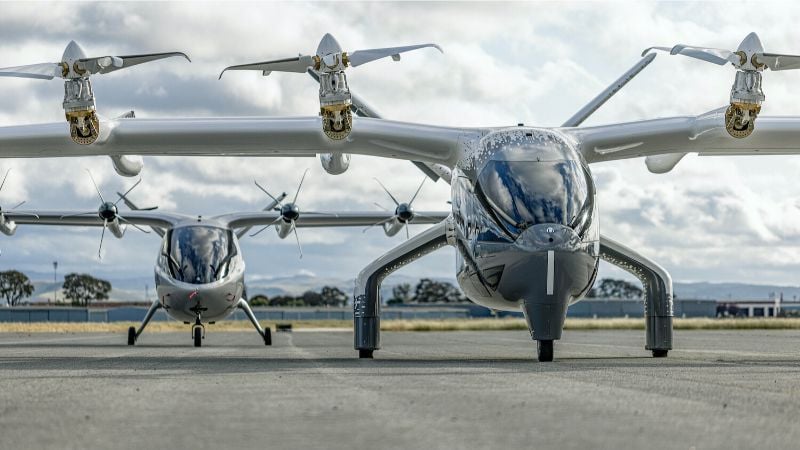
Midnight eVTOL. Image used courtesy of Archer
Supporting Infrastructure and Charging Networks
The first eVTOL aircraft will need charging access at airports and other takeoff and landing sites. eVTOL companies are developing charging networks or teaming up with providers.
Vermont-based Beta Technologies, which made the first crewed transition flight for its five-passenger ALIA-250 eVTOL aircraft in 2024, plans to bring a network of nearly 150 chargers online by 2025. The company will offer a high-power “Charge Cube,” enabling DC fast-charging at airports. The system, connected to the grid with a 320 kW AC/DC inverter, can charge Beta’s ALIA aircraft in 50 minutes. Archer received UL certification for the Charge Cube last year and will expand the network nationwide for electric aircraft and ground vehicles.
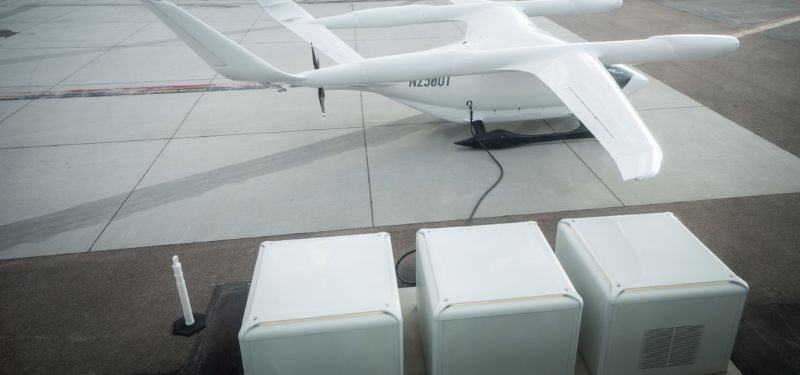
Beta Technologies’ ALIA aircraft receives a change through the company’s four-foot-tall Charge Cubes. Image used courtesy of Beta Technologies
Last year, Archer partnered with aircraft services provider Atlantic Aviation to leverage Beta Technologies’ Combined Charging System-based interoperable chargers across several locations in 2025, including New York City, Miami, San Francisco, and Los Angeles. Atlantic also secured agreements with Joby Aviation and Lilium to deploy eVTOL charging infrastructure in the coming years.
Due to their compact design, eVTOL would ideally integrate with existing infrastructure and charging equipment. Lilium Jet’s low D-value—the difference between a pressure surface’s height above sea level vs. a surface in the reference atmosphere—of less than 45 feet means it can fit compactly into existing landing pads without requiring vertiports or terminals. The eVTOL jet uses standard Combined Charging System equipment and needs about 45 minutes to charge. A full charge enables the aircraft to fly missions at 154 mph speeds with a 108-mile maximum operational range.
Quiet Operations for Urban Airspace
Quiet operation is a key selling point of eVTOL, with companies integrating mechanisms to minimize ground noise in urban environments.
Lilium’s eVTOL jet uses ducted fan technology to reduce its acoustic signature. Noise-containing duct casings and acoustic liners direct sound to the front of the engine instead of the air below.
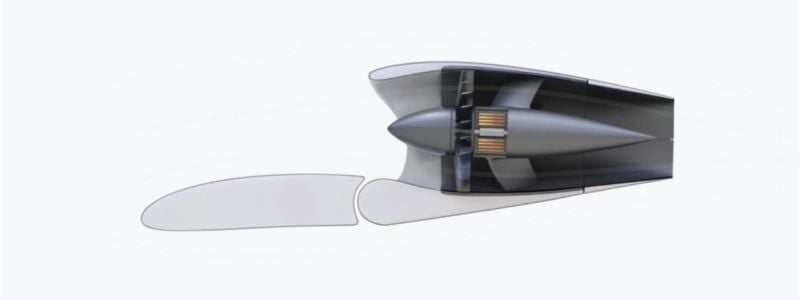
Cutaway of Lilium’s ducted fan system. Image used courtesy of Lilium
Joby Aviation claims its eVTOL propellers are “quiet as a conversation,” thanks to large-diameter propellers, slow tip speeds, and low-intensity, low-frequency pressure waves. This is a critical distinction from conventional helicopters, which get their sound from rotor-wake interaction and large-diameter rotors spinning at medium-tip speeds.
Archer Aviation, whose rotors are also smaller than helicopters, claims its fully-electric population aircraft are 100x quieter at cruise altitudes.
Sound demonstration of an eVTOL flyover. Video used courtesy of Joby Aviation
High-Density Designs
High-power discharge requirements are a characteristic feature of eVTOL operations. eVTOL batteries must deliver enough specific power for the hover phase and high energy density for long-range flights. Range depends on the cells’ total energy and minimum state of charge.
Achieving longer flights and heavier payloads comes down to battery density. Conventional lithium-ion batteries have a 200-300 Wh/kg energy density, depending on the specific chemistry—whether lithium nickel manganese cobalt oxide, lithium iron phosphate, or solid-state variants. This means they have 4 kg of material per kWh of energy storage. According to an analysis by Thunder Said Energy, this standard could increase to 500 Wh/kg in the 2030s with electrolyte improvements and reduced material requirements. A recent Journal of Energy Storage study estimates that batteries could reach 400 Wh/kg of energy density by 2025.
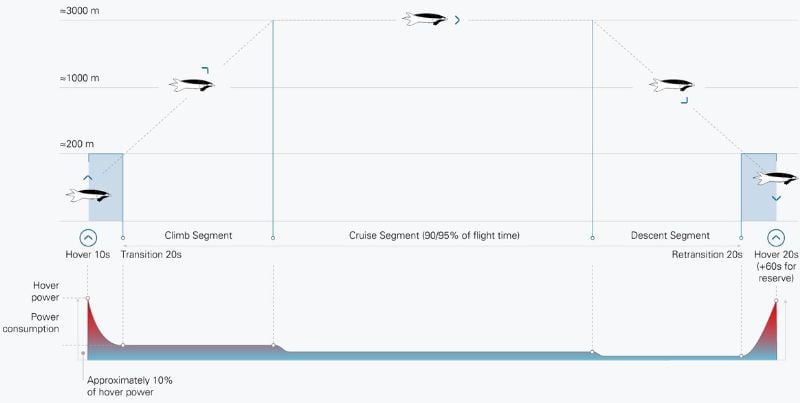
Lilium Jet’s flight path. Image used courtesy of Lilium
eVTOL architectures combine high-density batteries with designs balancing aerodynamics and range. Lilium Jet’s setup leverages 30 battery-electric motors in the canard flaps and main wings, bridging the airframe and powerplant so the flaps tilt down on hover and align flush in cruise. The jet uses only 10% of the available power during cruising, combining efficiency with high-density 330 Wh/kg batteries.
Archer Aviation’s 12-engine Midnight aircraft uses six independently operating battery packs, each supporting two electric engines with forward and aft motors positioned diagonally. This fail-safe design allows pilots to complete flights if any engine or pack shuts down. The lithium-ion battery system needs only 12 minutes to charge between trips.
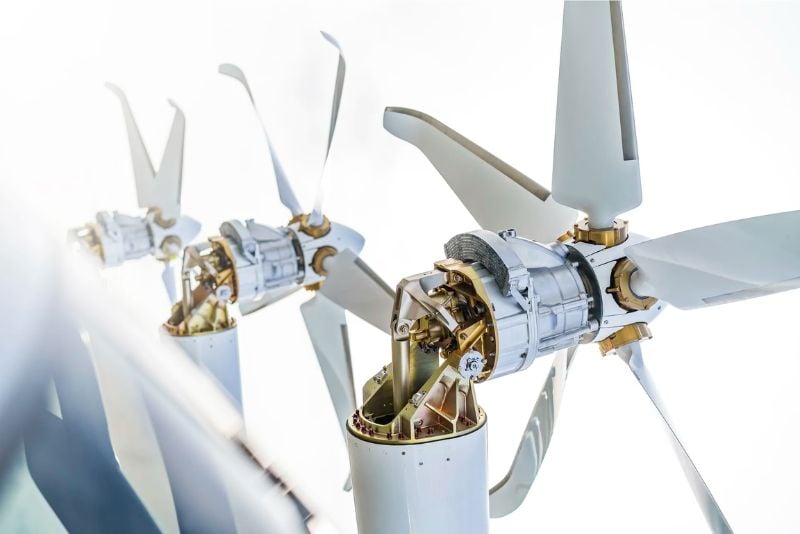
Archer Aviation’s battery-powered propellers. Image used courtesy of Archer Aviation
For enhanced safety, Archer uses continuous monitoring and operational redundant technologies in the engines, fly-by-wire flight controls, batteries, and instruments.