Facebook
 Google
 GitHub
 Linkedin
Google Invests in CO2 Battery for Long-Duration Energy Storage
Google has partnered with Energy Dome to scale long-duration carbon dioxide battery storage to advance its carbon-free goals.
The rapid global shift toward renewable energy is hitting a familiar wall: inconsistency. Solar panels can’t collect sunlight after dark, and wind turbines don’t spin on command. As grids absorb more intermittent sources, the challenge becomes not just generating clean energy, but storing it long enough to meet demand. For years, lithium-ion batteries have provided stopgap storage, but they only bridge gaps of a few hours. To move beyond fossil fuels entirely, the energy sector needs longer-lasting storage.
Google, long committed to reducing its carbon footprint, has partnered with Energy Dome to support a carbon dioxide battery, making a major move into long-duration energy storage (LDES). With plans for multiple global deployments, the tech giant considers the technology as a path toward meeting its goal of operating on 24/7 carbon-free electricity by 2030. The partnership signals a broader push to stabilize grids with firm, flexible, non-lithium storage options, especially as renewables ramp up across markets.
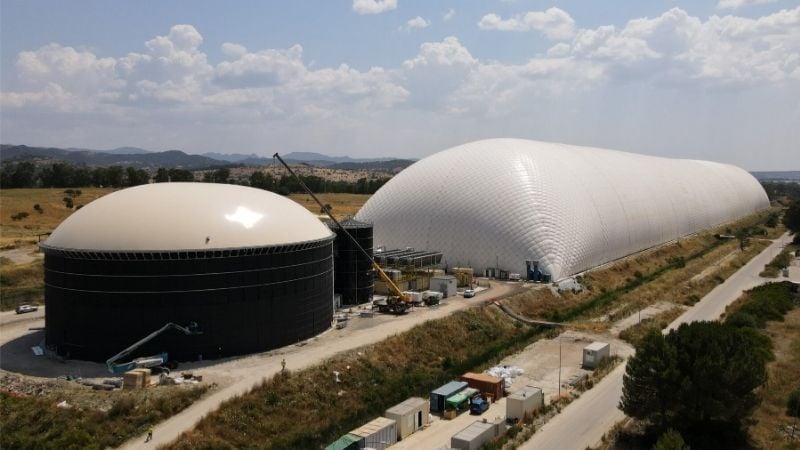
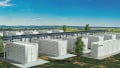
Energy Dome’s CO₂ battery. Image courtesy of Energy Dome
Why Google Is Betting on Long-Duration Storage
Google’s energy strategy has evolved from simply purchasing clean energy to actively reshaping how grids handle it. The company has supported short-term lithium-ion storage from Belgium to Nevada, enabling grids to shave peaks and avoid fossil ramp-ups. Lithium-ion batteries typically discharge in four hours or less, fine for momentary imbalances, but insufficient for day-to-night swings or multi-day lulls in wind or sun.
Long-duration energy storage can change that equation. Technologies like Energy Dome’s CO₂ Battery allow 8 to 24 hours of clean energy dispatch, making renewables more dependable across time zones and seasons. The Electric Power Research Institute has found LDES technologies cost-effective at integrating higher renewable loads. The LDES Council estimates that up to 8 terawatts of LDES by 2040 could unlock $540 billion in annual grid savings globally. Google’s investment is about capturing those benefits.
How the CO₂ Battery Works
Unlike electrochemical storage, Energy Dome’s system uses thermodynamics. The process starts by compressing carbon dioxide gas into a liquid when excess renewable electricity is available. That energy remains “stored” in the high-pressure liquid form. When demand spikes, the system reverses: the liquid CO₂ is evaporated into gas, creating pressure that drives a turbine, much like steam in traditional power plants.
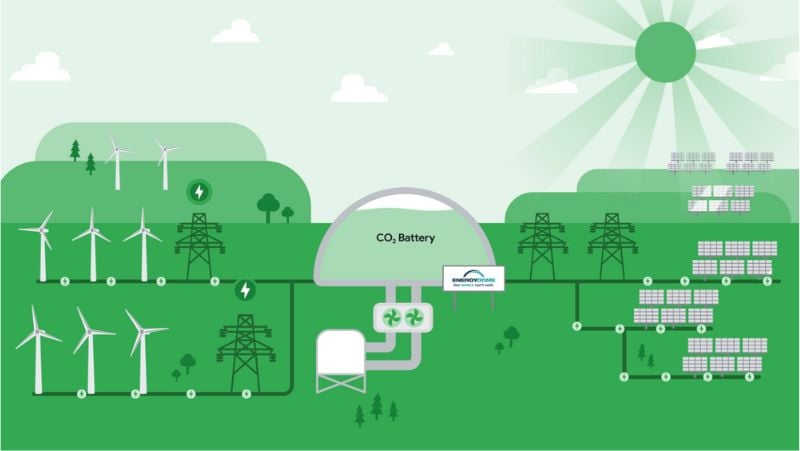
A schematic featuring the CO₂ battery. Image used courtesy of Google/Energy Dome
This approach avoids rare minerals, eliminates lithium dependency, and can be deployed near existing power infrastructure. The adiabatic compression cycle, where CO₂ is compressed and expanded without losing or gaining heat from the environment, boosts efficiency and reduces losses.
Energy Dome’s closed-loop design means no CO₂ is released in the process, making it both environmentally and operationally stable. The result is a modular, scalable system that stores megawatt-hours of clean electricity without the chemical batteries’ thermal degradation or capacity fade. Engineers evaluating grid integration, uptime, and storage duration may like the design’s simplicity, material availability, and ability to operate in industrial settings without major retrofits.
Wisconsin's First CO₂ Battery Project Gains Approval
In addition to Google's investment, Energy Dome is also moving ahead with its first large-scale U.S. deployment. Wisconsin state regulators have approved a 20 MW/200 MWh CO₂ battery installation at the Columbia Energy Centre in Pacific, near a coal plant slated for transition. Alliant Energy, WEC Energy Group, Madison Gas & Electric, Shell Global Solutions, and research institutions back the project. It is expected to break ground in 2026 and complete construction by late 2027.
The U.S. Department of Energy’s Office of Clean Energy Demonstrations selected the site to receive part of a $325 million fund to scale LDES technologies. The Wisconsin battery will mirror Energy Dome’s ongoing deployment in Sardinia, Italy, which is the same size and configuration.
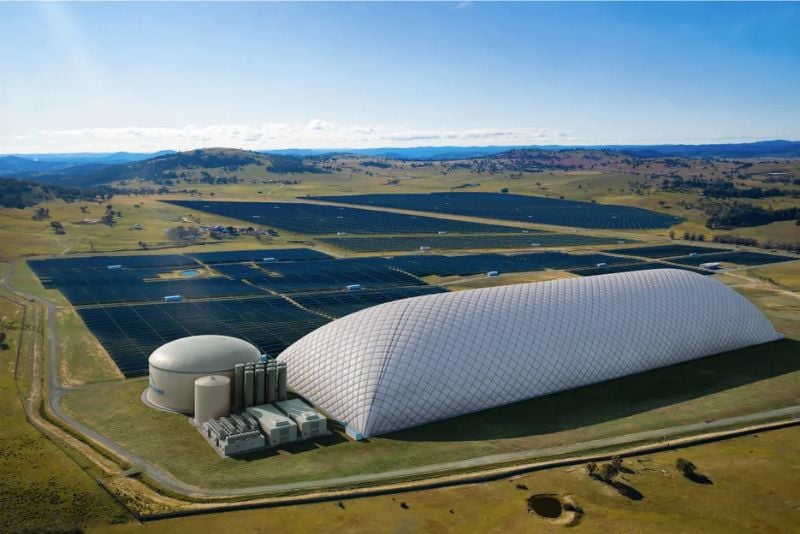
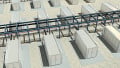
Rendering of a proposed CO2 storage facility in Australia. Image used courtesy of Energy Dome
After over three years operating in Italy, Energy Dome has already proven technical viability and is scaling to meet real-world demands. The U.S. expansion complements ongoing developments in India, where Energy Dome’s 20MW/160MWh system will be deployed at an NTPC power plant in Karnataka. The company has also established an Asia-Pacific headquarters in Melbourne, Victoria, where it’s planning future LDES sites.
As the portfolio grows, so does industry confidence in CO₂-based storage as a reliable alternative for round-the-clock clean power. Storing clean electricity for just a few hours won’t be enough to meet the world’s energy goals. As grids become more renewable-heavy, they also need to become more flexible. Google’s partnership with Energy Dome and the company’s growing global footprint could be the key to bridging the clean energy timing gap, one CO₂ dome at a time.