Facebook
 Google
 GitHub
 Linkedin
Geothermal Advances With Expansions, Deep Holes, and Meta Funds
Meta has invested in geothermal development, advanced geothermal drilling tech is reaching deeper depths, and the Department of Interior has fast-tracked more projects.
Geothermal energy has long been used to heat and cool buildings, but interest in its grid-scale applications is growing. As a renewable energy source, it’s consistent, cost-effective, and low in emissions. Technology giants like Meta are also warming to geothermal as a strategy to power their AI operations and meet net-zero goals worldwide. At the same time, technologies to harvest and produce geothermal energy continue to improve, and locations for geothermal plants are expanding rapidly.
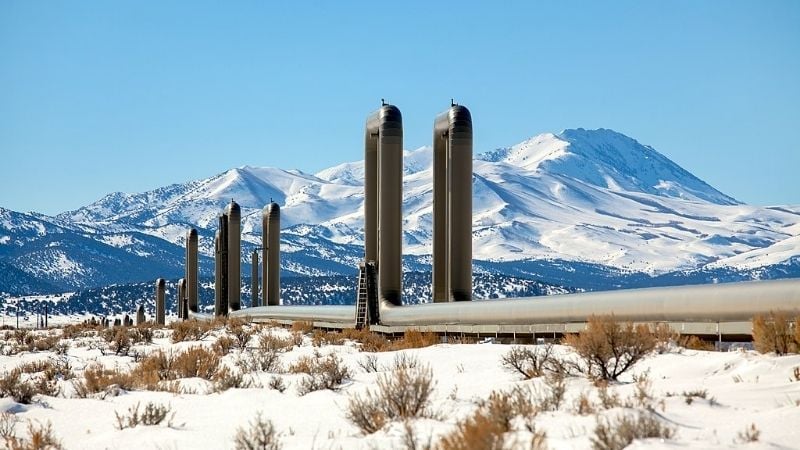
Pipelines at a geothermal plant in Nevada. Image used courtesy of Wikimedia Commons
Meta To Develop 150 MW of Geothermal for AI
Meta, parent company of Facebook and Instagram, will help XGS Energy develop 150 MW of advanced geothermal energy in New Mexico. The energy will help power Meta’s AI data centers in the state and contribute to the PNM power grid. The two-phased project will be fully operational by 2030.
XGS Energy’s advanced geothermal production involves drilling vertical wells and sinking a water-filled pipe. Proprietary thermally conductive materials transfer the heat from the underground rocks through the pipe to harvest the energy. The heated water is sent back to the surface.
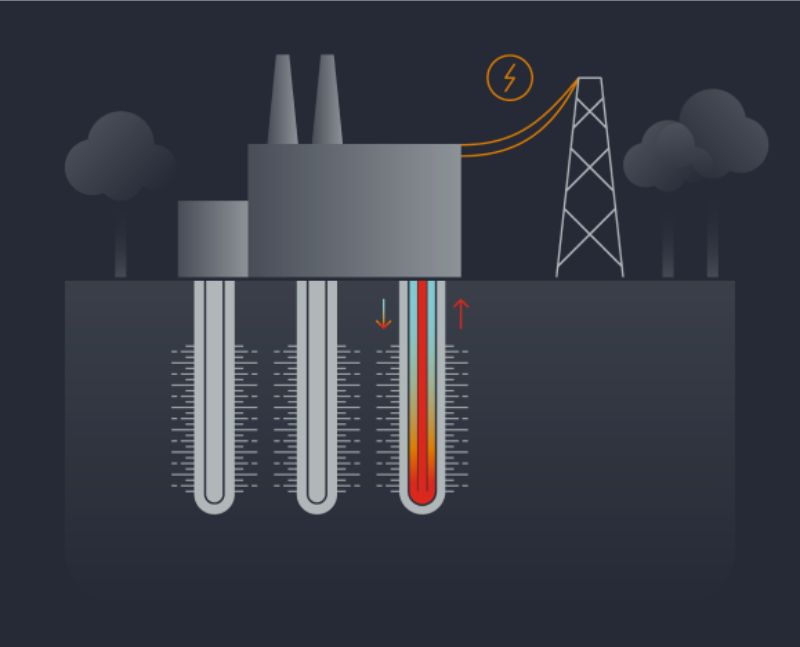
XGS Energy’s geothermal process. Image used courtesy of XGS Energy
Meta operates 11 data centers in Albuquerque and will soon expand. New Mexico already has one geothermal plant in the state’s Southwest.
In 2024, Meta signed a similar agreement to buy 150 MW of geothermal energy from Sage Geosystems in Texas.
Fervo Energy Drills Geothermal Well Nearly 3 Miles Deep
Fervo Energy has drilled a 15,765-foot geothermal well expected to reach a bottomhole temperature of 520°F. Drilling the Sugarloaf appraisal well finished in 16 days, 79% less time than the U.S. Department of Energy’s baseline for ultradeep wells.
Fervo set several drilling performance records in the process, including a maximum bit run length of 3,290 feet. They also achieved an average rate of penetration of 95 feet per hour and an instantaneous rate of 300 feet per hour at depths greater than 15,000 feet.
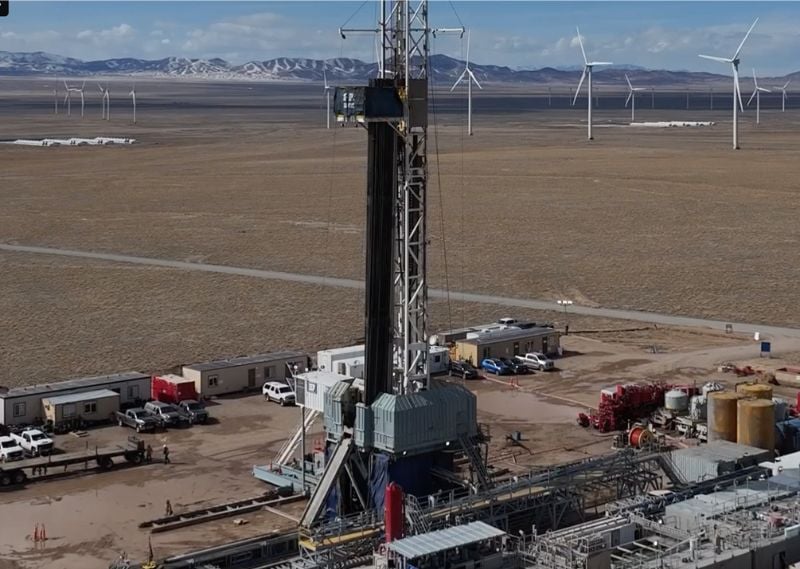
Cape Station geothermal project. Image used courtesy of Fervo
The Sugarloaf appraisal well is part of Fervo’s Cape Station geothermal development in Utah. Fervo has secured $206 million in financing to complete the project, which will begin operations next year with 100 MW of electricity. An expansion will add another 400 MW in 2028. Bill Gates’ Breakthrough Energy group has contributed $100 million.
The project area can support over 5 GW of geothermal development at depths up to 13,000 feet, according to Fervo’s independent consultant, Degolyer & MacNaughton. The consultant also stated that Fervo’s advanced methods can recover up to 50 to 60% of thermal energy, triple the amount conventional technology recovers.
Geothermal Projects Accelerate in Nevada
The Department of the Interior has fast-tracked multiple geothermal development projects, including three in Nevada.
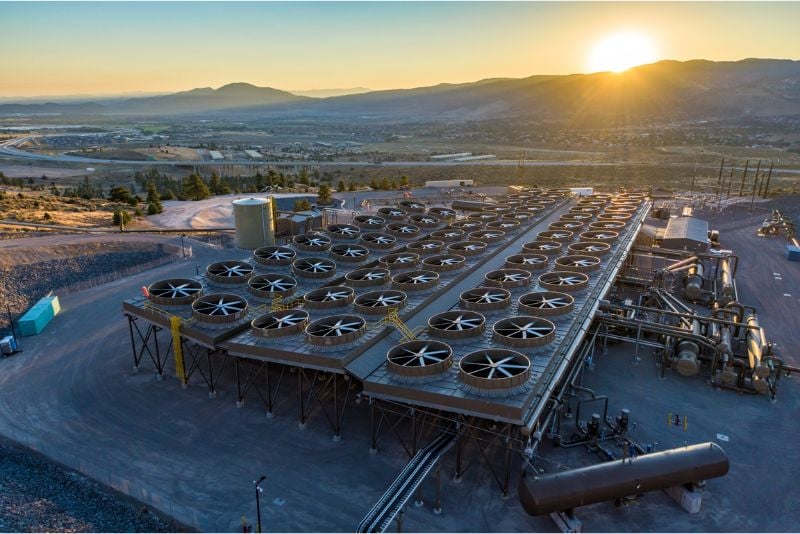
Geothermal plant in Nevada. Image used courtesy of Ormat Technology
Developed by Ormat Nevada, Inc., the projects receiving emergency permits include:
- McGinness Hills Geothermal Optimization Project: Three geothermal power plants will be upgraded and expanded with new wells, cooling fans, advanced heat exchangers, and a 15 MW photovoltaic field. The upgrades could improve efficiency and increase output beyond 193 MW, the current production capacity. The McGinness Hills Complex is the fourth-largest geothermal plant in the U.S. and the largest in Nevada. When completed, it will provide electricity for 12,000 homes and offset 120,000 tons of carbon dioxide emissions.
- Diamond Flat Geothermal: Ormat will drill up test wells on federally leased land to confirm whether geothermal resources are commercially viable.
- Pinto Geothermal Project: Ormat will conduct test drilling and evaluate the site for geothermal potential. Pinto is also located on federally leased land.