Facebook
 Google
 GitHub
 Linkedin
Fueled by Nature: World’s First Biodiesel Truck Powered by Solar
ENOC Group has unveiled the world’s first biodiesel delivery truck powered by two 550 W solar panels.
While lithium-ion (Li-ion) batteries are a great fit for smaller passenger vehicles, they can’t handle large payloads needed for long-haul trucking. The battery packs are extremely heavy and prohibitively expensive for many small shipping companies.
Trucking is a major contributor to worldwide carbon emissions, with roughly 420 million metric tons released yearly. Dubai-based Emirates National Oil Company (ENOC) has released a solution combining biodiesel and solar panels to create the world’s first delivery truck to use these two power sources.
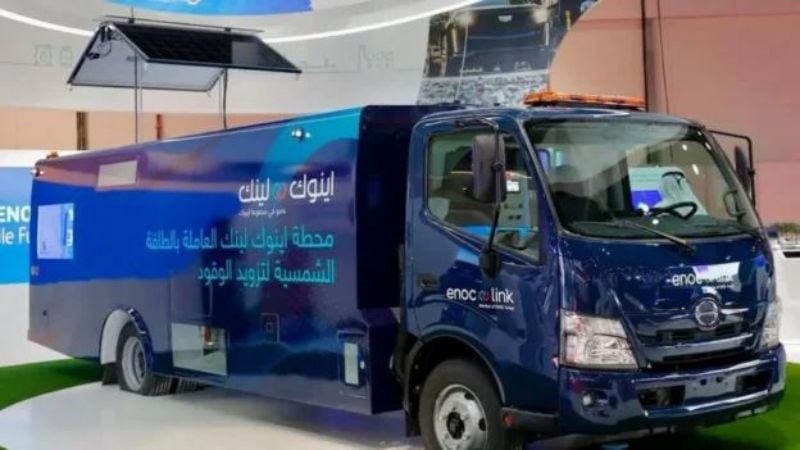
The ENOC delivery truck combining biodiesel and solar panels. Image used courtesy of ENOC Group
Energy Density and Power Output Problems for Biodiesel and Solar
Biodiesel might seem like a perfect long-haul trucking fuel solution. However, the energy density and equipment compatibility issues are significant.
While cleaner than conventional diesel, biofuel has a lower energy content, so trucks require more fuel to travel the same distance. This results in larger fuel tanks, which increase vehicle weight and reduce payload capacity.
Additionally, biodiesel can cause engine compatibility issues, particularly in older trucks not designed for biofuels, leading to potential performance reductions and higher maintenance costs. Biodiesel production is limited by raw material availability like vegetable oils or animal fats, which may not scale to meet the demands of the long-haul trucking industry. Even using the entire U.S. corn and soybean production supply for biofuels would only meet 6% of the diesel and 12% of the gasoline demand. U.S. canola oil imports have surged to meet biofuel production needs, growing from a 50-60% share of Canada canola oil exports to 91% in 2023, according to the U.S. Department of Agriculture.
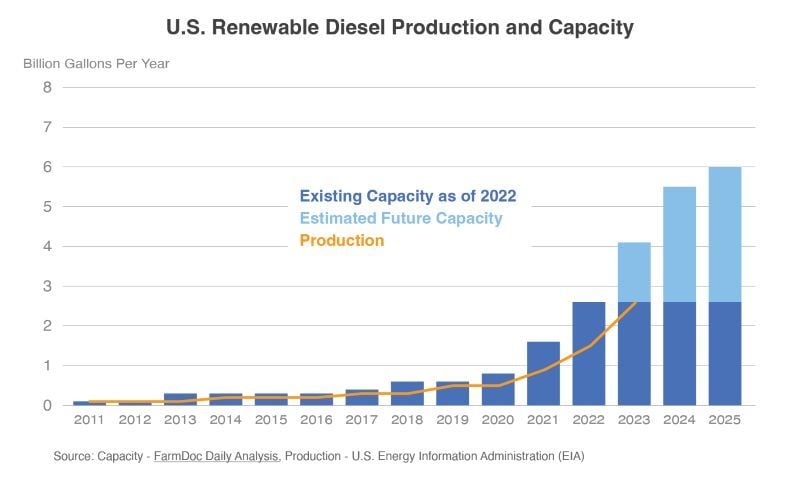
U.S. renewable diesel market trends. Image used courtesy of the USDA
Solar panels also face significant challenges in the long-haul transportation sector, particularly for larger trucks, due to their limited power output and space constraints. Standard solar panels typically convert about 15-20% of sunlight into electricity, with high-efficiency panels reaching around 22%. Even under ideal conditions, an average solar panel produces roughly 200-300 watts per square meter. Considering that a large truck roof might offer around 40-50 square meters of space, the maximum power output would be around 8-12 kW, assuming perfect efficiency and full sunlight, which rarely occurs.
For context, heavy-duty trucks require substantial energy to operate. Depending on terrain and weight, a fully loaded Class 8 truck can consume upwards of 500 kWh per 100 miles of travel. The solar panels on a truck would struggle to meet even a small fraction of this demand. Further, these numbers are based on ideal conditions, not accounting for solar energy’s naturally intermittent quality.
ENOC’s First Solar-Powered Biodiesel Truck
At the Water, Energy, Technology, and Environment Exhibition (WETEX), the ENOC group unveiled a novel power source combination that might transform the long-haul trucking sector.
The truck is outfitted with two 550 W solar panels and a 1,320-gallon tank with two separate compartments that can blend different biodiesel formulations. This hybrid design results in an eight-hour operation capacity and ample time for a delivery truck to work a full shift.
The solar panels can produce 1.3 MWh of energy annually, substantially reducing carbon emissions. These solar panels can offset 6.6 tonnes of carbon dioxide annually, reducing emissions significantly, especially if the hybrid model is adopted on a large scale.
Even if this solar and biodiesel combination is a temporary solution until long-haul trucking has settled on the most efficient fuel solution, it is certainly a step in the right direction to help this industry pivot away from reliance on fossil fuels.