Facebook
 Google
 GitHub
 Linkedin
Drones, Sensors Enable Dynamic Line Rating Optimization
Pitch Aeronautics’ drone-installed dynamic line rating sensors will provide Idaho Power with real-time data analysis.
Power companies must shift from traditional static line rating methodologies to dynamic, data-driven approaches to provide reliable power. Static ratings are predicted based on conservative assumptions, which can lead to underutilizing transmission line capacity. This increases vulnerability to fluctuations caused by changing weather conditions. When power line conductors heat up and cause the line to sag to its natural safety clearances, electricity flow can become constrained. Real-time monitoring and analysis, necessary for optimized grid performance, are imperative.
Watch a drone installation Video used courtesy of Pitch Aeronautics
Pitch Aeronautics and Idaho Power have teamed up on a $4 million project to deploy advanced sensor networks using unmanned aircraft systems (UAS). Pitch’s Astria platform will provide precise, real-time monitoring of transmission line conditions, significantly advancing power companies' use of dynamic line rating technologies. The project was funded by the Department of Energy’s Grid-Enhancing Technologies initiative.
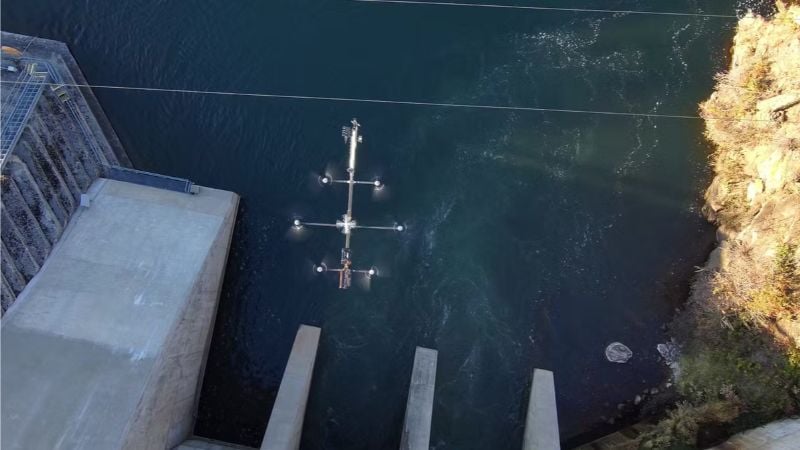
The UAS can reach power lines in hard-to-access locations. Image used courtesy of Pitch Aeronautics
The WireWarrior Sensor
Pitch’s WireWarrior sensor is a multi-parameter device engineered to provide comprehensive environmental and line condition data. It is integrated with meteorological sensors with line sag monitoring capabilities. The WireWarrior captures critical data points, including ambient temperature, pressure, humidity, wind speed, line sag angle, and vibrational characteristics. It can also provide direct wind measurements at the conductor level, which mitigates the usual inaccuracies associated with traditional pole-mounted anemometers and ensures accurate wind data that can pinpoint wildfire risks in a single power line span.
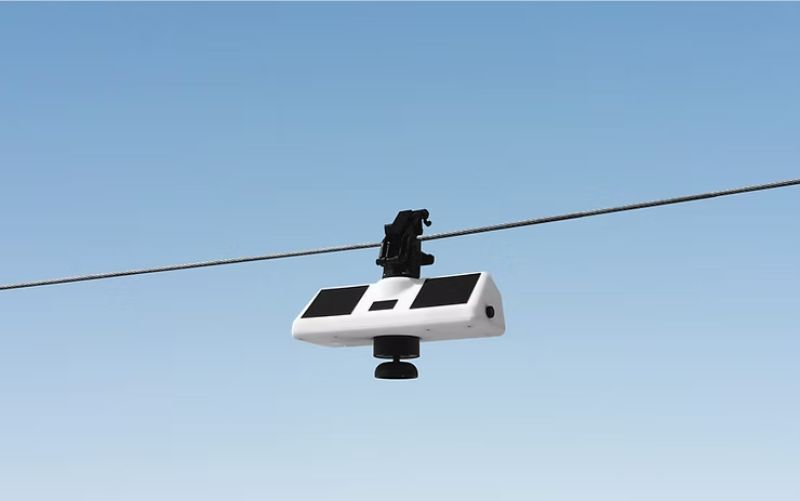
The joint project will deploy 35 WireWarrior sensors across Idaho Power’s network. Image used courtesy of Pitch Aeronautics
Data acquisition from the sensor uses high temporal resolution and is transmitted securely through 5G and satellite networks to ensure data integrity and accessibility. The data feeds into Pitch’s WireWeather software, a sophisticated analytics platform employing advanced algorithms, including artificial intelligence and statistical modeling, to generate dynamic line ratings, ambient adjusted ratings, and emergency ratings. The system utilizes meteorological forecasting models to predict conductor thermal behavior that can account for convective cooling effects. It also enables precise ampacity determination to enhance operational flexibility.
“Our project marks a significant advancement in grid modernization,” Ian Gibson, co-founder of Pitch Aeronautics, stated in a press release. “By integrating advanced drone-deployed sensor technology with weather modeling, we can provide utilities with actionable insights that enhance grid performance, improve reliability, and support operational efficiency.”
Simplifying Sensor Installation With the Astria Drone
The Astria UAS platform allows companies to safely and efficiently deploy the WireWarrior sensor network. It is the only U.S.-made drone designed for power line installations. The drone's multi-sensor payload capacity and extended operational range enable rapid and scalable implementation, even in challenging terrains and on energized conductors. In a single flight, it can carry up to three WireWarrior sensors for installation.
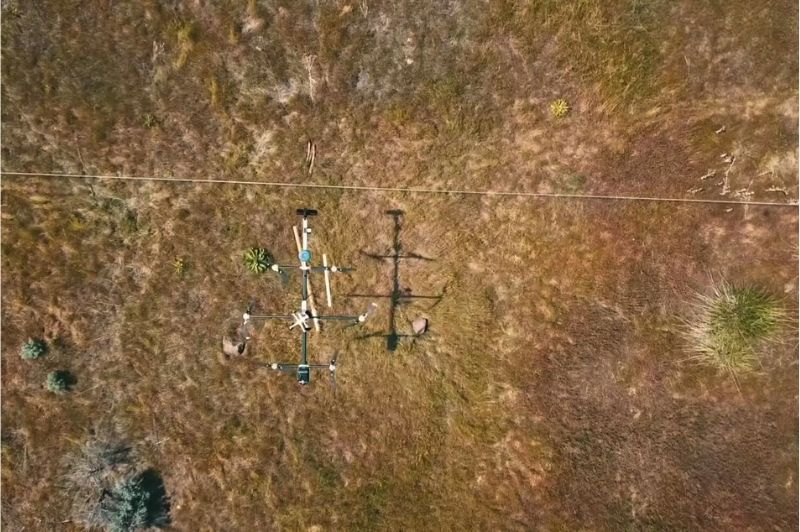
The Astria drone makes installation in difficult locations much easier and prevents unnecessary outages. Image used courtesy of Pitch Aeronautics
The Astria drone can install the WireWarrior sensors anywhere, including on lines running over canyons, rivers, or mountainsides, which bucket trucks or helicopters would struggle to get close to. It can install sensors on energized lines, whereas conventional installation would require temporary power outages. The platform's design also incorporates stringent safety protocols, including third-party audited safety management systems and FAA-certified pilot operations.
By strategically deploying UAS-installed sensor networks, Pitch Aeronautics and Idaho Power are developing a data-driven sensor network approach to grid management. The system could improve operational efficiency and reliability through real-time monitoring and advanced analytics.