Facebook
 Google
 GitHub
 Linkedin
GaN Goes Power Mainstream—Insights from EPC’s Nick Cataldo at APEC 2026
GaN is going mainstream in power electronics for AI, robotics, and cars. At APEC 2026, EPC's Nick Cataldo discusses GaN system-level value and cost advantages.
At the Applied Power Electronics Conference (APEC) show in San Antonio, EPC talked about how gallium nitride (GaN) is moving from being a niche enabling technology to being a key part of next-generation power conversion architectures that will be used in AI infrastructure, robotics, cars, wireless power, and autonomous systems.
Nick Cataldo, Senior Vice President of Global Sales and Marketing at Efficient Power Conversion Corporation (Figure 1), talked about how wide-bandgap adoption has changed over the past 35 years in the power semiconductor markets.
Many Transitions Over the Years
Cataldo has experienced multiple technology transitions across the industry—from superjunction silicon to silicon carbide (SiC) and now GaN. Among these shifts, he emphasized that GaN represented the steepest learning curve for the engineering ecosystem.
“After 35 years plus, I think all of those technologies were challenging, but I would probably say GaN was the most challenging. It required a different skill set from the engineering community, ” said Cataldo.
Unlike earlier device transitions largely confined to higher-voltage segments, EPC’s GaN portfolio spans approximately 15 V to 350 V, dramatically widening the scope of applications impacted and increasing the scale of customer education required.
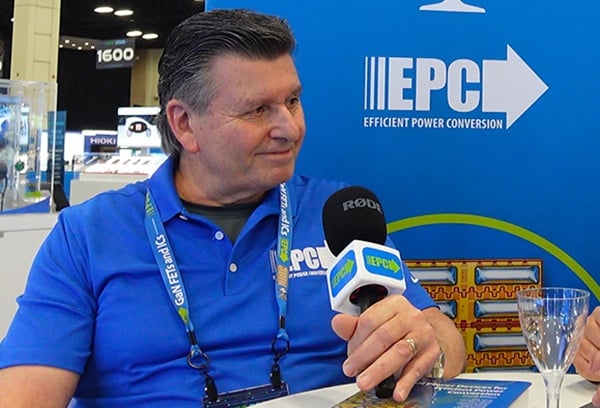
At APEC 2026, Nick Cataldo, Senior Vice President of Global Sales and Marketing at EPC
Recognizing the Limits of Silicon—and the Opportunity for GaN
Cataldo traced his early recognition of GaN’s potential to the broader realization that conventional silicon technologies were approaching physical and performance limits.
“It goes back probably 15 years ago that I knew silicon was hitting its barriers.”
His exposure to both SiC and GaN helped clarify where each technology would create the greatest system-level value. While SiC naturally addressed high-voltage domains such as traction inverters, GaN offered broader applicability across lower-voltage, high-frequency switching environments.
“GaN had a wider acceptance from the application side… so GaN was the best choice.”
From Lidar Leadership to AI Server Power Rails
GaN’s early commercial traction emerged in specialized application areas such as lidar and wireless power transfer. Cataldo highlighted lidar as one of EPC’s earliest strongholds.
“We pretty much dominated the lidar autonomous market for many, many years.”
Wireless power also represented an early opportunity, though adoption followed multiple technology paths depending on cost and integration constraints.
The real inflection point for scaling GaN deployment, however, came with 48 V–to–12 V conversion architectures - especially inside hyperscale computing infrastructure.
“It was really the DC-to-DC AI server value that we brought. Some of the big companies like NVIDIA certainly worked closely with us on defining some of those products.”
Today, GaN is expanding rapidly into motor-drive applications supporting drones, humanoid robotics, autonomous platforms, and untethered systems—segments where efficiency, switching speed, and power density directly influence system capability.
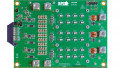
At APEC, EPC introduced the EPC91121 three-phase motor-drive evaluation platform, designed to accelerate GaN-based motion-control development (Figure 2).
“It’s got everything on board for any design engineer to use GaN quickly in a motor application.”
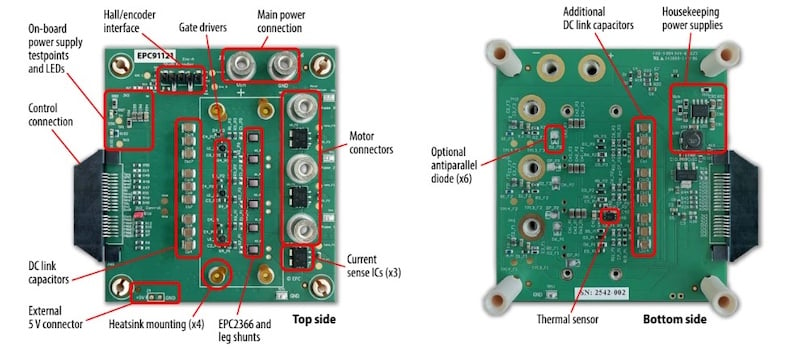
Photo overview of the EPC91121 board highlighting the main sections
The board integrates EPC’s newly announced EPC2366 40 V device, delivering up to 50 A RMS with extremely low conduction losses.
“The RDS(on) for that device is less than a milliohm—about 0.89 mΩ—which is significant in the industry.”
System-Level Cost Advantage Drives Adoption
While engineers often evaluate switching technologies using metrics such as RDS(on), procurement teams typically focus on component cost. Cataldo emphasized that GaN adoption succeeds when evaluated at the system level rather than the discrete-device level.
“What really sells the technology is adding value to the end product.”
GaN enables reductions in passive component size, improved thermal efficiency, higher switching frequency, and increased power density—all of which contribute to lower total system cost.
“The inductors and the magnetics come down in size. Thermal efficiencies go up. Power efficiency goes up.”
These advantages increasingly make it difficult for procurement teams to reject GaN-based solutions when system-level performance improvements are clearly demonstrated.
Natural Technology Segmentation Is Emerging
Looking ahead, Cataldo expects the power semiconductor landscape to evolve toward complementary coexistence rather than competition between silicon, SiC, and GaN.
Silicon MOSFETs will remain dominant in cost-sensitive consumer applications. SiC will continue leading high-voltage automotive and industrial electrification systems. Meanwhile, GaN is expanding rapidly across low-to-mid voltage conversion and is beginning to address higher-voltage architectures through multilevel topologies.
“People are starting to look at GaN even for higher voltages.”
Cataldo also noted that the next generation of engineers entering the workforce already views GaN as a primary design option rather than an experimental alternative.
“The natural evolution will be for new designers that have studied GaN to want to use GaN.”
Reliability Data and Customer Alignment Remain Essential
Despite its rapid progress, GaN adoption still depends heavily on reliability validation. EPC has accumulated nearly two decades of reliability testing, including extended stress testing beyond datasheet limits.
“No one’s going to use new technology until it’s fully vetted.”
Cataldo stressed that successful technology transitions depend not only on performance data but also on collaboration with customers over multi-year development roadmaps.
“If you share a roadmap with your customer, you align with them in those two to five years, and you build the best of the best products.”
Drawing on his early career as a field applications engineer, he closed with practical advice for engineers and technical sales professionals entering the wide-bandgap era:
“Listen, listen, listen. The customer knows best in terms of what those applications need.”
All images used courtesy of EPC.