Facebook
 Google
 GitHub
 Linkedin
Wolfspeed Releases HV SiC Power Module for Renewables, Utilities
The compact power modules reduce switching losses and are easily scalable.
Wolfspeed has introduced a silicon carbide (SiC) power module designed to significantly enhance the performance of renewable energy systems, energy storage, and fast-charging infrastructure.
The 2300 V module uses 200 mm silicon carbide technology. Using SiC as a semiconductor throughout these models offers better efficiency and performance than traditional silicon. It can handle higher voltages and temperatures, making it suitable for power electronics.
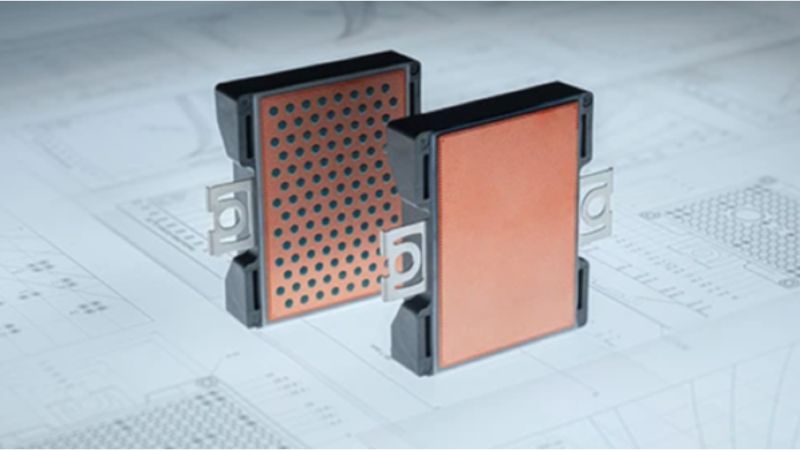
The 2300 V silicon carbide power module. Image used courtesy of Wolfspeed
Functionality Improvements
The power module contains several improved features.
These modules can handle up to 2300 volts, which is relatively high and practical for large-scale power applications. The SiC power modules can improve a system's overall efficiency by reducing energy wasted during conversion. The 2300 V module has 15% greater voltage headroom, which is the extra capacity it can handle beyond its rated voltage. The additional headroom means the modules can safely hold higher voltages without damage risk.
Wolfspeed has improved the SiC modules' dynamic performance and temperature stability. The 2300 V component can maintain optimal performance as temperatures vary, which is crucial for reliability. The EMI filter size has also been substantially reduced, making the component more compact and potentially less costly.
IGBTs (insulated gate bipolar transistors) are frequently utilized in power electronics. Switching losses happen when the device turns on and off. Wolfspeed’s SiC module demonstrated a 77% reduction in switching losses compared to IGBTs, further enhancing the system's efficiency.
Design Improvements
Wolfspeed developed the 2300 V silicon carbide module to increase market scalability through design simplifications. System designers can utilize less expensive PCBs to reduce overall manufacturing costs. Compared to standard bus bar solutions, the simplified design process saves money and development time.
Traditional systems typically employ a three-level topology with IGBTs, which can become intricate and require more components. However, Wolfspeed’s SiC modules resolve this issue by integrating a two-level topology, thus simplifying the system design and reducing the required number of drivers. Thus, the system becomes more accessible to construct and maintain. Moreover, the 2300 V modules can be building blocks for scaling power from small (kilowatts) to large (megawatts) systems. This flexibility makes it easier to design systems for various power requirements.

Wolfspeed's 200 mm, automotive-qualified SiC fabrication facility in Marcy, New York, is now the largest in the world. Image used courtesy of Wolfspeed
Wolfspeed’s Partnership and Market Predictions
Jay Cameron, Wolfspeed’s senior vice president and general manager of power, emphasized the growing importance of energy efficiency and reliability, noting that the company’s collaboration with forward-thinking partners like EPC Power aims to deliver innovative, scalable solutions through Wolfspeed’s silicon carbide technology.
During the SiC module’s launch, Wolfspeed also revealed a collaboration with EPC Power, a company known for manufacturing large-scale inverters tailored for utility applications. The Wolfspeed modules will be integrated into utility-grade solar and energy storage systems to provide a scalable high-power conversion system, advanced performance controls, and system redundancy. This collaboration marks the advance of integrating cutting-edge technology within renewable energy systems.