Facebook
 Google
 GitHub
 Linkedin
Vishay MOSFET Driver Simplifies High-Voltage Designs
The VODA1275 automotive-grade photovoltaic MOSFET driver delivers 20 V output, reinforced isolation, and faster switching for high-voltage systems.
Vishay has introduced the VODA1275, an automotive-grade photovoltaic MOSFET driver designed for high-voltage systems, such as electric vehicle battery management, pre-charge circuits, and wall chargers. The device provides 20 V open-circuit output, 20 μA short-circuit current, and an 80 μs turn-on time in a compact SMD-4 package.
Vishay has designed the VODA1275 driver to drive high-voltage MOSFETs and IGBTs without requiring multiple drivers or an external power supply. That simplifies the design, reduces component count, and supports higher reliability in systems operating at 800 V and above.
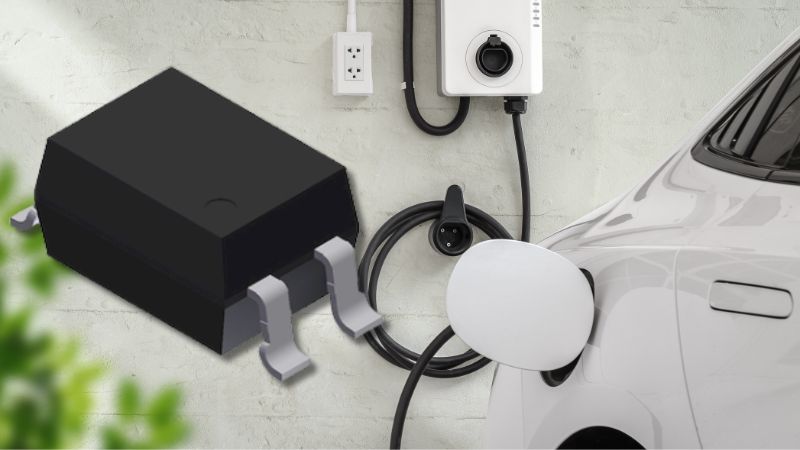
Target applications include EV charging and high-voltage battery systems. Adapted from image used courtesy of Vishay
Electrical Performance and Switching Characteristics
The VODA1275 delivers an open-circuit voltage of 20 V (typ.) and a short-circuit current of 20 μA, providing the drive capability needed for high-voltage MOSFETs and IGBTs. The turn-on time is specified at 80 μs, which, compared to other photovoltaic drivers, is about three times faster. This improves switching response in applications such as pre-charge circuits and battery management, where timing and controlled switching behavior are important.
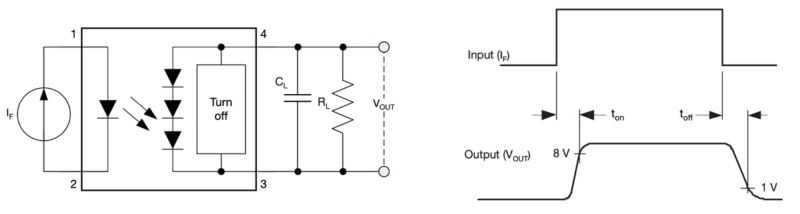
A typical test circuit and output waveform for the VODA1275 driver. Image used courtesy of Vishay
Isolation and High-Voltage Capability
The VODA1275 is designed for high-voltage environments, with an isolation voltage of 1260 Vpeak and an isolation test voltage of 5300 VRMS. It also provides an 8 mm creepage distance and uses a mold compound with a CTI of 600, supporting reinforced isolation requirements.
These parameters make it suitable for 800 V battery systems and other high-voltage automotive applications where insulation performance and long-term reliability are critical. The combination of creepage distance and material rating helps reduce the risk of tracking and breakdown under harsh operating conditions.
Design, Packaging, and Integration
The VODA1275 driver is optically isolated and derives its operating energy from an internal infrared emitter on the low-voltage side of the isolation barrier. This eliminates the need for an external power supply on the high-voltage side and reduces overall circuit complexity.
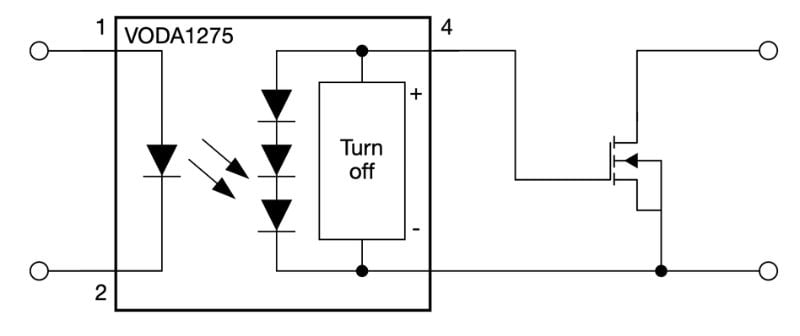
Sample application of the VODA1275 as an isolated MOSFET driver for high-voltage switching. Image used courtesy of Vishay
Its higher open circuit output voltage allows design replacements that previously required two drivers in series, reducing component count and simplifying layout while enabling the use of solid-state relays in place of electromechanical relays in automotive systems.
The device is housed in a compact SMD-4 package measuring 5.08 mm × 9.8 mm × 3.55 mm and is AEC-Q102 qualified, with an operating temperature range of -40°C to +125°C, supporting use in automotive environments, such as EV and HEV battery systems, charging circuits, and power switching applications.
Vishay’s VODA1275 is an automotive-grade photovoltaic MOSFET driver designed for high-voltage applications, delivering 20 V output, 20 μA current, and 80 μs turn-on time with reinforced isolation. Since the need for external power has been eliminated, users can reduce the number of required driver components, simplifying high-voltage designs while supporting reliable operation in EV and industrial systems.