Facebook
 Google
 GitHub
 Linkedin
Rad-Hard GaN MOSFETs Beat Silicon Alternatives for Satellite Designs
Learn how rad-hard GaN FETs surpass silicon in satellite power systems. They offer superior SWaP, higher efficiency, and radiation immunity for high-frequency, high-voltage space applications.
Rad-Hard GaN solutions are revolutionizing satellite power architectures by enabling higher switching frequencies and superior efficiency compared to traditional silicon-based radiation-hardened MOSFETs. These devices are critical for meeting the Size, Weight, and Power (SWaP) requirements in applications such as LEO/GEO satellite power supplies, motor drives for reaction wheels, and ion thrusters.
Technical Advantages Over Silicon
The radiation resilience of eGaN devices stems from the fact that, unlike silicon MOSFETs, they do not have a gate oxide, making them immune to Single Event Gate Rupture (SEGR) and more resistant to Total Ionizing Dose (TID) radiation. They also have a higher displacement threshold energy, improving performance under neutron radiation.
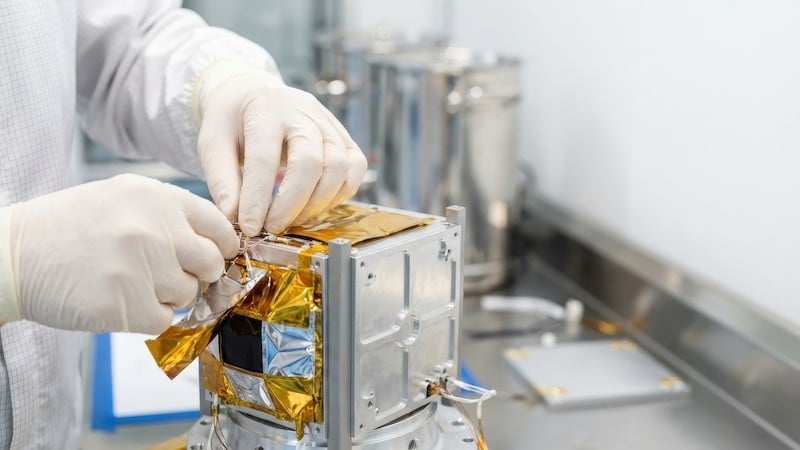
Figure 1. A technician assembles a small satellite technology component. Source: Adobe Stock (licensed).
To compare efficiency, GaN typically has a Figure Of Merit (FOM) that is 5 to 10 times better than the best Silicon MOSFETs, offering much lower RDS(on) for the same physical footprint, which reduces conduction losses. Additionally, it has a lower Gate Charge (QG), requiring less energy to turn on the switch and minimizes switching losses, especially at high frequencies.
Another significant technical advantage of GaN over Silicon is the complete elimination of Reverse Recovery Charge (Qrr). In traditional Silicon MOSFETs, the intrinsic body diode stores charge during conduction; when the device switches off, this charge must be discharged, causing a massive spike in energy loss and EMI. Because GaN devices possess zero reverse recovery, they eliminate these switching losses entirely.
GaN drives system-level efficiency by operating at higher MHz frequencies, enabling smaller, more optimized components and shorter PCB traces that reduce parasitic inductance. Furthermore, superior thermal efficiency allows for the removal of heavy, energy-intensive cooling systems like fans and heatsinks ultimately reducing overall system mass and battery requirements.
Key Applications in Satellite Systems
From deep-space exploration to the Low Earth Orbit (LEO) telecommunications market, the applications shown in Table 1 highlight how GaN is optimizing the modern satellite architecture.
| Application Category | Specific System | Key Benefits of GaN | Impact on Satellite Design |
| Power Management | DC-DC Converters | Peak efficiencies up to 96%; high power density. | Enables smaller passive components and significantly reduces heat sinking requirements |
| Communication | RF Power Amplifiers | Optimal for high frequencies (12–40 GHz) in Ka and Ku bands. | Provides high linearity and power density for 5G and SATCOM terminals. |
| Propulsion | Ion Thrusters | Compact, high- performance switching. | Enhances efficiency for orientation, positioning, and interplanetary travel. |
| Navigation & Control | Reaction Wheels | Drives high-precision brushless DC motors. | Allows for miniaturized control systems, essential for CubeSat orientation. |
| Remote Sensing | Lidar Systems | Ultra-high switching speeds. | Improves Lidar resolution for autonomous docking, navigation, and robotics. |
Table 1. How GaN provides benefits in different space applications
Space-Grade Power Solutions
To evaluate a three-phase power stage based on Rad-Hard GaN ICs for satellites, the technical equipment is divided into three critical categories: signal control, power analysis, and space reliability monitoring.
Signal Generation and PWM Control
Because GaN devices switch at extremely high speeds (nanosecond range), high-precision control is mandatory to prevent false triggering. This requires Space-Grade Microcontrollers or FPGAs capable of executing advanced motor control algorithms (such as FOC or BLDC) while generating PWM signals with sub-nanosecond resolution.
Furthermore, High-Speed Digital Isolators are essential to provide galvanic isolation between the control logic and the high-power bus, ensuring signal integrity without introducing significant propagation delays.
Power and Switching Analysis
Measuring GaN devices requires a significantly higher bandwidth than traditional silicon-based inverters. A Digital Phosphor Oscilloscope with at least 1 GHz bandwidth is essential to capture rapid switching transients (dv/dt and di/dt) and detect parasitic oscillations.
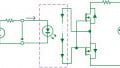
Furthermore, optically isolated probes are critical for measuring high-side gate-source voltage (VGS) without interference from high common-mode noise. Finally, a three-phase motor analyzer is used to evaluate inverter efficiency and monitor the Total Harmonic Distortion (THD) delivered to the satellite's motor.
Space Reliability Monitoring
For Space Reliability Monitoring of GaN power stages, the equipment must simulate orbital environments while detecting radiation-induced failures in real time.
Thermal Vacuum Chambers (TVAC) are used to replicate space vacuum and extreme temperature cycles, paired with high-speed Data Acquisition Systems (DAQ) to monitor voltage drifts or leakage currents under thermal stress.
To address radiation, Single Event Effects (SEE) Testing Systems are connected to particle accelerators to detect destructive events like Single Event Burnout (SEB) or Single Event Gate Rupture (SEGR).
Furthermore, high-precision Source Measure Units (SMU) are vital for measuring nanoampere-level leakage currents to identify latent degradation from Total Ionizing Dose (TID).
Finally, high-resolution Infrared (IR) Thermographic Cameras are utilized within the vacuum to pinpoint hotspots that signal inefficiencies or imminent catastrophic failure.

Figure 2. Orbital Power Systems: Solar Arrays and Power Management in Space. (Source: Pixabay)
EPC Space: Extending the Reach of Rad-Hard GaN for Satellite Systems
EPC Space’s ongoing mission is to provide space-grade Rad-Hard GaN solutions that outperform silicon radiation-hardened MOSFETs in efficiency, size, and thermal management, enabling more capable, reliable, and scalable satellite systems to support high-voltage bus architectures and more compact spacecraft.
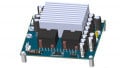
The EPC7C021, a three-phase motor drive evaluation board, is designed around the radiation-hardened EPC7011L7C eGaN IC.
This demonstration board is a fully functional three-phase motor speed controller which uses the radiation-hardened EPC7011L7C eGaN IC. It shows how GaN enables compact, high-efficiency motor control of up to 400 watts in a small footprint. The EPC7C021 functions as a standalone three-phase motor controller, but it could also support connections with the EPC9147A, a controller board for advanced closed-loop controls.
Key applications include satellite reaction wheels, electric propulsion actuators, pumps, robotics, and deep space missions where power and radiation resistance lightweight are needed without sacrificing performance.
Rad-Hard GaN FET
The EPC7030MSH, a 300 V radiation-hardened GaN FET, aimed to work in higher-voltage satellite power systems. The EPC7030MSH is a 300 V, 50 A, low RDS(on) device. More and more satellites are switching to higher DC bus voltages to minimize distribution losses and support higher power system requirements, such as electric propulsion and advanced solar array technologies.
A reliable 300 V device like this allows designers to build efficient front-end converters without parallel connection that must operate under stringent thermal constraints, and also reduces size, weight, and complexity while, of course, maintaining radiation resistance and performance.
This eGaN power switching HEMT has been specifically designed for critical applications in space and other high reliability environments. It is the ideal solution for front-end DC-DC converters in satellite power systems, power conversion for high-voltage distribution buses in spacecraft and electric propulsion platforms, and motors for space robotics that demand compact, high-performance switching.