Facebook
 Google
 GitHub
 Linkedin
Transforming Motor Control With GaN ICs
Cambridge GaN Devices and Qorvo integrate high-performance microcontrollers with ICeGaN ICs to boost energy efficiency.
Motors consume around 50% of global electricity. The proliferation of electric motors has intensified the need for advanced control technologies to deliver precision and reliability with minimal energy consumption. Advanced semiconductor technologies can optimize power management, reduce thermal losses, and enable more intelligent motor control architectures.
Using gallium nitride (GaN) devices can help meet these demands. Qorvo and Cambridge GaN Devices are collaborating to provide compact, energy-efficient motor solutions.
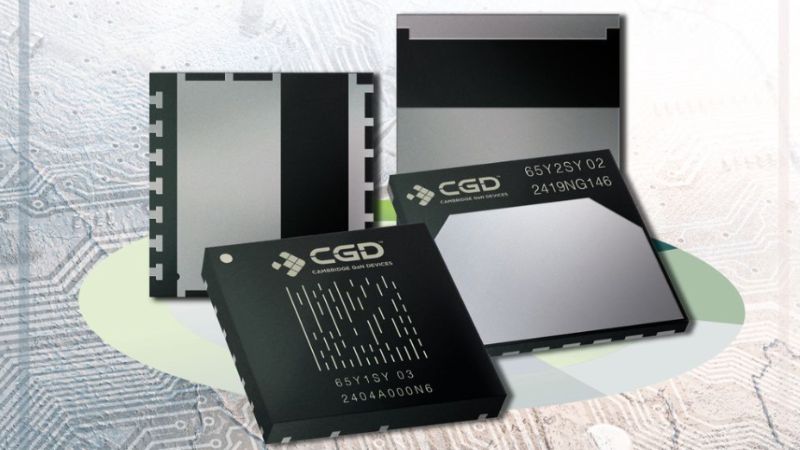
650 V IceGaN Power ICs. Image used courtesy of Cambridge GaN Devices
Motor Control Essentials
Permanent magnet synchronous and brushless DC motors are known for their efficiency and durability.
These motors rely on an electronically generated rotating magnetic field for operation, necessitating precise voltage and current control of their phases. Generally, control is achieved through electronic commutation, which requires a motor controller to accurately time coil energization for optimal speed, torque, and efficiency. Other motor controller parameters include precise speed and torque regulation, soft start for smooth operation, acceleration and deceleration control, and protection against faults or overloads.
Modern motor controllers integrate this functionality into advanced microcontrollers to drive high-power MOSFETs (H-Bridge). This integration simplifies circuit design, minimizes external components, and lowers costs.
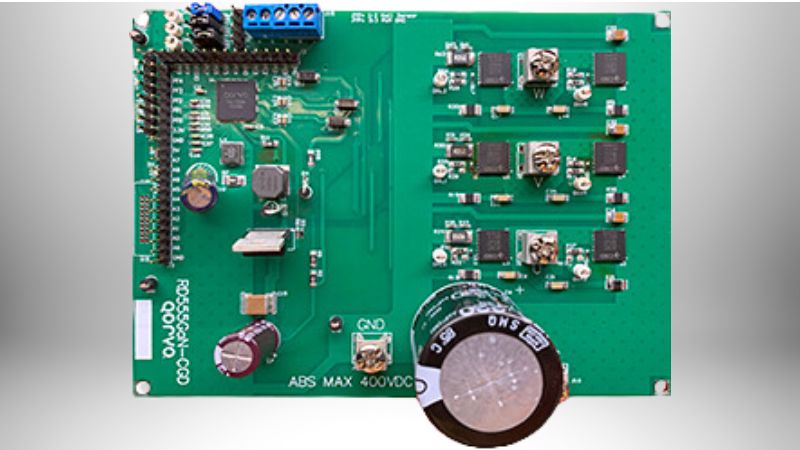
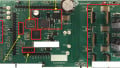
Reference design for PAC5556 CGD. Image used courtesy of Qorvo
In these architectures, the microcontroller is the core processing unit for motor controllers, executing algorithms for precise speed, torque, and position control. It manages electronic commutation, drives MOSFETs, and ensures system protection. The MCU's most notable specifications include high PWM resolution, real-time processing capabilities, integrated peripherals (ADCs, timers, communication interfaces), and sufficient memory for firmware. Low latency and reliability are also needed to ensure smooth motor operation and handle dynamic load changes effectively.
Alongside the MCU, the H-Bridge is made of power MOSFETs arranged in a H-shaped pattern. MOSFETs in an H-bridge motor controller act as high-speed switches, controlling current flow to drive the motor in both directions. Important specifications include low RDS(on) to minimize conduction losses, high current-handling capacity, fast switching speeds to support high PWM frequencies, and robust thermal performance for efficient heat dissipation.
Qorvo and CGD’s Efficient Motor Control Solutions
Qorvo and CGD have developed advanced motor control solutions, namely the PAC5556AEVK and PAC5556AEVK3, by integrating Qorvo's PAC5556A motor controller with CGD's ICeGaN ICs.
The PAC5556A is a high-performance microcontroller incorporating precise commutation and torque control capabilities. The 32-bit microcontroller features inbuilt 600 V gate drivers (low-side and high-side), eliminating the need for external gate drivers. It also incorporates a 12-bit, 2.5 mega samples per second (MSPS) ADC and digital communication interfaces for real-time monitoring parameters.
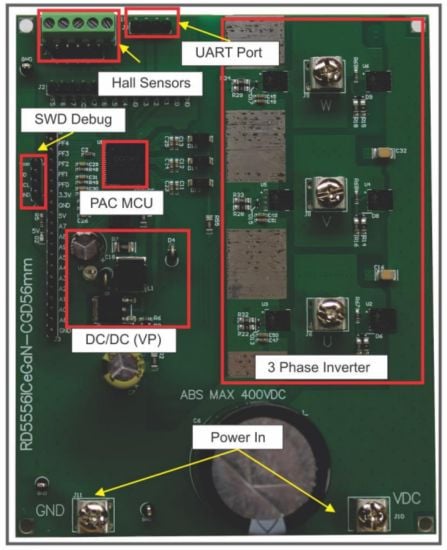
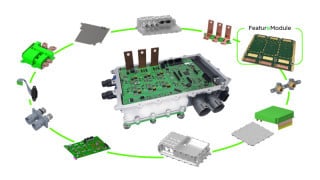
The PAC5556AEVK2 motor controller. Image courtesy of Qorvo
These devices are built using CGD’s ICeGaN P2 ICs, which leverage GaN technology to achieve ultra-low power loss and high switching efficiency. The PAC5556AEVK2 and PAC5556AEVK3 support peak performances of 400 W with 240 mΩ (RDS(on)) and up to 800 W using 55 mΩ (RDS(on)) variants. ICeGaN also incorporates current sense and Miller clamp elements to further reduce the bill of materials.
Future Pathway
By integrating advanced gate technologies with sophisticated microcontrollers, the Qorvo-CGD partnership could help reduce the global energy consumption attributed to motors.