 Facebook
 Google
 GitHub
 Linkedin
Toshiba Intros 3300 V High-Surge SiC MOSFET Module
The IX800FXF2YMS4 is a 3300-V, 800 A dual SiC MOSFET module rated for 300 kA²s surge current, targeting railway traction, renewable energy, and power conversion systems.
Toshiba Electronic Devices & Storage has expanded its iXPLV power module lineup to four parts with the IX800FXF2YMS4, a dual SiC MOSFET module built on the company's third-generation SiC chips.
The module specifies a 300 kA²s I²t limit for its diode section, a 1.4 V typical drain-source on-voltage, and a 175°C channel temperature rating. Toshiba positions the launch around surge current capability, the margin a module needs when fault currents flow through it under abnormal conditions.
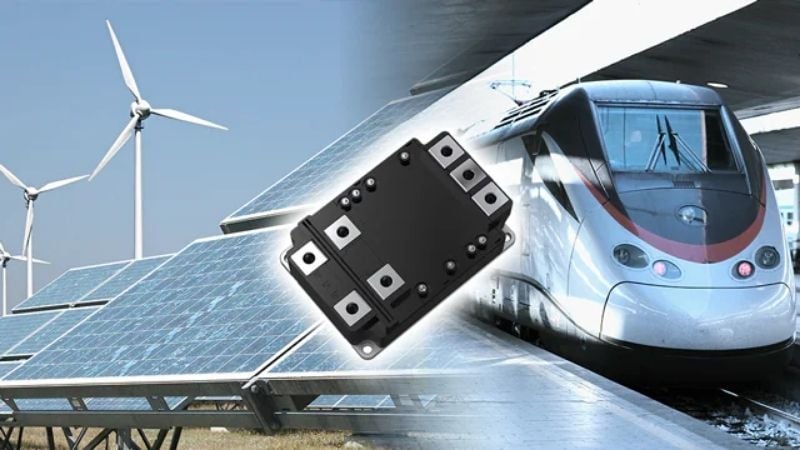
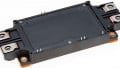
The IX800FXF2YMS4 is designed for wind, solar, and rail traction applications. Image used courtesy of Toshiba
Surge Withstand Under Fault Conditions
Surge current capability describes what a module can absorb when a fault drives current far beyond its continuous rating. Circuit impedance rather than the converter's control loop sets the current in that condition, and the module must carry it until upstream protection clears. The standard figure of merit is I²t, the current-squared-time integral the device can take over a defined pulse, and protection schemes are coordinated against it.
The specification carries particular weight for silicon carbide modules that rely on the MOSFET body diode for reverse conduction. That diode is intrinsic to the MOSFET structure, so the same die area that determines conduction loss sets surge withstand, rather than a diode optimized independently for fault duty.
Toshiba rates the IX800FXF2YMS4's diode section at 300 kA²s on a single 10 ms half-sine pulse, with the gate at -6 V and the channel starting at 175°C rather than room temperature. The hot starting point describes the margin at the top of the thermal range. Pulsed source current is rated at 1600 A.
Losses Set the Cooling Budget
On-state losses in a SiC MOSFET climb steeply with temperature, as carrier mobility falls as the die heats and channel resistance rises with it. At 800 A, drain-source on-voltage is 1.4 V typical at 25°C and 3.8 V at 175°C, a 2.7-fold rise across the operating range. The hot figure is used to size a heatsink, since no traction or grid converter runs at room temperature. That positive temperature coefficient also aids current sharing when modules are paralleled, as the hotter device sheds current to its neighbors.
Turn-on switching loss is 185 mJ and turn-off 175 mJ, measured at 1800 V and 800 A with the channel at 175°C. Against those figures, reverse recovery costs 14 mJ over 70 ns. A SiC body diode stores almost no charge, so the opposing switch in the leg sees little recovery current when it turns on, the effect that dominates turn-on loss in silicon IGBT inverters.
Low switching loss is what buys frequency headroom, since dissipation scales with energy per event times switching frequency, and raising frequency shrinks the filter inductors and transformers that dominate converter volume.
Package Integration and Paralleling
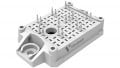
The iXPLV package measures 144 × 99.5 × 40 mm and weighs 840 g, with stray inductance between the P and N terminals held to 12 nH typical. Low package inductance matters for a device switching this hard, since the voltage overshoot at turn-off scales with it. Designers who cannot contain overshoot end up slowing the gate, giving back the switching advantage the SiC die provides.
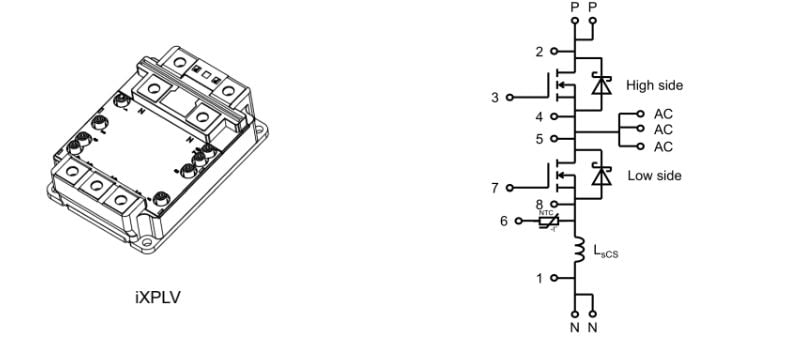
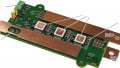
The iXPLV package and the module's internal half-bridge circuit. Image used courtesy of Toshiba
Toshiba uses silver sintering at the die-bond interfaces, which it credits with the 175°C channel-temperature rating. The module integrates an NTC thermistor and a current-sense terminal, eliminating discrete transducers from the converter design, and isolates the electrodes from the metal baseplate at 6000 Vrms. Toshiba describes the package as designed for paralleling, as converters above this current rating are built.
Target Applications
Toshiba lists railway traction inverters, renewable generation, industrial motor drives, and power conversion systems including solid-state transformers, UPS, and energy storage.

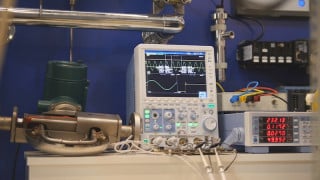
Railway traction system example. Image used courtesy of Toshiba
Full specifications are available in the product datasheet.
Looking Forward
High-power module packaging has consolidated around a small set of standard outlines—Mitsubishi's LV100, Infineon's XHP 2, and Toshiba's iXPLV—and that consolidation shapes how silicon carbide actually reaches traction. Rail converters are built for service lives measured in decades, so operators upgrading them want new semiconductors without new busbars, cooling assemblies, or mechanical qualification.
A shared footprint keeps a device-technology change contained, and it moves the competition inside the outline, where vendors are judged on what the die does rather than on how the module bolts down. Toshiba said it will keep extending its SiC lineup for industrial equipment, which the iXPLV platform is built to absorb.