Facebook
 Google
 GitHub
 Linkedin
Toshiba Introduces 40 V eFuse ICs for Compact Power Protection
The TCKE6-series devices add fast fault response, current limiting, and thermal shutdown in compact TSOP6F packages.
Toshiba has expanded its eFuse portfolio with the TCKE6 series, a group of five 40 V protection ICs for industrial and consumer power systems. The lineup—TCKE601RA, TCKE601RL, TCKE602RM, TCKE603RA, and TCKE603RL—targets equipment that operates on 5 V to 24 V rails, including industrial robots, PLCs, multifunction printers, and compact consumer devices such as robotic cleaners.
The company positions these devices as higher-voltage complements to its existing protection blocks, offering a more complete set of functions for designers moving away from physical fuses.
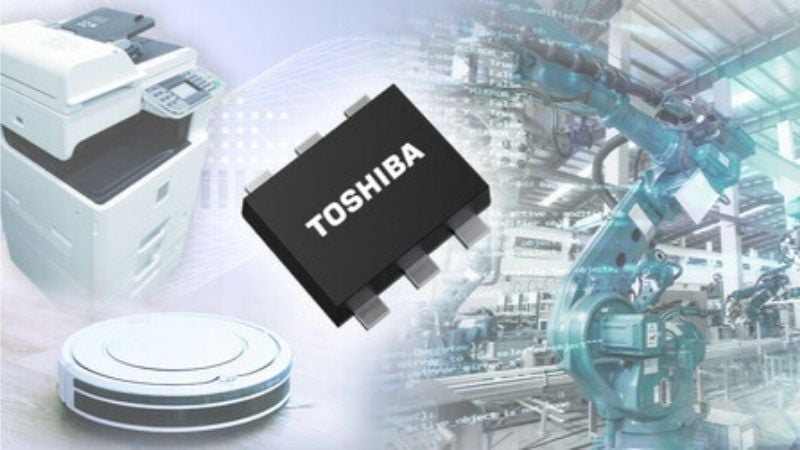
The TCKE6 series. Image used courtesy of Toshiba
A Broader Protection Envelope for Modern Power Rails
Each device in the TCKE6 family integrates multiple protection features into a footprint measuring just 2.9 x 2.8 x 0.8 mm. Short-circuit protection behaves like a traditional fuse at the point of fault, but the IC adds functions that passive fuses cannot provide.
Overcurrent limiting, overvoltage cutoff, and thermal shutdown all operate autonomously once the device is in line with the rail. According to Toshiba, these functions are designed to prevent fault energy from propagating into downstream ICs, which is increasingly important as more compact motors, converters, and digital controllers converge on shared supply paths.
The 40 V rating gives headroom for 24 V industrial rails that experience common transients. The operating range from 4.4 V to 30 V makes the same device usable in low-voltage digital systems as well as higher-voltage electromechanical platforms. On-resistance is 52 megaohms typical at 1 A with a maximum of 90 megaohms, which reduces heat generation during continuous operation. These numbers matter for high-density modules and enclosed housings where thermal budgets limit the use of discrete MOSFET-based protection stages.
Functional Variants for System-Level Control
Toshiba is offering the TCKE6 devices in several control and recovery configurations. Two versions include a FLAG output that asserts during abnormal conditions, while two more provide an EN pin so a host controller can manage when the eFuse is active. One device omits both FLAG and EN but allows designers to choose between auto-retry and latched recovery through an external mode input.
These recovery types define how the system behaves once a fault clears:
- Auto-retry devices restore output automatically after conditions return to normal.
- Latched devices hold the output off until a reset or enable pulse is issued.
This flexibility helps match the protection behavior to the application. A robot controller with rigid safety requirements may use a latched device to enforce manual verification after a fault event. A compact consumer appliance may favor auto-retry to resume operation without user involvement.
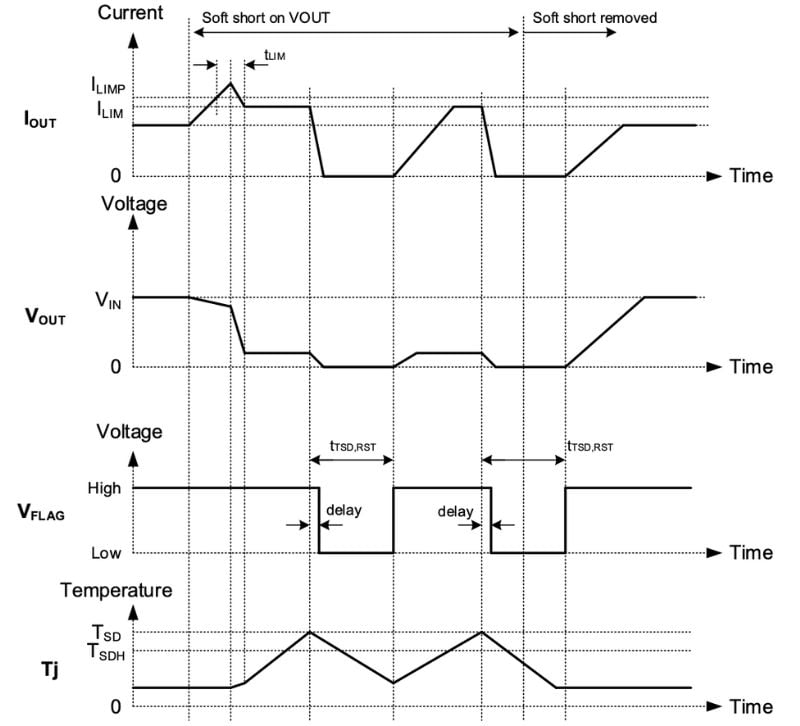
Timing chart for auto-retry type, overcurrent protection operation. Image used courtesy of Toshiba
The TCKE6 series supports output currents up to 2.5 A, covering both digital loads and moderate electromechanical subsystems.
Implementation in Space-Constrained Designs
Distributed protection is becoming common in industrial and commercial designs. Instead of a single upstream fuse feeding multiple blocks, engineers increasingly place localized protection near the point of load. This approach limits the extent of a fault and reduces the current path length feeding it.
The TCKE6’s small TSOP6F package supports that trend, particularly in motorized equipment and modular I/O designs where PCB space is shared among sensors, converters, and actuators.
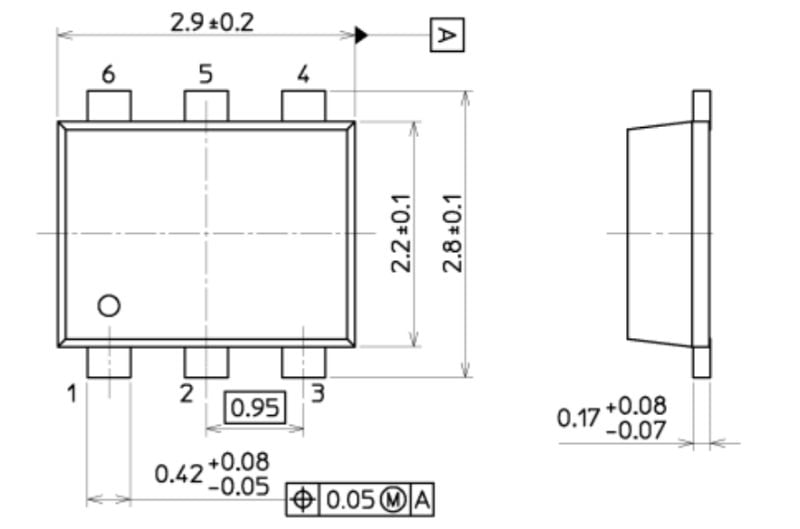
TSOP6F outline drawing. Image used courtesy of Toshiba
Slew-rate control and the ability to clamp faults in microseconds also help with downstream design validation. Sensitive microcontrollers, FPGAs, and communication interfaces often specify strict limits on rail rise times and overvoltage conditions. Integrating an eFuse ahead of those devices simplifies compliance without adding a collection of discrete comparators, pass elements, and thermal cutouts.
In consumer designs, the benefits center on size and simplified maintenance. A robotic vacuum or compact appliance that uses an eFuse can avoid non-serviceable fuses or user-replaceable components, while still preventing catastrophic faults that originate in motors or charging circuits.
Toshiba states that it will continue expanding its eFuse portfolio to address more application classes. The company’s focus on integrating multiple protection behaviors into a single device reflects a shift away from fixed-function analog components.
Physical fuses, while simple and predictable, offer no current limiting or thermal supervision and must be replaced after a fault. Meanwhile, eFuses recover automatically or through software, reduce the number of components around the rail, and offer deterministic behavior across temperature.