Facebook
 Google
 GitHub
 Linkedin
The Advancement of DIN Rail PSUs for Modern Industrial Automation
Modern power supplies must be small, powerful, and compliant, delivering high performance in the tightest of spaces.
Industrial automation systems are continuously evolving to improve optimization and performance. These developments have increased the need for more compact, space-efficient components that can deliver higher functionality. As a result, a critical challenge has emerged: the available space within electrical control cabinets is shrinking, while the demand for stable and continuous DC power is escalating.
DIN rail-mounted power supply units (PSUs) are the default method for installing power equipment to supply stable DC power to components such as sensors, actuators, programmable logic controllers (PLCs), motors, solenoids, relays, and robotics. These emerging complex design requirements mean DIN rail-mounted PSUs must conform to increasingly narrow form factors while remaining power-dense and highly proficient in dissipating excess heat.
Meeting the Demands of Space-Limited Robotic Systems
DIN-rail mounted PSUs often encounter industrial applications that require high power densities in limited control cabinet spaces, such as industrial automation applications with robotic arms, selective compliance assembly robot arms (SCARA), and other warehouse robots. Robotics typically requires higher power densities to drive DC motors for high-torque actuation. To optimize power consumption, industrial automation facilities must carefully consider the number, layout, and positioning of robots in their floor planning.
Smaller industrial enclosures and cabinets are utilized to reduce automation footprint and maximize floor space (Figure 1). There are other components to consider in the space’s design aside from PSUs, such as:
- PLCs
- Motor starters
- Relays
- Human-machine interfaces (HMIs)
- Circuit protection equipment
- Circuit breakers
These additional devices emphasize the need for PSUs that optimize limited cabinet space and maintain reliable performance across wide temperature ranges, with minimal derating at elevated temperatures.
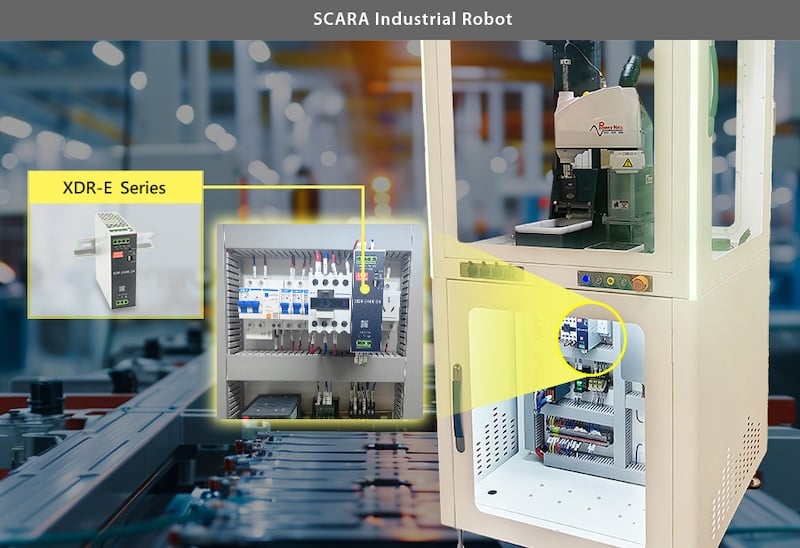
Figure 1. Industrial cabinets often fit within narrower dimensions to consume less floor space or to better fit within an allotted spot in an industrial facility. Image used courtesy of Meanwell
Industrial Power Supply Selection: Key Considerations
Ease of Integration
Industrial control and automation facilities must abide by strict regulations and functional safety requirements to protect personnel and surrounding equipment. Selecting off-the-shelf PSUs that meet the regional safety standards described in Table 1 helps ensure that your systems are safe for operators and prevent damage to equipment. This can reduce the time required for developing and validating new systems.
Table 1. Regional safety requirements for electrical equipment.
| Region | Safety standard | Description |
| North America, Europe, and Asia | UL61010 | Standard for Safety Requirements for Electrical Equipment For Measurement, Control, and Laboratory Use |
| EU | TUV BS EN/EN62368-1, BS EN/EN61558-1/-2-16, BS EN/EN61010 | Safety Standard for information and communication technology (ICT) and audio/video (AV) equipment |
| North America | CB IEC62368-1, IEC61558-1, IEC61010 | Hazard-based product-safety standard for ICT and AV equipment |
| Australian and New Zealand | RCM AS/NZS 62368-1, AS/NZS 61558-1/-2-16 | Safety standard for AV and ICT equipment |
| Taiwan | BSMI CNS15598-1 | For AV Equipment and IT Products |
| China | CCC GB4943.1 | For AV Equipment and IT Products |
| Russia | EAC TPTC004 | Regulation of the Customs Union of the Russian Federation on Low Voltage Products |
| Korea | KC KC62368-1 | Hazard-based product-safety standard for ICT and AV equipment |
| India | BIS IS13252 | Information Technology Equipment -Safety |
The IEC 62368-1 safety standard, for example, uses a Hazard-Based Safety Engineering (HBSE) approach to identify potential hazardous energy sources that could transfer damaging energy to a user and implement precautionary measures, such as insulation with proper creepage and clearance distances, to mitigate this risk.
International and regional EMC standards such as CISPR 32, EN61000, and EN55032 are critical aspects of PSU operability. A PSU that does not pass radiated and conducted emissions and susceptibility testing cannot be integrated within an industrial system. Ensuring an AC/DC PSU’s global applicability is essential; however, this also requires a compatible input AC voltage range that aligns with the mains power in various regions (Figure 2).

Figure 2. Standard mains voltage and frequency used globally. Image used courtesy of electricaltechnology.org
Reliability
While some of the described standards only include EMC emissions, EMC immunity, safety extra-low voltage (SELV), withstand voltage, and isolation resistance testing, others also require compliance with stress tests such as vibration and high altitudes. Equipment malfunctions can precipitate unwanted downtime, resulting in significant financial burdens for industrial enterprises. These regulatory factors assure the customer that the PSU can withstand environmental strain and maintain the standard operational lifetime.
Safeguard features such as short circuit, overload, overvoltage, and over-temperature protections also help extend the PSU’s lifetime. These functions activate during a transient surge to prevent damage or a fire. They then provide automatic recovery after the fault condition clears, eliminating the involvement of maintenance personnel.
XDR and XTR PSUs: Compact, High-Performance Solutions
Jameco, a leading distributor of electronic components and power supplies, provides the Meanwell XDR and XTR PSUs to address space constraints and deliver optimal efficiency. Meanwell, a major global manufacturer of power supplies, designs the XDR and XTR PSUs to meet all the certifications in Table 1, ensuring high reliability for industrial automation systems worldwide. The XDR and XTR feature power density improvements over previous generations of single-phase (1Ø) and three-phase (3Ø) PSUs.
XDR and XDR-E
The single-phase (1Ø) XDR and XDR-E PSU series shown in Figure 3 combines high performance with an ultra-slim 30 mm form factor and supports a wide input voltage range of 85–264 VAC. This makes them suitable for global mains power. The XDR-E offers a cost-effective alternative to the high-reliability XDR, with a slightly narrower input range but fewer advanced features such as DC OK relay contact, remote control, ORing FET, and extended certifications. The XDR series delivers power densities from 75 W to 960 W in a space-saving design, up to 45% smaller than previous models. The series also maintains up to 91% efficiency and less than 1 W of no-load power consumption. A built-in parallel function allows scalability up to 3.84 kW.
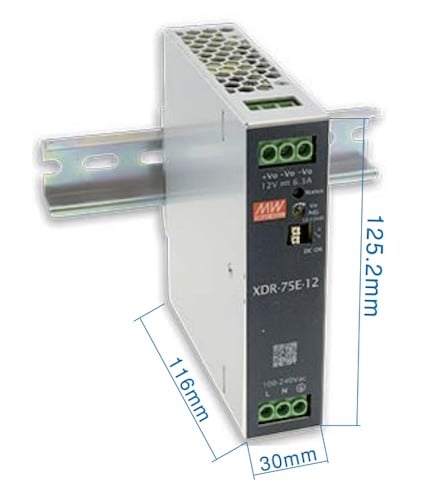
Figure 3. Meanwell XDR DIN-rail mounted power supply unit. Image used courtesy of Meanwell
XTR
The three-phase XTR PSU shown in Figure 4 has been improved over the older TDR generation and is narrowed down to a 48 mm width. The XTR PSU allows for current sharing of up to 960 W of power in a 3+1 configuration. This power supply has a maximum efficiency of 93.5% and a standby power consumption of less than 2.5 W for energy savings and carbon reduction.

Figure 4. Meanwell XTR DIN-rail mounted power supply unit. Image used courtesy of Meanwell
Powering the Future of Industrial Applications with Advanced PSUs
Industrial PSUs must ensure reliability and safety under regional standards while maximizing power density to optimize control cabinet space. The XTR and XDR series of PSUs address these requirements, offering global certifications and advancements in both space savings and efficiency. Jameco is a leading electronic parts distributor that offers a wide-ranging selection of in-stock products at competitive prices. For more information, please visit Jameco.com.