Facebook
 Google
 GitHub
 Linkedin
Toshiba Adds Zener Diode Series for Better Circuit Reliability
The CMXBxxA Zener diode lineup also cuts leakage and simplifies upgrades for power line protection.
Voltage surges are a quiet threat in any design, especially when they last longer than a quick transient. Surges, switching noise, and slow overvoltage pulses can quietly wear down a system over time.
Toshiba Electronics Europe GmbH has introduced 15 devices in its CMZBxxA series, designed to protect semiconductor power lines from both transient and long-duration voltage spikes. These diodes use a planar structure that replaces a phased-out older mesa-style design.
These CMZBxxA Zener diodes aim to keep that from happening by clamping voltage spikes before they cause trouble. With Toshiba’s refined planar structure and improved leakage control, the CMZBxxA diode series could bring extra reliability to the parts of a circuit that rarely get the attention that's deserved.

The CMZBxxA series is Toshiba’s new Zener diode line that features 15 new devices. Image used courtesy of Toshiba
Planar Structure for Better Consistency
In conventional Zener structures, small variations can appear in the diffusion process, which can shift breakdown voltage and widen device tolerances. With the CMZBxxA series' planar construction, an oxide layer passivates the PN junction, stabilizing the electric field at the junction edge, reducing leakage current and improving voltage precision.
Toshiba’s dies will have a tighter ±5% Zener voltage tolerance, down from ±10%, which may give them an advantage with a more predictable clamp behavior that can enable simplified voltage margining in these circuits.
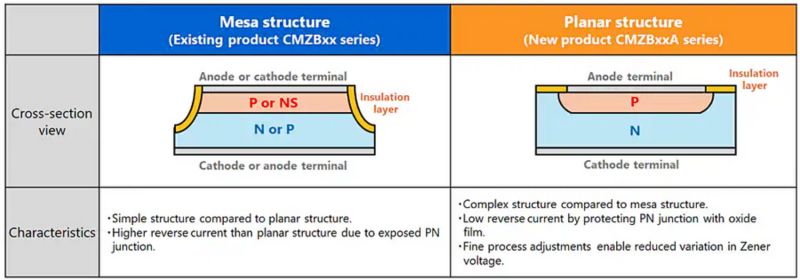
The old CMZBxx series structure vs. the CMZBxxA series planar style structure. Image used courtesy of Toshiba
By shielding the junction, the diodes can also resist environmental stress and contamination that can degrade performance over time, making them more ideal for demanding environments such as industrial control equipment, test systems, or consumer power supplies that operate continuously.
Improved Efficiency and Drop-In Compatibility
Reverse leakage is an overlooked factor in power line design. Toshiba’s CMZBxxA series reduces reverse current from 10 µA to just 0.5 µA at maximum ratings. The reduction helps minimize standby losses in systems where these diodes remain permanently connected to power rails. Lower leakage also means less heat generation and a lower cumulative power burden across the board.
The CMZBxxA devices share the same M-FLAT package dimensions2.4 by 4.7 by 0.98 millimeters, allowing designers to swap them into existing layouts without touching the PCB. This eases the transition for manufacturers already using Toshiba’s diodes in legacy platforms.
Protection Across a Broad Voltage Range
The CMZBxxA family covers Zener voltages from 12 to 51 V, giving engineers flexibility for protecting common power rails. The series also handles both short transients and long surges lasting several milliseconds. That capability bridges a gap where ESD diodes typically fall short, allowing the devices to defend circuits against switching surges close to direct current in behavior.

The CMZBxxA series provides surge and overvoltage protection closer to DC faults. Image used courtesy of Toshiba
These diodes may be suitable where consistent voltage regulation and long-term reliability are essential, such as power supply modules, control boards, industrial automation equipment, and electronics that experience repetitive switching noise.
Focused on Simplifying Design and Reducing Power Loss
Combining tighter voltage precision, low leakage, and easy replacement means the CMZBxxA series improves reliability and simplifies design. Engineers can build powerline circuits with narrower voltage margins, reducing calibration effort and lowering total power draw without changing board layouts. It’s a small update with meaningful downstream benefits, essentially less energy wasted and longer component lifespans.
By transitioning to a planar structure, Toshiba’s CMZBxxA diodes combine lower leakage, tighter voltage control, and compatibility with existing designs. The improvements simplify circuit calibration while reducing standby losses across power rails. It’s a quiet improvement, but one that directly enhances power integrity and equipment lifespan.