Facebook
 Google
 GitHub
 Linkedin
TDK Adds High-Current Inrush Limiters for High-Power Systems
The S30 and S36 NTC thermistors target large power supplies, inverters, and motor drives with ratings up to 35 A and 750 J.
High-power AC-DC and DC-DC systems face a chronic challenge when first connected to the line. Bulk capacitors charge from zero volts, transformers saturate, motor windings act as near-shorts, and rectifiers see peak currents several times higher than their steady-state ratings. If nothing is in place to manage those surges, designers run into nuisance fuse trips, overstressed diodes, and mechanical relays that wear out long before the end of a product’s lifecycle.
TDK developed its S30 and S36 thermistors to fill a gap for equipment that needs a simpler soft-start strategy without the board space, wiring, and timing circuitry associated with traditional resistor-and-relay schemes. The S30 parts reach continuous current ratings between 10 A and 30 A, while the larger S36 units step up to 35 A with energy absorption capability as high as 750 J.
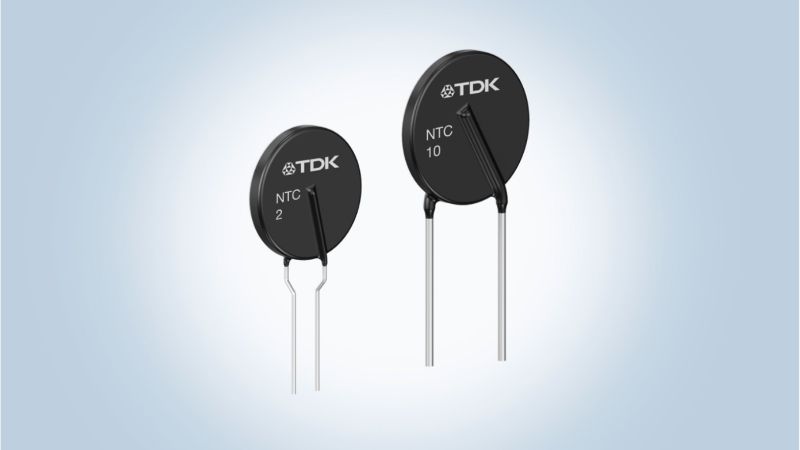
S series inrush current limiters. Image used courtesy of TDK
Extending NTC Soft-Start Into Higher Power Classes
The appeal of NTC inrush limiters is their simplicity. A single thermistor in series with the AC input is often enough to limit the initial charging current into a bulk capacitor bank. As the device warms from that current, its resistance falls sharply, leaving only a small voltage drop during steady operation.
For many power supplies under a kilowatt, this remains the most economical soft-start option. The challenge has been scaling that approach to larger systems where inrush energy is higher, and the operating current would overheat conventional NTC elements.
TDK’s S30 and S36 families push the NTC approach into operating regions where designers would normally default to an active circuit. The S30 series offers nominal resistances from 2 ohms to 20 ohms at room temperature and power handling up to 19 W, depending on part selection. The S36 expands that envelope with up to 35 A continuous current capability and power dissipation ratings reaching 25 W. Both sets can handle high single-pulse energy loads during startup, with the S36 series topping out at 750 J.
A wide operating temperature range of -55°C to 170°C and a climatic category of 55/170/21 help the devices fit into industrial and renewable energy installations, where ambient conditions vary significantly across enclosures, rooftops, and plant-floor equipment. The thermistors also use flame-retardant coatings rated to UL 94 V-0 to support safety certification across common designs.
Application Guidance for High-Power Supplies and Inverters
Selecting an NTC inrush limiter involves more than matching the steady-state current rating. The first step is determining the energy that the thermistor must absorb at turn-on, which depends on the capacitance and the voltage it must charge. TDK’s datasheets specify maximum permissible energy for a single pulse, giving designers a first screening check before moving to thermal and electrical modeling.
From there, designers size the resistance value to shape the inrush current profile while maintaining an acceptable voltage drop once the system has warmed the thermistor to its low-resistance region. The S30 and S36 parts support this process with multiple R25 options, allowing engineers to set the balance between initial surge limiting and warm operating loss. In systems where efficiency matters, that loss can be mitigated by placing the thermistor ahead of a PFC stage or using it only for cold starts.
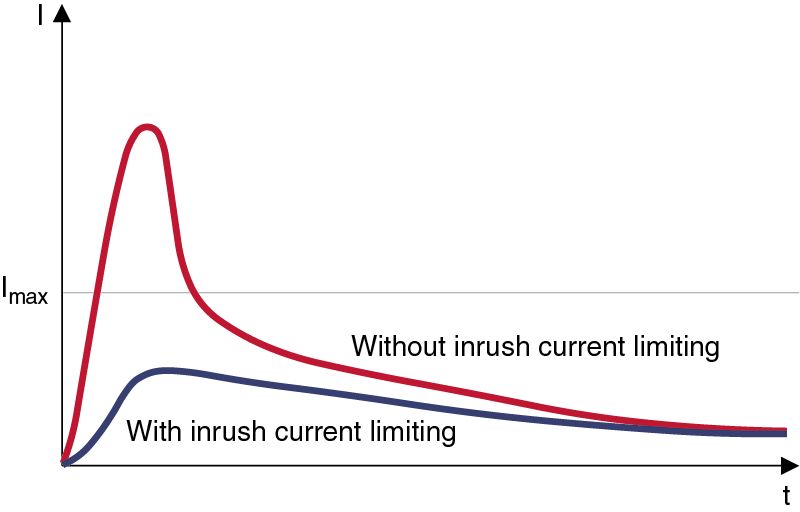
Inrush current limitation prevents the current from exceeding the critical level. Image used courtesy of TDK
The thermal performance of an NTC limiter is tied closely to its placement and cooling path. Both the S30 and S36 use radial leads designed for through-hole mounting, which improves heat transfer into large copper areas on the PCB. Designs that mount the device near airflow paths or onto thermally conductive planes can further improve recovery behavior during repetitive on-off cycles.
In systems that start and stop frequently, designers may need to review whether the thermistor can cool sufficiently between starts. If not, a bypass relay or dedicated active soft-start circuit may still be the better choice. For equipment that powers up only a few times each day, however, a high-rating NTC can be the lowest-complexity solution.
By extending the current and energy ratings of NTC limiters, TDK has created an option for systems that sit between hobby-scale power supplies and fully engineered soft-start platforms. Industrial equipment, PV inverters, and UPS units often need durable surge control but do not always justify the overhead of a relay-based approach.
The S30 and S36 series were built to serve this middle tier of applications where startup robustness, long operating life, and reduced component count matter as much as raw efficiency. TDK’s release highlights that the NTC approach can scale farther than earlier devices suggested, provided the material system and mechanical format are robust enough for sustained industrial use.