Facebook
 Google
 GitHub
 Linkedin
STMicroelectronics Launches Dual GaN Half-Bridge Gate Drivers
The STDRIVEG212 and STDRIVEG612 bring fast switching and smart shutdown to motion control and power conversion applications.
STMicroelectronics has released two high-speed half-bridge gate drivers for GaN HEMTs, designed to improve thermal performance and enable miniaturization across a range of power and motion-control applications.
The STDRIVEG212 and STDRIVEG612 deliver tightly controlled 5 V gate-drive signals across voltage ranges of up to 220 V and 600 V, respectively. The gate drivers integrate protection and regulation features that previously required external circuitry.
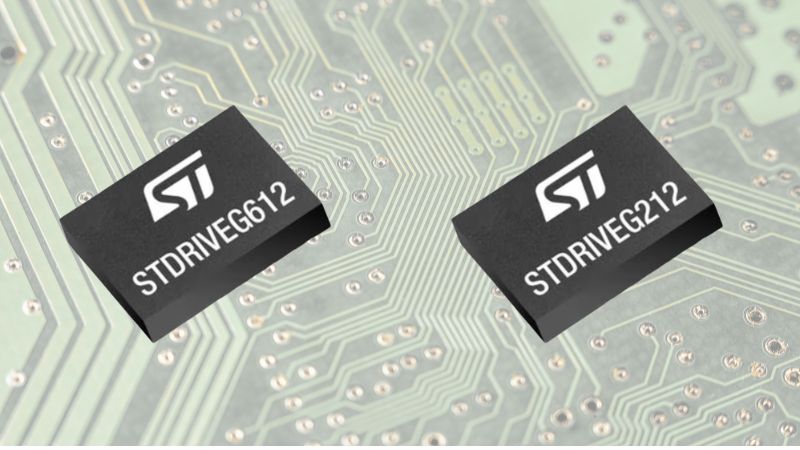
The GaN HEMT gate drivers. Image used courtesy of STMicroelectronics
Speed and Integration at the Core
Both drivers achieve 50 ns propagation delay, with closely matched performance between high-side and low-side channels. In half-bridge topologies, asymmetric propagation can cause cross-conduction spikes and increase electromagnetic interference. Matched timing within the driver IC allows designers to tighten dead-time margins and extract more usable switching frequency from the GaN devices.
The high-side channel reaches full operating voltage in five microseconds, avoiding the multi-millisecond delays typical of bootstrap-based designs with slower charge-pump recovery in motor-drive applications.
Meanwhile, integration substantially reduces the bill of materials, and on-chip features include high-side and low-side 5 V LDOs, a high-side bootstrap diode, and a fast-startup voltage regulator that stabilizes the driver's output-stage supply.
GaN HEMTs require precise 5 V gate drive to avoid threshold voltage violations that degrade reliability. Unlike silicon MOSFETs, which tolerate gate-voltage variation over a wider window, enhancement-mode GaN devices operate within a narrow gate-voltage margin. The integrated LDOs in both drivers maintain regulation accuracy across load transients and temperature, reducing the risk of gate overvoltage that can cause permanent device degradation.
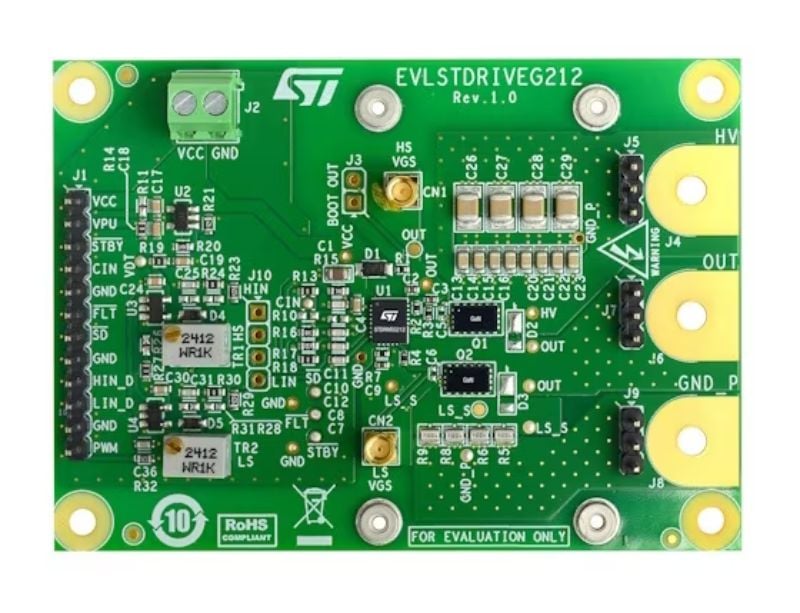
Evaluation board. Image used courtesy of STMicroelectronics
The dV/dt transient immunity rating of +/-200 V/ns provides margin against switching transients in hard-switched topologies, where rapid voltage changes across the devices can couple into high-impedance nodes and trigger false switching events. This rating exceeds the requirements of most 100 kHz to 500 kHz power-conversion and motor-drive designs.
Protection Built In
An embedded comparator detects overcurrent by monitoring a sense signal and turns off both gate drivers in response. This coordinated shutdown prevents shoot-through and limits peak fault current. The same protection path feeds the fault output pin, along with overtemperature and undervoltage lockout status.
Smart shutdown, meanwhile, automatically holds both switches off when a fault is detected, allowing the power devices to cool down before normal operation resumes. The hold-off period is managed internally, removing the need for external timers or microcontroller-based fault-recovery logic. Once conditions return to safe levels, the driver releases the shutdown state and allows normal switching to resume.
The fault pin consolidates all protection statuses into a single output, simplifying system-level monitoring. Engineers can route the fault output to a microcontroller or safety interlock without polling multiple status registers or interpreting complex fault hierarchies. Both devices protect the industrial temperature range of -40°C to 125°C and carry industrial-grade qualification, supporting deployment in factory automation, robotic motor drives, and electric vehicle auxiliary power systems.
Packaging, Pricing, and Availability
Both drivers ship in a 4 mm x 5 mm QFN package, keeping PCB footprint minimal in space-constrained applications like motor drives and battery chargers.
An evaluation board, EVLSTDRIVEG212, is also available for rapid prototyping. The board pairs the STDRIVEG212 driver with a GaN half-bridge power stage, allowing engineers to evaluate switching performance, thermal behavior, and protection response before committing to a custom PCB layout.
Target applications include servo motor drives, brushless DC motor controllers, LLC resonant converters, and totem-pole power factor correction stages. These topologies share a common requirement of fast, clean switching with minimal dead time and robust fault handling. The STDRIVEG212 and STDRIVEG612 address that requirement with a single IC, reducing board area and component count compared to discrete gate-drive designs built from individual bootstrap diodes, regulators, and protection circuits.