Facebook
 Google
 GitHub
 Linkedin
SiC Modules Pack More Power into the TO-247 Package
Rohm’s DOT-247 SiC module combines two devices in one package, raising power density and cutting board size for inverters, UPS, and EV systems.
Every generation of solar inverters, UPS units, and electric vehicle chargers seems to demand higher voltage handling and greater efficiency. Yet, engineers are still stuck trying to fit it all into enclosures that are already full. More often than not, the tradeoff comes down to space versus performance.
Rohm may have cracked that dilemma with its new DOT-247 family of silicon carbide (SiC) molded modules. The package combines two TO-247 devices into one, allowing engineers to design half-bridge or common-source circuits that deliver more power without demanding extra board area. For industries chasing compact layouts, the DOT-247 is meant to squeeze twice the performance into the same space.
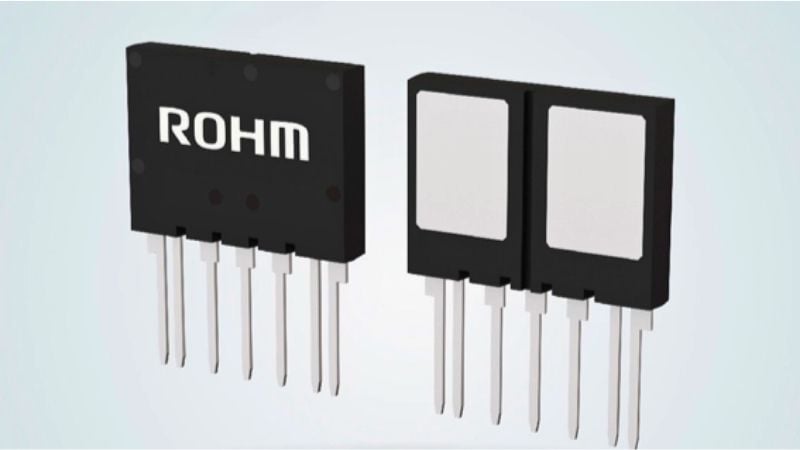
DOT-247 module delivers higher power density in less space. Image used courtesy of Rohm
Making Room for Bigger Chips
The secret is structural. Standard TO-247 packages limit chip size and, therefore, current handling. By molding two devices into a single body, Rohm creates space for larger chips with lower on-resistance. Internal refinements cut thermal resistance by about 15% and reduce inductance by nearly 50%. In practice, that means the same circuit can run at more than double the density, 2.3 times higher by Rohm’s own data, without expanding its footprint.
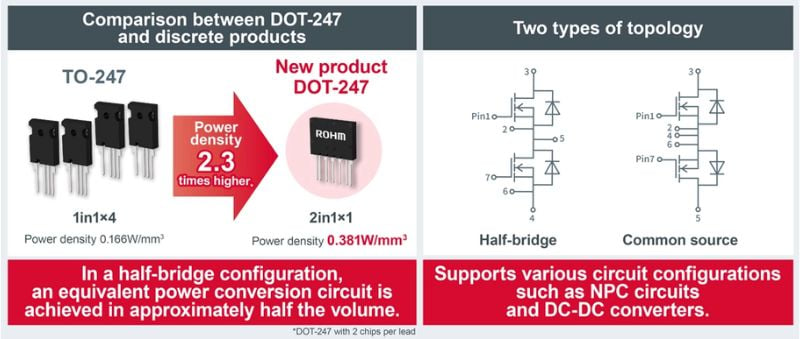
The TO-247 supports Half-bridge and common-source topologies. Image used courtesy of Rohm
That flexibility is increasingly important as power electronics move away from simple two-level switching. Solar inverters are also adopting three-level NPC and five-level ANPC designs to meet grid code requirements. These architectures often require mixing different switching topologies, which historically meant costly custom modules. By offering half-bridge and common-source versions in the DOT-247, Rohm provides ready-made building blocks for multi-level inverters, DC-DC converters, and protective eFuse circuits in AI servers.
Tools and Reliability
To speed up adoption, the company is releasing a series of support tools alongside the hardware. Evaluation kits for double-pulse testing are already shipping. Three-phase inverter boards and reference designs are also expected to begin shipping before the end of the year. Engineers will also have access to simulation models, thermal design data, and in-house motor testing setups. Together, these resources are designed to reduce the time between concept and validated prototype.
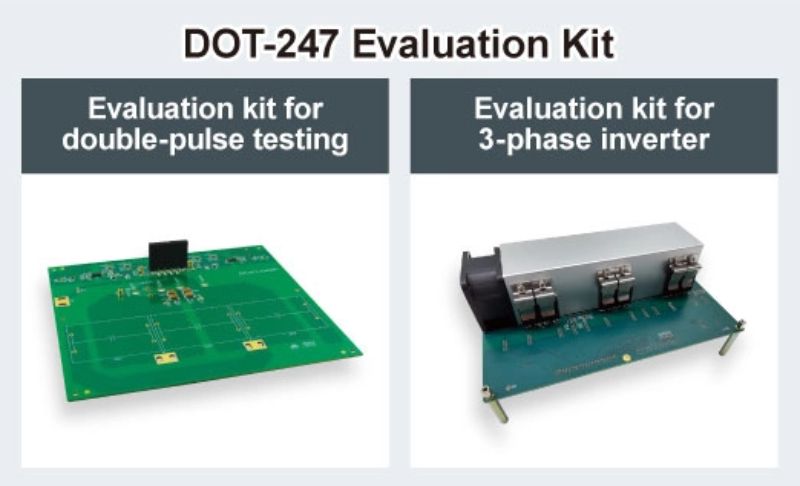
Rohm provides evaluation kits to help speed up the adoption of their devices. Image used courtesy of Rohm
Automotive reliability is also in focus. Several DOT-247 devices under development are being qualified to the AEC-Q101 standard, which sets the bar for discrete semiconductors in fuel cell vehicles and other high-voltage systems. ROHM expects to start sample shipments of the qualified versions in October.
The DOT-247 could replace multiple discrete components while reducing the overall mounting area. For many projects, fewer parts and smaller circuits mean savings in assembly, thermal management, and long-term reliability.
For engineers trying to push more power into shrinking enclosures, the DOT-247 offers a practical path forward. It brings two topologies into a single molded package, trims down wasted space, and comes with support tools that make integration easier. In the ongoing struggle between performance and size, Rohm’s latest module might tip the balance.