Facebook
 Google
 GitHub
 Linkedin
Rohde & Schwarz Multimeters Offer Improved Precision and Usability
Rodhe & Schwarz’s new multimeters address voltage ranges from 1000 V DC to 750 V AC and combine high-resolution measurements with enhanced features.
Rohde & Schwarz has released the R&S UDS digital multimeter series to replace the legacy R&S HMC8012 with improved measurement precision and user experience. Available in 5.5-digit and 6.5-digit models, the UDS series introduces upgraded features such as a large, multi-measurement display, enhanced remote interfacing, and statistical analysis functions. Voltage ranges extend up to 1000 V DC and 750 V AC with a current capacity of 10 A.
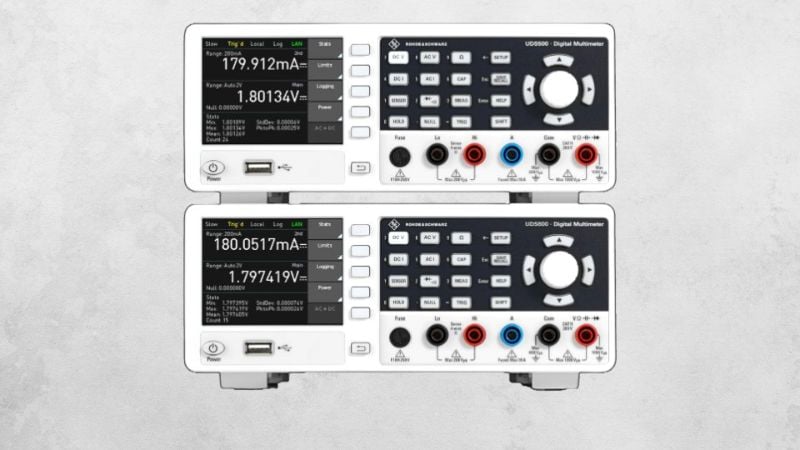
The R&S UDS digital multimeters. Image used courtesy of Rhode & Schwarz
The R&S UDS Series
The R&S UDS family comprises four models: the UDS500 and UDS600, each with optional GPIB variants designated UDS500-G and UDS600-G. The UDS600 features 6.5-digit resolution and a basic DC accuracy of 0.0075%, while the 5.5-digit UDS500 offers 0.015% accuracy. Both models support a maximum reading rate of 200 measurements per second and span signal acquisition ranges from DC to 100 kHz.
The multimeters can simultaneously display up to three measurement values on a 3.5-inch QVGA color screen so that users can monitor DC voltage, AC current, and statistical metrics in parallel. Supported measurement functions include DC and AC voltage/current, true RMS, frequency, resistance (two- and four-wire), capacitance, temperature (via PT100/PT500/PT1000 sensors), diode testing, and continuity checks. Minimum resolutions reach 100 nV for voltage, 10 nA for current, 0.1 mΩ for resistance, and 0.1 pF for capacitance.
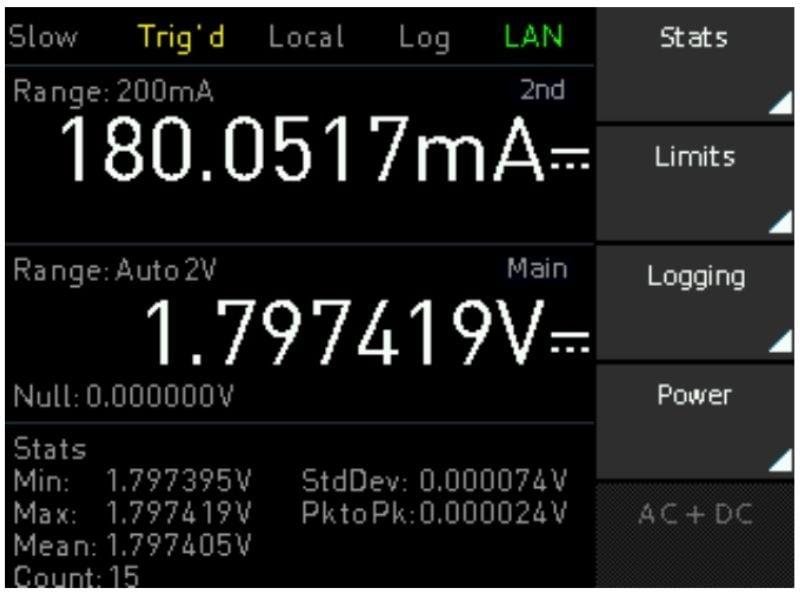
Display screen. Image used courtesy of Rohde & Schwarz
Mathematical and statistical operations (e.g., min/max, average, standard deviation, dB, dBm, and offset) are accessible via a dedicated soft menu. The instruments also support programmable limit testing. When a measurement exceeds set bounds, the display highlights the anomaly in red, with an optional error tone as auditory feedback.
Other notable features include auto-ranging and the ability to save and recall instrument settings and log data via USB drives or remote transfer through USB and LAN interfaces. All models adhere to SCPI command protocols, and drivers are provided for LabVIEW, LabWindows/CVI, and IVI.net environments.
Four-Wire Sensing for Precision Measurement
Four-wire sensing, also known as Kelvin sensing, is a fundamental technique used to improve measurement accuracy in applications where low resistance values are involved.
In a two-wire configuration, the same pair of leads carries both the stimulus current and the measurement signal. As a result, any resistance in the test leads or connections adds directly to the value being measured. This can be particularly problematic in power electronics, where accurate characterization of components such as shunt resistors, PCB traces, or connector paths is needed for current sense validation and power loss analysis.
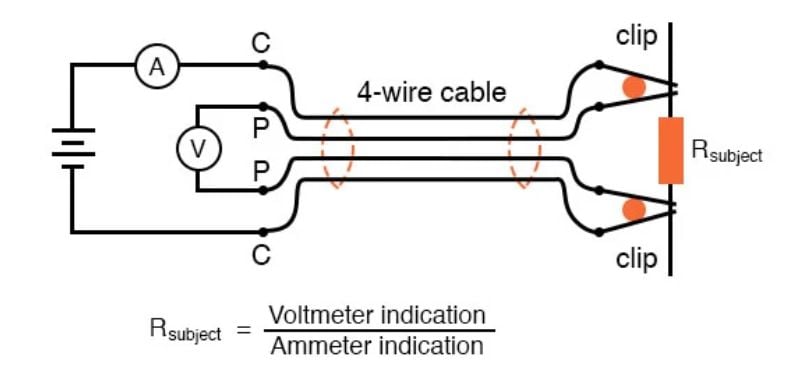
Four-wire sensing setup. Image used courtesy of All About Circuits
Four-wire sensing solves the problem by separating the current-carrying and voltage-sensing paths. A pair of force leads delivers the test current to the device under test (DUT), while a separate pair of sense leads measures the voltage directly across the DUT. Because the sense leads draw negligible current, voltage drops across them are insignificant, guaranteeing the voltage measured reflects only the DUT's resistance, not the resistance of the leads. It also enables more accurate temperature coefficient assessments, as the DUT’s resistance can be isolated from environmental or fixture-related variables.
A Forward-Thinking Test Instrument
Electronics continue to grow in complexity and precision, and test instruments must evolve in tandem. Rohde & Schwarz is answering this call with improvements in resolution and accuracy, along with a reimagined user experience to support both manual bench work and automated production testing. By incorporating a wider set of measurement capabilities, statistical tools, and flexible remote interfaces, the R&S UDS digital multimeters may be a great solution for the test engineer.