Facebook
 Google
 GitHub
 Linkedin
Rohm Introduces 500 mA Nano Cap LDOs for 12 V and 24 V Rails
The BD9xxN5 Series supports sub-1 µF output capacitors across automotive, industrial, and infrastructure designs.
Rohm has expanded its Nano Cap linear regulator portfolio with the BD9xxN5 Series, a family of 500 mA LDO regulators designed for 12 V and 24 V primary power rails in automotive, industrial, and communications infrastructure equipment. First announced on January 27, the devices are designed for applications requiring high input-voltage tolerance and stable operation with small ceramic output capacitors.
The BD9xxN5 lineup comprises 18 AEC-Q100-qualified devices, spanning fixed 3.3 V and 5.0 V outputs as well as adjustable versions, with multiple package and enable-pin variants.
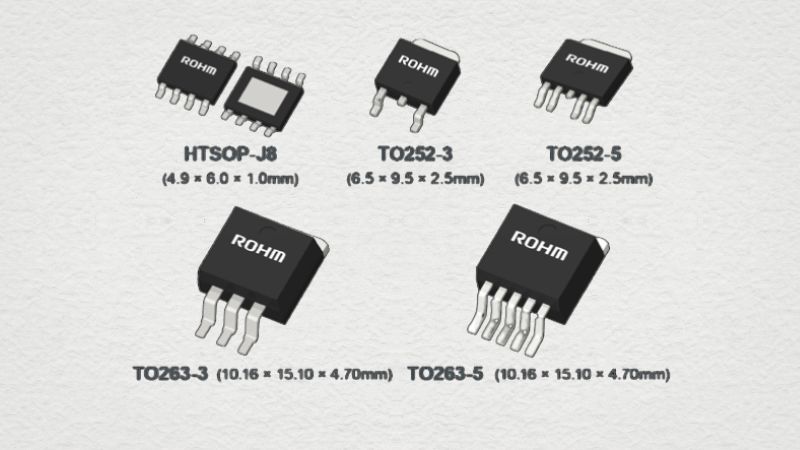
The BD9xxN5 series. Image used courtesy of Rohm
High-Voltage LDOs With Reduced Output Capacitance
Most notable with the BD9xxN5 series is stable operation with ultra-small output capacitors, enabled by Rohm’s proprietary Nano Cap control technology. ROHM stated that the new series offers stable regulation with an output capacitor of 470 nF, using ceramic capacitors, even under fast transient load conditions.
ROHM demonstrated the transient response with an example load step from 1 mA to 500 mA in 1 µs, reporting output voltage variation of approximately 250 mV under those conditions with the stated capacitance. The devices are compatible with 0603M ceramic capacitors, reflecting the intent to support dense layouts in applications with restricted board area and/or component height.
The BD9xxN5 devices are intended for direct connection to higher-voltage rails, with Rohm’s datasheet specifications listing an operating input voltage range of 3 V to 42 V, with an absolute maximum rating of 45 V. This aligns with the voltages of automotive battery environments and industrial supply rails that may experience transients. Meanwhile, maximum output current is rated at 500 mA, with output voltage accuracy specified at +/-2%.
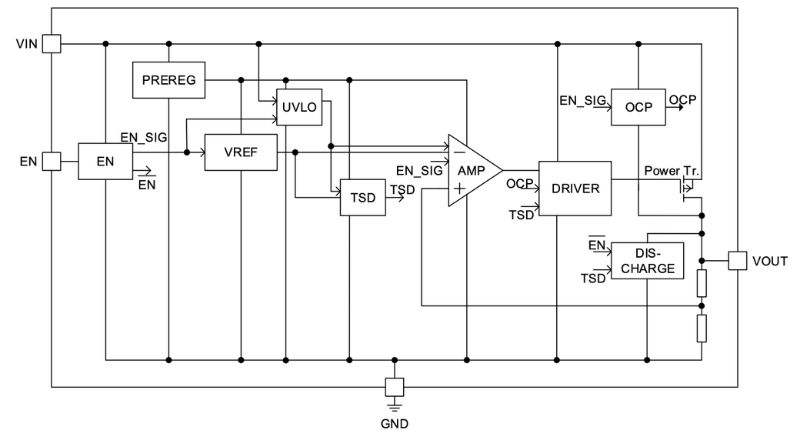
Block diagram for output voltage fixed type with output shutdown function. Image used courtesy of Rohm
Electrical Characteristics and Protection Features
In addition to output current capability, Rohm placed a heavy emphasis on its low standby consumption. The typical quiescent current is specified at 25 µA, excluding any external resistor-divider current on adjustable versions. The devices are rated for operation across a junction temperature range of -40°C to 150°C, consistent with AEC-Q100 Grade 1 requirements.
The BD9xxN5 series also integrates standard protection functions expected in automotive-grade LDOs, including overcurrent protection, thermal shutdown, and undervoltage lockout. Rohm also designates the family as functional safety supportive, due to alignment with automotive safety development processes.
Output configurations include fixed-voltage variants and adjustable versions supporting output voltages from 1.0 V to 18 V using an external resistor divider. Rohm offers the series in several package options, including surface-mount packages suited for compact power modules and control boards.
Positioning Relative to Conventional Automotive LDOs
Many high-voltage LDOs continue to specify minimum output capacitances in the multiple-µF range in the automotive and industrial power space, often paired with narrow ESR constraints to maintain loop stability. That approach reflects long-standing compensation strategies, but it can complicate designs that rely exclusively on modern MLCCs, whose effective capacitance drops significantly under DC bias and temperature stress.
Rohm’s Nano Cap represents an alternative control strategy that relaxes those constraints. Rather than relying on the output capacitor to stabilize the loop, Nano Cap is designed to maintain stability across a wider capacitance range, allowing designers to select smaller ceramics without violating minimum capacitance requirements. Rohm noted, however, that designers must still account for DC bias and temperature derating when selecting capacitors to ensure the effective capacitance remains above the specified minimum.
For applications that still require electrolytic or tantalum capacitors, Rohm advises paralleling a small ceramic capacitor near the output pin when ESR exceeds 400 mΩ, indicating that the devices are optimized primarily around low-ESR ceramic implementations.