Facebook
 Google
 GitHub
 Linkedin
Recom Intros 40W/75W Railway DC/DC Modules With Ultra-Wide Input
The RMD40-UW and RMD75-UW target EN 50155 rail applications with a single 11:1 input range, integrated ride-through, and baseplate cooling for full-power operation to +85°C.
Recom has expanded its railway power portfolio with two isolated DC/DC converter families designed to simplify onboard power design across multiple nominal supply rails. The RMD40-UW and RMD75-UW are hailed as cost-efficient, fully featured modules for rolling stock and trackside electronics, covering nominal input voltages from 24 V to 110 VDC within a single ultra-wide range.
The two families are rated at 40 W and 75 W, respectively, with short-term overload capability of 60 W and 90 W for 10 seconds. Initial variants ship with a 24 V output, with 12 V and 15 V versions listed as forthcoming. Both are offered as compact, baseplate-cooled modules intended to operate at full rated power from -40°C to 85°C without additional airflow, regardless of mounting orientation.
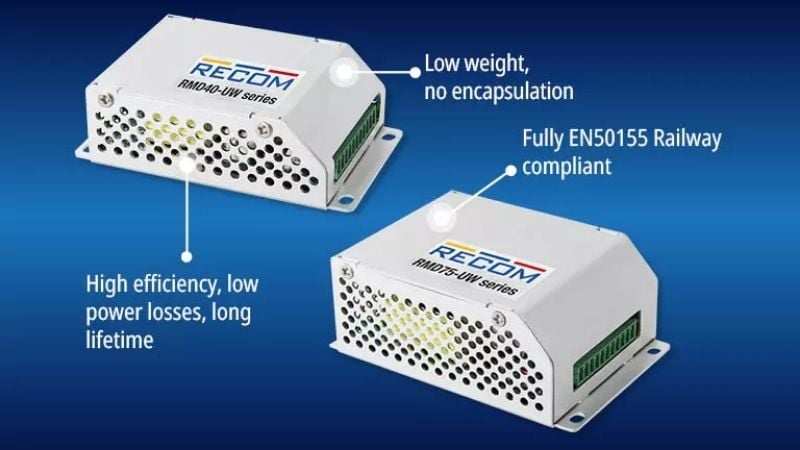
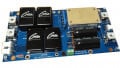
40W and 75W railway DC/DCs.
One Input Range for Multiple Rail Systems
Railway electronics designers must manage a wide range of DC supply voltages depending on region and vehicle class, alongside defined dips, interruptions, and surges set out in EN 50155. Recom’s approach with the RMD-UW series is to consolidate those requirements into a single input specification rather than multiple product variants.
According to Recom, the converters operate continuously from 16.8 V to 137.5 VDC, with tolerance for short-duration events down to 14.4 V and up to 154 V. This practically allows one module family to cover nominal 24 V, 36 V, 48 V, 72 V, and 110 V systems while remaining within the boundaries of typical EN 50155 supply profiles.
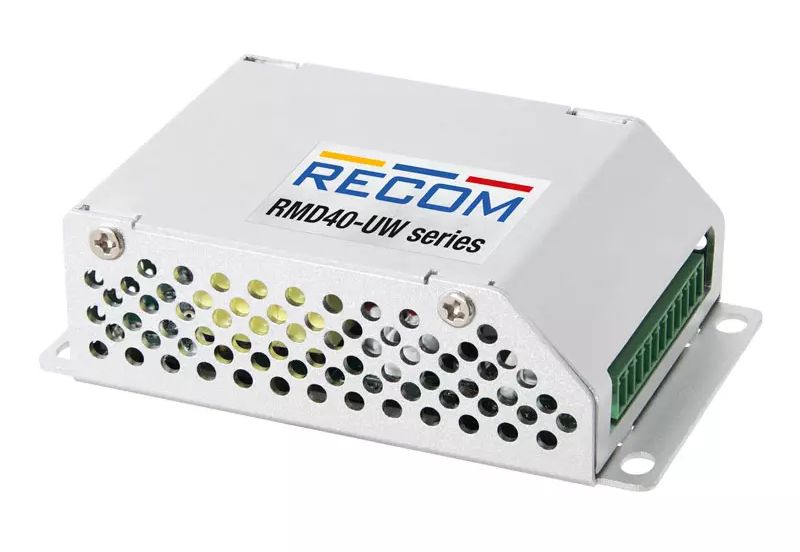
RMD40-UW series, DC/DC, 40 W, single output.
Ride-through behavior is also integrated, with both the 40 W and 75 W modules specifying at least 10 ms of hold-up time across the input range, extending to 30 ms at higher input voltages. That’s often enough to bridge short interruptions without adding external capacitance, which can be difficult to qualify in rail applications.
The modules also include active inrush current limiting and active reverse polarity protection. Recom specifies inrush control to less than 3.5 times the nominal input current, with reverse-polarity protection rated across the full input voltage span. These aim to reduce stress on upstream supplies and simplify compliance during system-level testing.
Integrated Features Aimed at EN 50155 Designs
Recom describes the RMD-UW parts as “fully featured,” with output OR-ing circuitry built in, allowing modules to be paralleled or used in redundant supply configurations without external diodes. This is a common requirement in safety-related and high-availability subsystems that use dual power paths.
Remote on and off control is provided, alongside a power-good indication. The standard versions offer an open-collector DC OK signal, while the optional /PT variants replace this with relay changeover contacts. The relay option is for designs that need galvanically isolated status signaling or direct integration with control circuits that expect dry contacts.
Output trimming is supported on the standard connector variants, allowing adjustment over a range suitable for compensating voltage drops on long cable runs or for fine-tuning supply rails. For the 24 V models, the trim range spans roughly 21.6 V to 26.4 V. Trimming is disabled on the /PT versions, reflecting the different integration priorities of relay-based monitoring.
Isolation is specified as reinforced, with air and creepage distances aligned to railway safety expectations. RECOM lists isolation test voltages in the kilovolt range and positions the modules for use in designs subject to EN 50155, EN 50121-3-2 for EMC, EN 61373 for shock and vibration, and EN 45545-2 for fire protection.
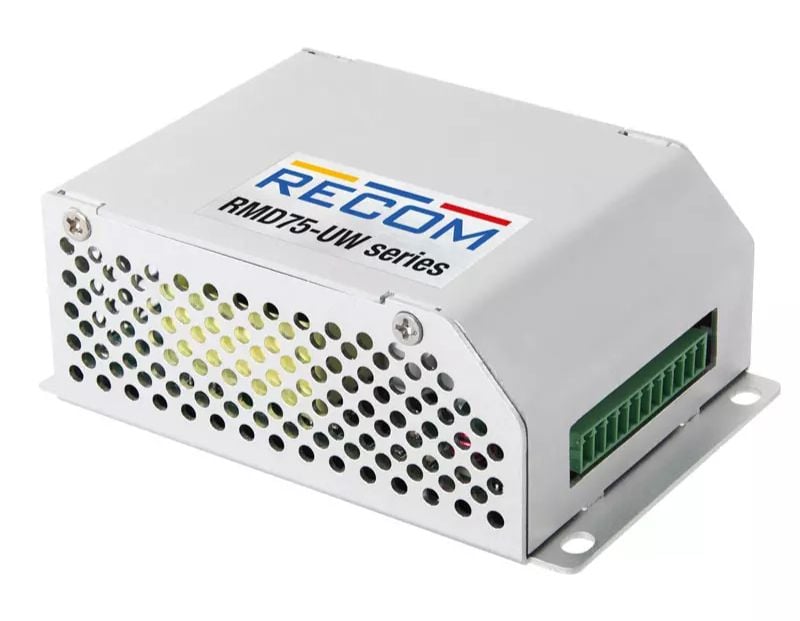
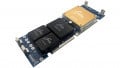
RMD75-UW series, DC/DC, 75 W, single output.
Thermal Design and Installation Options
Thermal management is handled through a baseplate intended for conduction cooling to a chassis or cold wall, with Recom claiming conversion efficiency better than 90%. This supports full-power operation across the entire -40°C to 85°C temperature range without derating, provided the baseplate is properly coupled to a suitable thermal mass. These temperatures align with EN 50155 OT4 and ST1 and ST2 classes, which cover equipment installed in controlled cabinets and require defined switch-on behavior at elevated temperatures.
Several mechanical and connection options are also available. In addition to standard pin-based versions, Recom offers push-in terminal variants and a factory-fitted DIN rail option, intended to reduce installation time and accommodate different enclosure and wiring configurations, especially in retrofits or modular cabinets.
The RMD40-UW and RMD75-UW might not be the highest-power or highest-density solutions in Recom’s lineup, but they target a common mid-power band where designers end up adding external components to meet rail-specific requirements. By integrating hold-up, protection, OR-ing, and monitoring into the module, Recom hopes to reduce the amount of qualification work pushed onto the system designer.