Facebook
 Google
 GitHub
 Linkedin
Recom Adds Isolated 50 W and 100 W DC-DC Converters
The RP50-AW and RP100-FW series pair ultra-wide input-voltage flexibility with compact footprints and operating temperatures up to 110°C.
The Austrian power supply manufacturer Recom has introduced the RP50-AW and RP100-FW families to its isolated DC-DC converter portfolio. The RP50-AW delivers up to 50 W of output power in a 1x1-inch footprint, while the RP100-FW delivers 100 W in a 50.8mm x 25.4mm x 10.7mm package.
Both converters feature 4:1 ultra-wide input voltage ranges and are designed for applications including industrial control, datacom, telecom, test and measurement, and transportation.
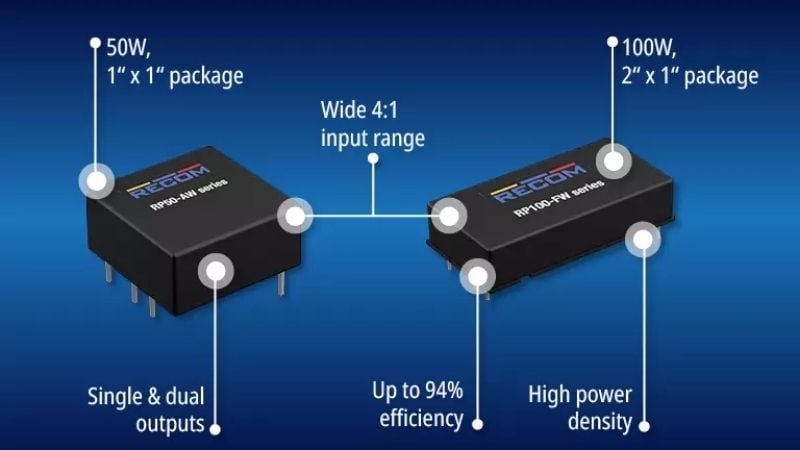
The RP50-AW and RP100-FW series target industrial, transportation, and telecom applications. Image used courtesy of Recom
RP50-AW for Space-Constrained Designs
The smaller component supports input voltage ranges of 9-36 VDC and 18-75 VDC, achieving efficiencies up to 93% with 2.25 kVDC isolation between input and output, according to Recom. The operating temperature range extends from -40°C to 105°C, with an optional heatsink version available for applications that need additional thermal headroom in high ambient temperatures.
The RP50-AW series supports input voltage ranges of 9-36 VDC and 18-75 VDC, achieving efficiencies up to 93% with 2.25 kVDC isolation between input and output. Single-output and dual-output models are both available. The operating temperature range extends from -40°C to +105°C, and an optional heatsink version is available for applications that require additional thermal headroom in high ambient temperatures.
The 1x1-inch footprint makes the RP50-AW particularly relevant for designs where board space is at a premium, but 50 W of isolated, regulated power is still needed. The 4:1 input range lets a single converter model handle the voltage swings common in battery-fed systems, unregulated bus rails, and industrial environments where input-voltage tolerance must be wide enough to handle brownouts, transients, and source variation without derating or shutting down.
For designers working within the 18-75 VDC input range, the RP50-AW covers standard 24 V and 48 V nominal bus voltages with a comfortable margin on either side. That flexibility reduces the number of converter SKUs an equipment manufacturer needs to stock and qualify, simplifying procurement and certification across product variants.
100 W With Extended Temperature and Altitude Ratings
The RP100-FW series matches the RP50-AW's input-voltage flexibility with the same 9-36 VDC and 18-75 VDC ranges, but delivers up to 100 W at efficiencies up to 94%. The operating temperature range widens somewhat to -40°C to +110°C, and the converters are rated for operation at altitudes up to 5,000 meters.
Without a heatsink, the RP100-FW measures 50.8mm x 25.4mm x 10.7mm, while an optional heatsink version (50.8mm x 26.5mm x 32.2mm) is available for demanding thermal conditions where natural convection can’t keep junction temperatures within safe limits.
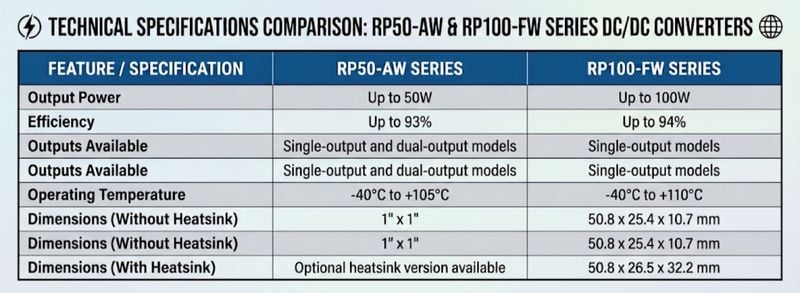
Comparison of key features. Image created using data courtesy of Recom
Both the RP50-AW and RP100-FW series integrate overvoltage, overload, over-temperature, and continuous short-circuit protection, along with remote on/off control supporting positive or negative logic. Depending on the model, the output voltage can be adjusted over a wide range, allowing system designers to fine-tune the supply voltage to their specific load requirements. Both series comply with RoHS and REACH requirements and are designed for robust EMC performance.
Addressing Power Density Demands
Recom stated that its customers are being challenged to deliver more power in increasingly compact systems. That trend is well established across industrial and telecom power design. As equipment functionality grows and enclosure sizes shrink, the pressure on isolated DC-DC converters to deliver more watts per cubic centimeter continues to intensify.
Recom’s approach with these two families covers the 50 W and 100 W tiers with standard modules that can be designed once and sourced across a range of input and output configurations, reducing engineering effort while maintaining supply chain flexibility.
The 5,000-meter altitude rating on the RP100-FW is worth noting for telecom and transportation engineers specifically. At high altitude, reduced air density weakens convective cooling and lowers the dielectric strength of air gaps, both of which can force derating in converters not designed for those conditions. Recom’s specification means the RP100-FW can operate at its full 100 W rating without requiring altitude-based power reduction in mountaintop cell tower installations or railway applications traversing high-elevation routes.