Facebook
 Google
 GitHub
 Linkedin
Pickering Rolls Out 1.2 kV Programmable Resistor Boards
Pickering Interfaces has introduced a family of PXI and PXIe programmable resistor modules for high-voltage simulation for automotive, aerospace, and energy test environments.
As electric vehicles adopt 800 V and higher battery architectures, and aerospace platforms migrate to more-electric designs, the demand for test systems capable of validating high-voltage electronics has grown sharply.
Pickering Interfaces’ new 40-230 (PXI) and 42-230 (PXIe) high-voltage programmable resistor modules address this challenge with a compact, single-slot form factor that combines channel density, wide resistance ranges, and built-in safety features.
These boards enable engineers to simulate resistive loads and fault conditions without compromising system safety, which makes them critical for validating traction inverters, battery management systems, and other high-voltage devices under test.
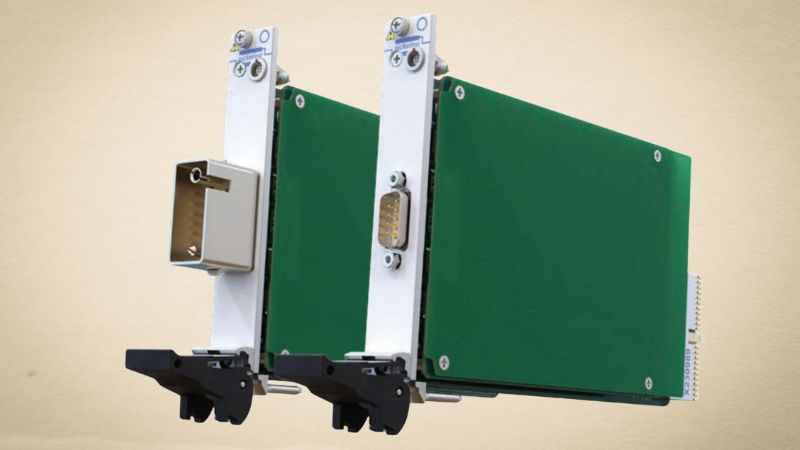
Pickering’s 4-channel PXI and PXIe high-voltage programmable resistor modules. Images used courtesy of Pickering Test
Flexible Simulation in High-Voltage Domains
The 40/42-230 modules can simulate realistic resistive behavior in high-voltage environments. Each channel can be programmed to replicate the resistance of RTDs, thermistors, or other sensors, enabling safe validation of electronic control units without requiring actual sensor hardware. This capability is particularly valuable for hardware-in-the-loop test setups, where engineers must evaluate system responses to various conditions, including sensor degradation, intermittent opens, or hard shorts.
Fault insertion is also integral to the design. Channels can be set to open- or short-circuit states, ensuring that a DUT such as an inverter or battery management system responds correctly to fault conditions. In practice, this allows engineers to confirm compliance with standards such as ISO 6469 for electric vehicle safety and IEC 60664 for insulation coordination.
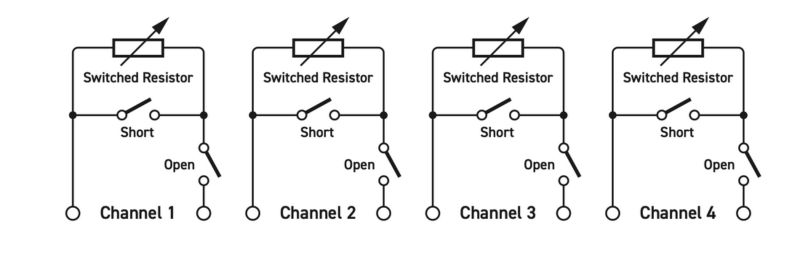
Functional diagram for high-voltage programmable resistor module. Image used courtesy of Pickering Test
The architecture supports voltage isolation check testing, a critical requirement for BMS and inverter validation. By subjecting the DUT to controlled resistance paths under high voltage, engineers can verify that insulation barriers perform to specification, a cornerstone for meeting automotive and aerospace safety regulations.
Safety and System Integration
Given the voltages involved, Pickering has prioritized safety in both hardware and software. Each board includes a hardware interlock system that, when triggered, returns all relays to their default unpowered state. This mechanism can be daisy-chained across multiple interlock-enabled modules, providing coordinated system-level shutdown in case of a fault.
Unlike software-only protections, this hardware layer ensures that safety is enforced regardless of the host PC state, reducing the risk of uncontrolled conditions during high-voltage testing. Pickering also provides an optional calibration cable assembly that can replace the DUT, allowing a digital multimeter to directly verify resistor channel values. This feature streamlines periodic validation, ensuring that modules remain accurate over long-term deployment.
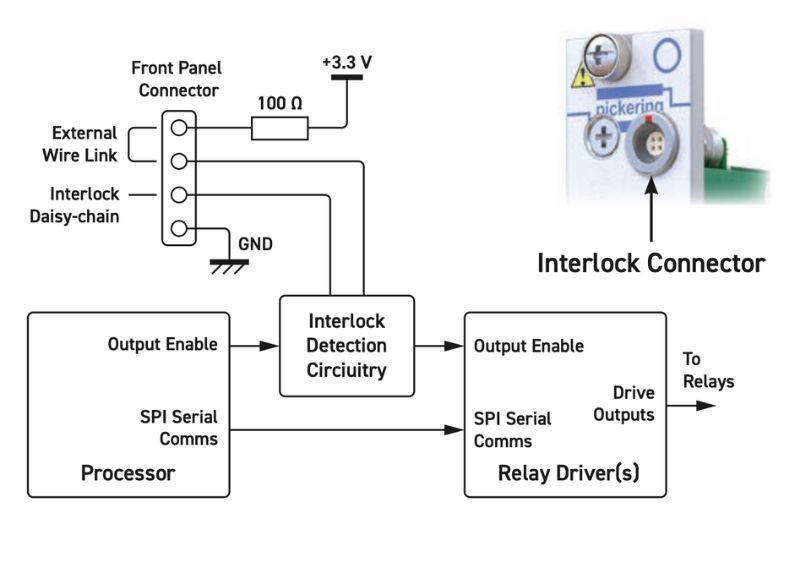
Interlock signal routing diagram for the 40/42-230. Image used courtesy of Pickering Test
The 40/42-230 family’s compact form factor enables four-channel, high-voltage resistance simulation in a single PXI slot. This is especially significant in environments where PXI chassis slot count is limited yet test coverage must be extensive. The design also addresses software integration. The boards are controlled via resistor value calls, where the requested resistance is mapped to the nearest available configuration. Engineers can interrogate the board to determine the exact value set, ensuring traceability in automated test sequences.
Meeting the Challenges of Widespread Electrification
With the proliferation of 800 V EV platforms and the migration toward 1 kV+ aerospace and industrial power systems, the ability to simulate resistive behavior at 1.2 kV provides engineers with valuable design and validation headroom.
As system voltages continue to rise and safety standards tighten, test engineers will increasingly rely on solutions like the 40/42-230 family to validate designs and accelerate the adoption of safer, higher-performance power systems.