Facebook
 Google
 GitHub
 Linkedin
Biwatt Rolls Out Scalable Sodium-Ion Energy Storage Solutions
The company’s energy storage systems provide safer and flexible power solutions for businesses, industrial, and residential sites.
Chinese battery maker Biwatt unveiled its complete portfolio of sodium-ion energy storage systems, marking a significant product release for an emerging alternative to lithium-based battery chemistry. The lineup spans residential, commercial, and industrial sectors, promising several competitive benefits over conventional lithium-ion batteries.
Energy storage markets are motivated to switch up their battery chemistries amid rising lithium costs, raw material supply constraints, and growing safety concerns around thermal events in high-density lithium systems. Sodium-ion batteries are becoming a commercially viable option for scaling stationary storage, particularly for long-duration and distributed energy applications.
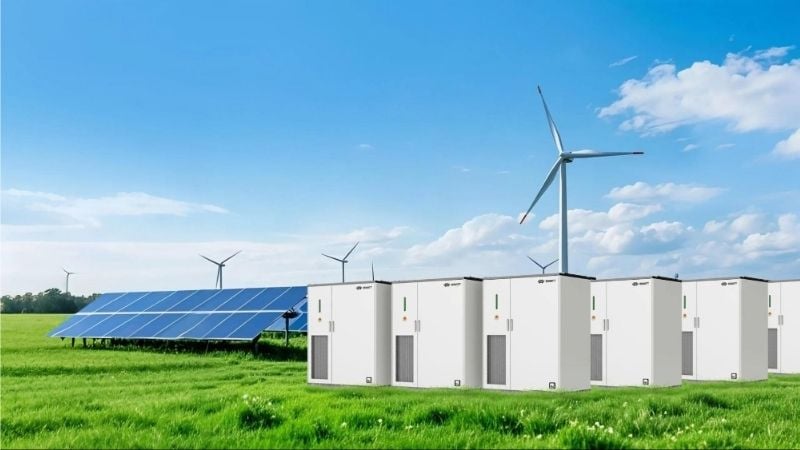
Biwatt’s sodium-ion energy storage systems for commercial and industrial users. Image used courtesy of Biwatt
Why Sodium-Ion?
Sodium-ion battery chemistry is gaining momentum as a safer and more cost-effective alternative to lithium-ion, especially in applications where energy density isn't the primary concern. Sodium is abundant, non-toxic, and free from the price instability and supply chain risks associated with lithium, cobalt, and nickel extraction.
One major technical advantage of sodium-ion batteries is their ability to tolerate full discharge without permanent damage. While lithium-ion cells can suffer irreversible capacity loss or fail to recover after deep discharge, some sodium-ion systems—including Biwatt’s—can safely reach 0V and be recharged, making them attractive for seasonal, standby, or long-duration storage applications.
Depending on cell and system design, sodium-ion batteries typically exhibit more stable thermal behavior than high-energy-density lithium-ion cells. This reduces the risk of localized overheating, a contributing factor to thermal runaway in lithium-based battery cells.
Biwatt’s lineup balances sodium-ion batteries’ inherent technical advantages with practical functions accommodating the company's end markets. For example, its PowerLake system, targeting industrial customers, features instantaneous grid-to-off-grid switch technology. This ensures uninterrupted operation in conditions where power stability is critical.
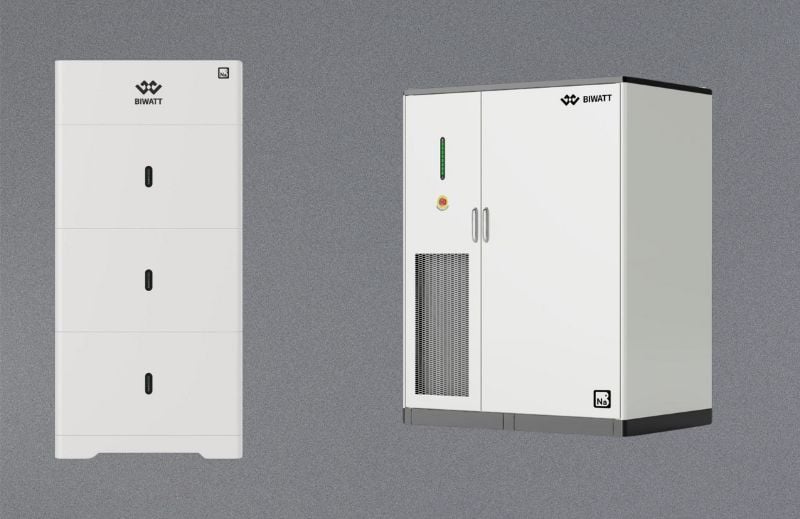
Biwatt's energy storage portfolio includes two new entrants: PowerNest R3 (left) and PowerLake I2 (right). Image used courtesy of Biwatt
Industrial-Scale Energy Storage: I2
Biwatt's PowerLake I2 product is a high-capacity energy storage system incorporating solar photovoltaic input, battery storage, power conversion, and electric vehicle charging in an all-in-one system. According to the company, the integrated design reduces installation costs by 30% and operational costs by 15%.
With a total storage capacity of 154.5 kWh, the PowerLake I2 is designed for facilities that demand continuous, stable power, such as data centers, hospitals, manufacturing plants, and other critical infrastructure.
A key feature is its fast-response off-grid switching technology, which can transition from grid to battery power in under 20 milliseconds, maintaining power delivery to essential loads during outages or grid instability.
The system has a 6,000-cycle lifespan and can operate within a -30 to 55°C temperature range.
PowerLake also boasts safety features designed to minimize thermal risks even during small temperature fluctuations among cells.
Stackable Battery Storage: R3
Biwatt bills its PowerNest R3 as the world's first stackable sodium-ion home battery, starting at 4.5 kWh per module. Each stack can reach 18 kWh, and four parallel stacks can scale up to 72 kWh (16 stacks total), making R3 potentially attractive for off-grid residential or small solar self-consumption systems.
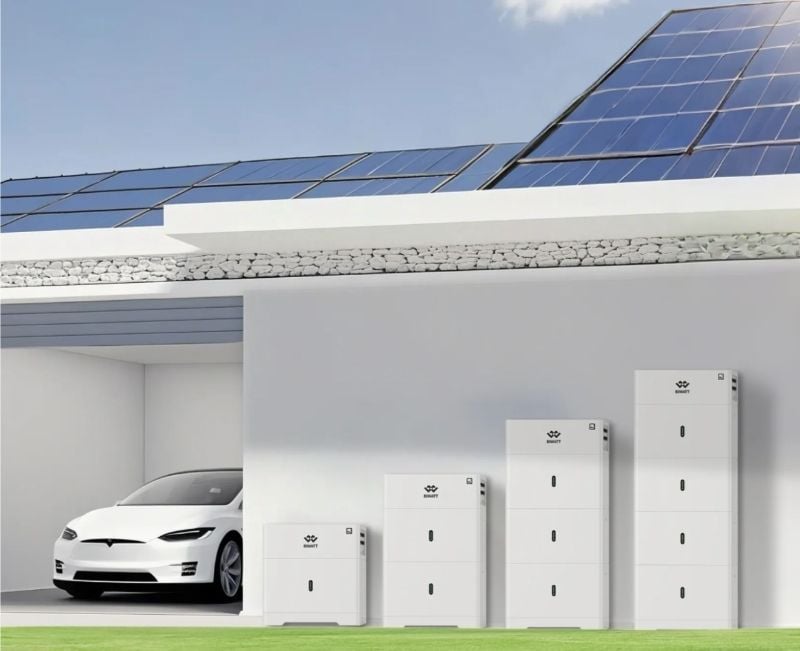
PowerNest R3. Image used courtesy of Biwatt
The system includes a "0V charge and discharge" function, allowing it to be safely stored or transported in a fully discharged state without safety or degradation risks.
The R3 is water-resistant and dust-proof for outdoor use, with an IP65 protection rating. Biwatt's accompanying mobile app provides real-time cell-level monitoring of battery performance.
Biwatt’s Expansion Plans
Biwatt's plans to expand into international markets, with large-scale sodium-ion battery deployments active in over 20 countries across Europe, Asia, and the Americas. The company also expects to release an integrated solar-storage-EV charging system in the second half of 2025.