Facebook
 Google
 GitHub
 Linkedin
Omron Launches 1500 VDC Relay Series for EV Charging and ESS
The G9KD high-current relays combine compact PCB mounting with industrial isolation performance.
Omron Electronic Components Europe has released the G9KD series 1500 V DC high-current relays. The PCB-mount relays are designed as direct replacements for traditional contactors in two markets: energy storage system (ESS) power-conditioning circuitry and electric vehicle fast-charger control units.
The G9KD is built with a single-pole, single-throw (SPST) normally open configuration and handles 100 A make current and 150 A carry-and-break current. The main contact gap measures 6 mm, a specification that provides what manufacturers describe as "generous isolation distance," critical when switching high-voltage DC circuits in safety-critical applications.
Measuring 60.5 mm x 43.5 mm x 56.5 mm, the relay’s initial contact resistance is less than 4 megaohms, a specification that directly reduces energy loss during switching events and minimizes self-heating over extended duty cycles.
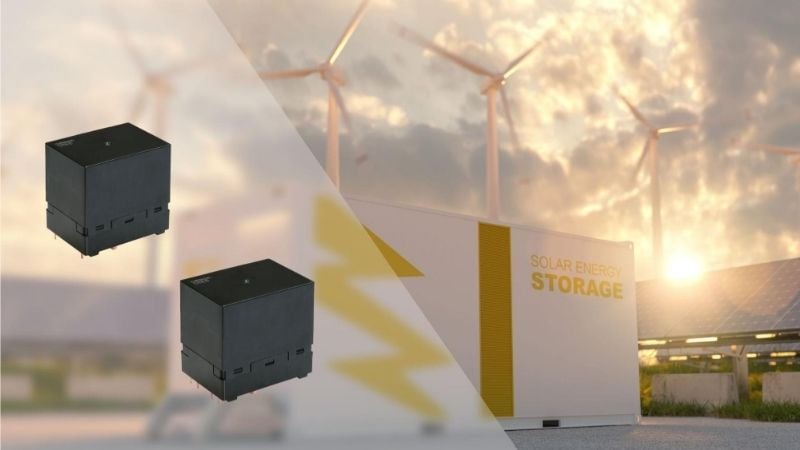
The high-current relays. Image used courtesy of Omron
Contact Performance
In high-current DC applications, contact resistance scales linearly with power dissipation. At 150 A, a circuit at 4 megaohms dissipates 90 W per contact pair, which is manageable within the relay's thermal envelope, provided contact quality remains consistent. Omron's specification suggests the relay tolerates normal contact wear without rapid degradation.
The optional auxiliary contacts operate at 1.0A and follow the normally closed (type 1b) configuration. These contacts enable contact-failure monitoring and diagnostic indication, providing real-time feedback on main-contact status to the host system's safety controller.
The auxiliary contacts conform to IEC/EN60947-4-1, making the relay suitable for both mission-critical ESS isolation circuits and charger safety networks.
Designed for Automated Assembly
The G9KD ships in a PCB-mount footprint designed for automated assembly. This specification carries particular weight in the EV charger and ESS markets, where volume manufacturers depend on high-speed pick-and-place and reflow-soldering processes. Manual relay insertion, fixture wiring, and hand-soldering create production bottlenecks, particularly in configuration-switching networks where EV chargers adjust power output dynamically or where ESS systems route current through multiple parallel or series topologies.
Omron has pitched the G9KD explicitly as a contactor replacement, allowing equipment makers to extend PCB integration and eliminate manual wiring. The relay also competes against emerging solid-state switching architectures.
Solid-state devices offer faster switching and higher integration density but introduce gate-drive complexity, electromagnetic interference, and thermal management challenges at the 150 A level. The G9KD sits between these extremes, requiring no drive circuitry, tolerating the electrical environment of high-voltage DC systems without degradation, and integrating into standard PCB assembly workflows that manufacturers already operate.
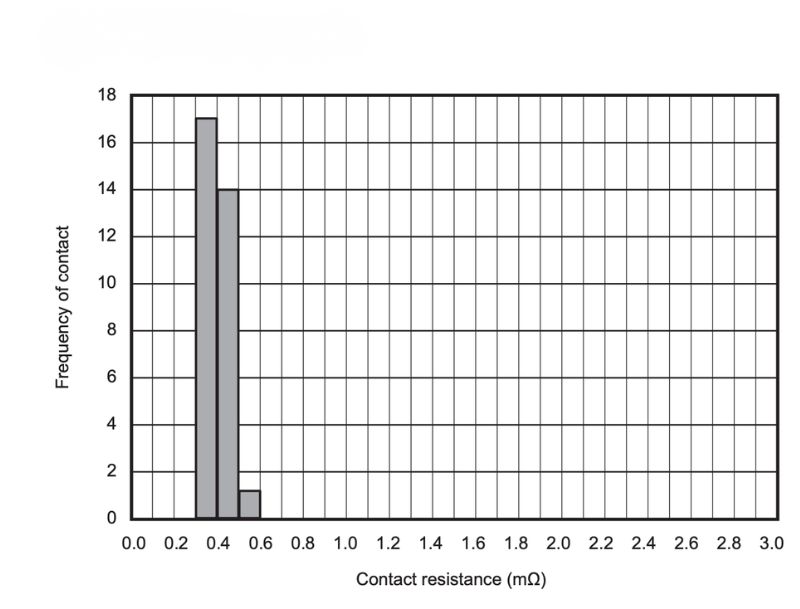
Contact resistance. Image used courtesy of Omron
The combination of 6 mm contact isolation, sub-4 megaohm contact resistance, and compact dimensions allows manufacturers to increase PCB-level integration density. Charger builders can also implement multiple switching stages on smaller boards, while ESS integrators can consolidate isolation switching closer to the battery management system without occupying the space a traditional panel-mount relay would demand.
Ideal for EV Fast-Charging
The 1500 V DC rating means the G9KD is well within the voltage architecture of modern EV fast-charging stations and grid-scale energy storage. Fast chargers operating at 800 V or 1000 V bus voltages require isolation devices with substantial margin above operating voltage to maintain safety compliance, so the 1500 V rating provides that headroom while accommodating transient voltage spikes during fault conditions and inrush events.
In ESS applications, battery strings increasingly operate at higher voltages to reduce current levels and associated copper costs. Systems built around 1000 V or 1200 V battery architectures need isolation relays rated well above the nominal bus voltage, and the G9KD's 1500 V specification addresses these requirements without forcing designers to move to larger, more expensive contactors.
The G9KD is in production now, arriving at a time when EV charger manufacturers face pressure to reduce board count and increase switching density, and when ESS integrators are working to lower system cost per kilowatt-hour while maintaining isolation and safety performance.