Facebook
 Google
 GitHub
 Linkedin
UCLA Team Reimagines Edison Battery for Grid-Scale Storage
Researchers have reengineered Thomas Edison’s original nickel-iron battery chemistry into a modern, nanostructured energy storage system.
Researchers have used 21st-century material science to revive a century-old energy storage concept developed by Thomas Edison. They are reconsidering a nickel-iron battery that Edison once promoted for electric vehicles for a different challenge: stabilizing renewable power grids.
An international team has modernized the classic nickel-iron chemistry to meet today's demands for faster charging and longer battery life. Unlike lithium-ion systems that prioritize high energy density, the Edison-inspired nickel-iron platform emphasizes durability, safety, and a lifespan in decades—features especially valuable for grid-scale storage.
The researchers envision applications ranging from storing excess electricity generated by solar farms during the day to delivering backup power for data centers.
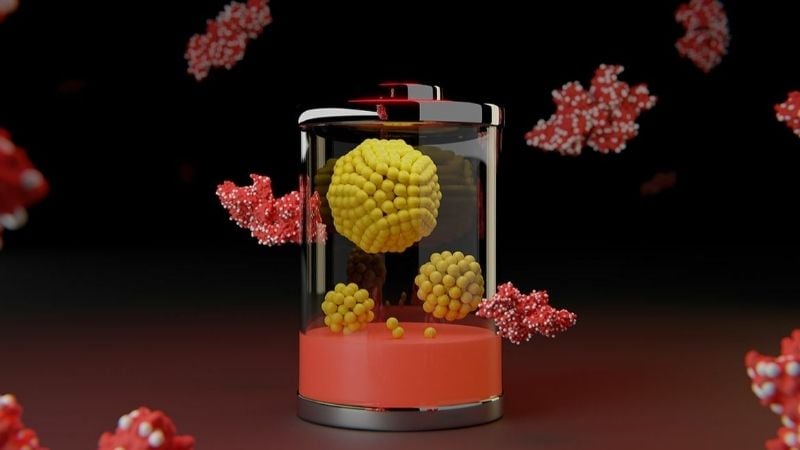
Concept of the reenvisioned battery. Image used courtesy of UCLA/Maher El-Kady
Edison's Original Design
Developed in 1901 and originally intended for EVs, Edison’s nickel-iron battery aimed to improve upon the dominant lead-acid systems of the era, which relied on lead plates immersed in sulfuric acid.
Lead-acid batteries, first demonstrated in 1859, were heavy and prone to sulfation, limiting their lifespan. Edison sought a tougher alternative using nickel oxide hydroxide as the positive electrode, iron as the negative electrode, and potassium hydroxide as the alkaline electrolyte.
Edison claimed his battery could power electric cars for up to 100 miles on a single charge and recharge in roughly seven hours—ambitious figures for the early-20th century. The battery found use in early Detroit Electric and Baker Electric vehicles, and its ruggedness also made it attractive for railroad signaling, mining operations, and industrial equipment.
Nickel-iron chemistry was also valued for its resistance to deep discharge and mechanical shock, allowing it to endure harsh operating conditions.
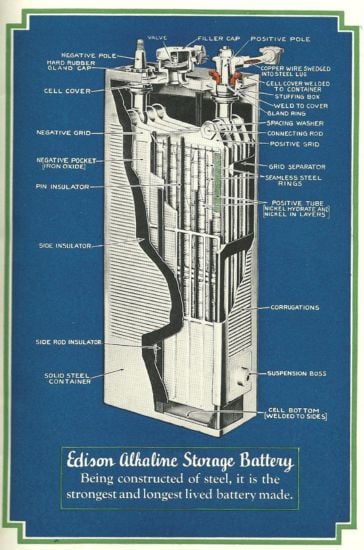
A cross-section of Edison's nickel-iron battery design in a 1920s-era technical manual. Image used courtesy of Wikimedia Commons
However, the technology faced several limitations. Manufacturing costs were high, energy density was modest, and performance declined in cold temperatures. During charging, the aqueous electrolyte could produce hydrogen gas through water electrolysis, requiring ventilation and periodic water maintenance.
As gasoline engines improved and mass production drove down costs, internal combustion vehicles overtook electric cars, pushing Edison’s battery into niche industrial applications. In recent decades, manufacturers and researchers have revisited nickel-iron chemistry, exploring improvements in materials and even its potential role in hydrogen production systems.
How Researchers Expanded Edison's Nickel-Iron Battery
The UCLA-led team used the same nickel-iron electrochemistry but redesigned the electrode architecture at the nanoscale. Performance data from laboratory prototypes show recharge times measured in seconds, along with durability exceeding 12,000 full charge/discharge cycles. That translates to over three decades of daily cycling.
For comparison, many commercial lithium-ion batteries typically deliver between 500 and 3,000 cycles before significant capacity degradation, depending on chemistry and application. Lithium-ion batteries used in EVs typically last between 1,000 and 2,000 full charge-discharge cycles before dropping below about 80% of their original capacity.
The researchers drew inspiration from biomineralization—the way shellfish build protective shells using protein scaffolds that guide mineral deposition.
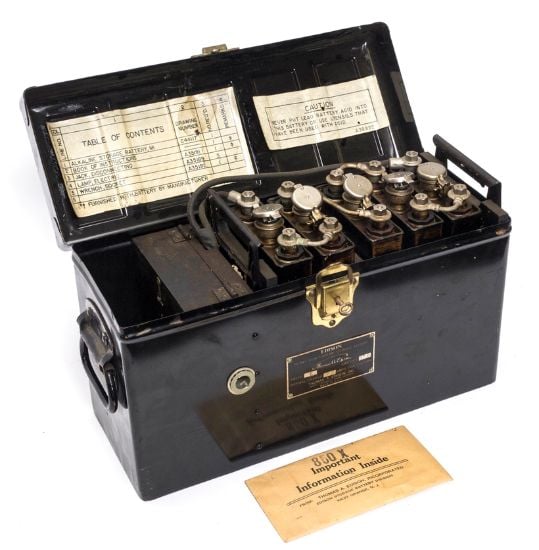
A pack of nickel-iron cells manufactured for electric cars in the early 1900s. Image used courtesy of Jensen-Thomas Apparatus Collection
Envisioning a similar material-deposit system, the team grew nanoclusters of nickel (for the positive electrode) and iron (for the negative electrode), using proteins originally sourced from beef industry byproducts. These proteins limit particle growth to the nanometer scale and increase surface-to-volume ratio.
The material then undergoes heat treatment where the proteins carbonize, and graphene oxide is reduced, forming an aerogel structure that's roughly 99% air by volume. This framework maximizes the electrochemically active surface area and improves electron transport pathways, enabling faster charge and discharge rates.
Although the system still falls short of lithium-ion batteries in energy density, its improved cycle life, tolerance to overcharging, and use of abundant materials may make it a promising candidate for renewable energy storage systems.
The study was published in Small.