Facebook
 Google
 GitHub
 Linkedin
Nexperia Transformer Drivers Offer Efficiency, EMI Reduction
The push-pull drivers can deliver 6 W of power while providing 90% efficiency.
Reliability, electromagnetic interference reduction, and energy efficiency are necessary for power electronics designers. DC-DC converters, particularly push-pull converters, have evolved to offer more precise control over power delivery, enhancing performance and safety.
Nexperia has introduced its NXF650x(A/B)-Q100 series transformer drivers. The series integrates reliable power converter features in a single tiny package.
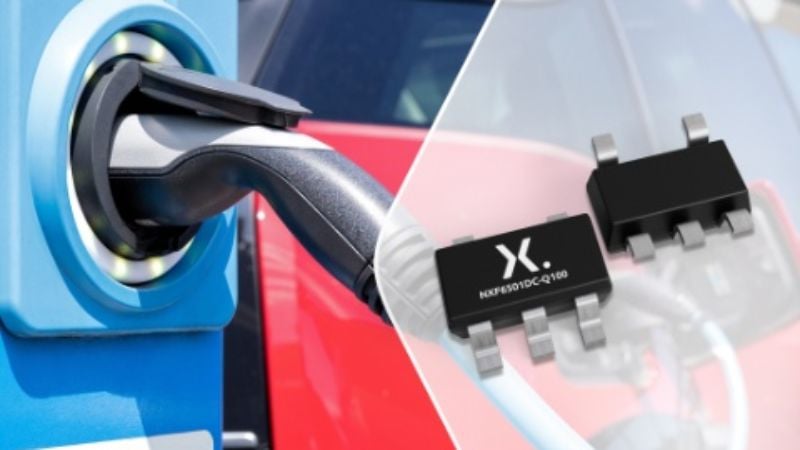
Transformer drivers. Image used courtesy of Nexperia
Push-Pull Transformers
A push-pull converter is a DC-DC converter utilizing a center-tapped transformer to transfer power between the primary and secondary windings. In this circuit, two transistors manipulate a push-pull transformer to drive the primary windings alternately. When one transistor (Q1) turns on, current flows through one-half of the primary winding, creating a magnetic field. When Q1 turns off and the other transistor (Q2) activates, current flows through the opposite half, generating a reverse magnetic field. This alternating current produces a voltage in the secondary windings.
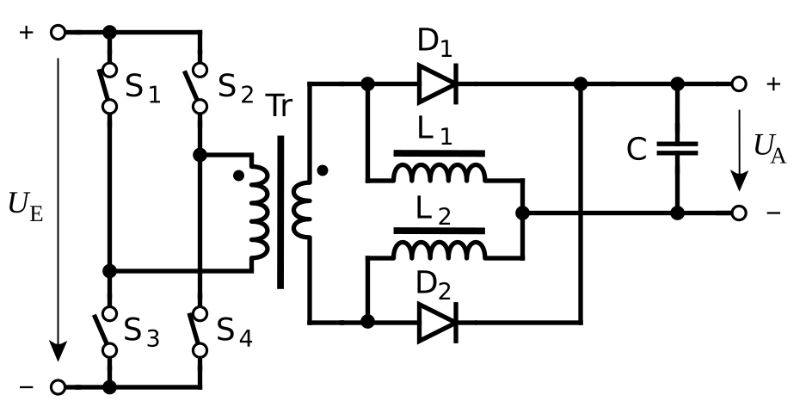
A push-pull current doubler circuit. Image used courtesy of Wikimedia Commons
An important feature of modern power converters is the ability to soft-start. This feature is necessary as sudden changes (spikes) in voltages can damage components such as capacitors and MOSFETs, cause overheating, and increase EMI. A soft-start circuit in power converters ensures a smooth startup by gradually increasing the output voltage to prevent excessive inrush current and protect the switches and load during power-up.
Soft starts are achieved using an RC circuit to control the ramp-up time, which is proportional to the RC time constant. The startup time can be adjusted via an external capacitor. The process involves four stages: initialization, voltage ramp-up, reaching steady-state, and fault handling, collectively enabling controlled and reliable power converter operation.
Nexperia Combines Performance and Efficiency
Nexperia’s NXF650x(A/B)-Q100 series transformer drivers are aimed at automotive and industrial applications.
These AEC-Q100-qualified push-pull drivers are powered by a 2.25 V to 5.5 V supply and can drive low-profile, center-tapped transformers with an output current of 1.2 A at 5 V (6 W). The series uses internal oscillators and gate drive circuits to drive N-channel power switches, with frequencies of 440 kHz or 160 kHz, depending on the model. It also features slew rate control and spread-spectrum clocking (SSC) to minimize noise and EMI, with optional external clock synchronization for enhanced precision.
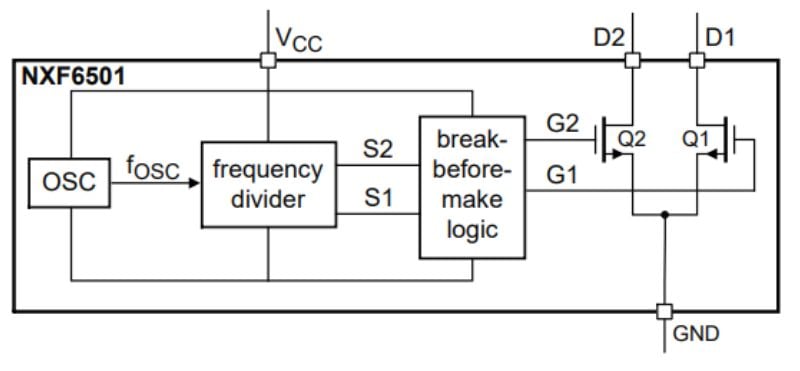
The block diagram of NXF6501 drivers. Image used courtesy of Nexperia
The NXF6501-Q100 device also incorporates a soft-start function to ensure smooth power-up. When powered on or when the EN pin switches from Low to High, the gate drive of the output power MOSFET gradually ramps from 0V to VCC over approximately 5 ms. This gradual ramping limits inrush current from VCC, preventing large decoupling capacitors on the secondary side from causing excessive current flow. It also minimizes secondary voltage overshoot during startup, protecting sensitive components. By controlling voltage overshoot, the feature further safeguards connected components.
Future of Power Converters
As power demands grow across automotive and industrial sectors, the need for compact, efficient, and low-noise power solutions increases. Nexperia’s NXF650x(A/B)-Q100 series addresses these challenges by blending efficiency, EMI reduction, and safety features into a versatile driver. Looking forward, the new drivers could unlock continued advancements in achieving higher performance within space-constrained designs.