Facebook
 Google
 GitHub
 Linkedin
Differentiating Transformer Losses
Learn about core and coil losses in transformers.
While transformers exhibit high efficiency, it is crucial to consider certain losses when delving into transformer theory. These losses can be broadly categorized as core losses and coil losses. Core losses remain relatively constant, originating from the magnetic circuit, which experiences minimal variations with changes in transformer current. On the other hand, coil losses, also known as I2R losses, are influenced by currents; as currents change, so do the coil losses.
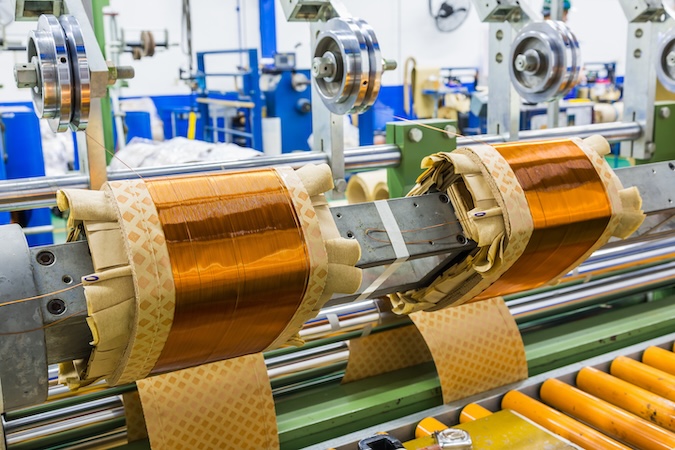
Image used courtesy of Adobe Stock
Core Losses
Core losses fall into two categories: eddy current losses and hysteresis losses.
Hysteresis Losses
When there is no secondary current flowing, the current flowing through the transformer’s primary winding creates magnetic flux, which induces the voltage in the secondary winding. This primary current is called the exciting current and is rather small because of the large CEMF of the primary winding. Because a transformer is a device that transfers energy through magnetic flux, concentrating the flux improves the efficiency of the transformer.
The magnetic flux of the primary winding is wound around an iron or steel material called the core to concentrate the magnetic flux. The magnetic core material provides a better path for the flux than the open air. The core will not transfer all the flux to the secondary coil. Some of the flux will be lost because of hysteresis, which is the tendency of a material to resist rapid changes in magnetic polarity. Because transformers are supplied by AC voltage, the magnetic field of the primary coil changes its polarity 60 times a second. Not all the core material can change polarity quickly, so the flux is somewhat weakened. Special high silicon steel is used in the core material to minimize hysteresis losses.
Eddy Current Losses
As a result of the relative motion of the magnetic field and the core material because of the AC supply voltage, a voltage is also induced in the core material, which can cause currents to flow in the core. These are called eddy currents and are supplied by the exciting current. Eddy currents create heating in the core, which results in losses. Minimizing eddy currents is accomplished by constructing the core out of many thin sheets of steel called laminations. The individual laminations are insulated from each other, so the current cannot flow through the entire core but rather only in each thin lamination. Total current flow and associated heating are thus reduced.
Figure 1 demonstrates how a laminated core in a transformer mitigates energy losses caused by eddy currents. The alternating current in the transformer's winding generates an alternating magnetic field (represented by green arrows) within the steel core. As the core possesses electrical conductivity, this field induces electric current loops (represented by red lines), known as eddy currents. These currents flow in planes perpendicular to the magnetic field and, when passing through the core's resistance, result in energy dissipation as heat, leading to power losses. Many transformers employ a laminated core design (on the right) instead of a solid core (on the left) to address this issue. The laminated core comprises stacked thin steel laminations, each coated with a nonconductive material. This construction prevents eddy currents from crossing between laminations, confining them to flow within the thickness of each lamination. As the current magnitude is directly proportional to the enclosed loop area, this configuration significantly reduces eddy currents and minimizes energy losses in the core.
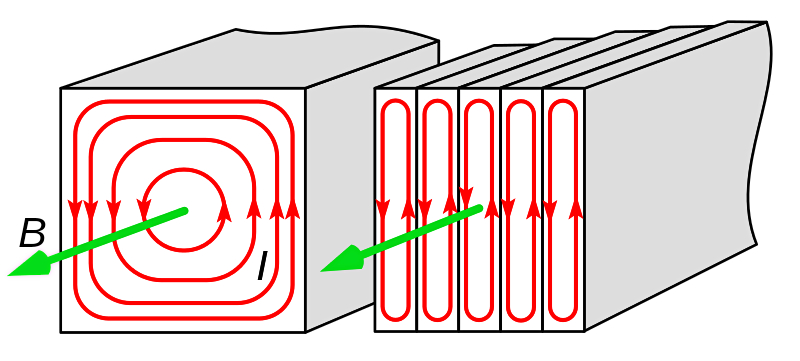
Figure 1. Laminated transformer core to reduce eddy currents. Image used courtesy of Wikimedia Commons
The losses associated with the transformer's core are magnetic and remain relatively constant. The impact of hysteresis and eddy currents remains largely unchanged with variations in current flow, as they are inherent to the core design and material.
Coil Losses
A transformer functions similarly to any electrical circuit or device. When electrical current passes through it, it generates a magnetic field and heat. This heat, known as coil or copper loss, is quantified using the formula I2R. The crucial aspect is that the coil loss correlates to the current flowing through the transformer. To mitigate this heat loss, transformers often employ copper conductors for winding, given their lower resistance compared to aluminum conductors of equivalent size. New super-conductive materials may be used to reduce heating losses further. Dissipating the heat will also reduce the resistance of the coils, as the resistance of a material increases with temperature.
Flux Linkage Losses
No matter how we position the transformer coils or construct the core, some magnetic flux will be produced by the exciting current of the primary winding, which will not cut across the coils. This is known as flux leakage.
The primary flux creates a CEMF for the primary but cannot cut across all the turns of the winding. This decreases the CEMF and increases the primary exciting current. As a result, more voltage should be induced in the secondary winding, but because not all the flux crosses the turns of the secondary winding, the secondary voltage does not increase. The increase in primary exciting current is wasted because the extra flux cannot be used.
The same problem exists with the secondary winding. When secondary current flows, not all the secondary winding flux can weaken the primary flux because of the flux leakage of the secondary winding. With less opposition to the primary CEMF, not as much primary current can flow to create the flux necessary to keep secondary voltage constant. As the transformer currents increase, this flux leakage can cause lower secondary voltages.
Secondary Voltage Drop
Lower secondary voltages are also the result of normal voltage drop across the secondary winding. When the current flows in the primary or secondary winding of the transformer, there is some drop in the voltage across the coil. The amount of this voltage drop depends on the current flow and resistance of the conductor. According to Ohm’s Law, the voltage drop is the product of current flow and resistance of the conductor.
The resistance in a transformer's primary winding is small compared to the applied voltage. Resistances may be only tenths of an ohm; if the primary supply voltage is high, the primary current is low, and the overall voltage drop is minimal. If the secondary winding has fewer turns, the secondary voltage is less, and secondary current will be higher. Although the secondary winding resistance is lower if larger wire is used to carry the increased current, the overall voltage drop across the secondary coil can be a sufficient percentage of the total voltage. It may cause the output voltage to be too low for the proper load operation.
For example, let’s say a primary winding supplied with 500 V has an effective resistance of 0.1 ohm. The secondary winding of the same transformer has an induced voltage of 100 V, and the effective resistance is 0.02 ohms. If a current of 50 amps is flowing in the primary winding, the voltage drop (amps x ohms) will be 5 V—or 1% of the supply voltage. Current flow in the secondary coil must be 250 amps if power in is to equal power out. The secondary winding voltage drop will be 0.02 ohms x 250 amps—or 5 V, which is 5% of the induced voltage. As a result, the actual secondary voltage will only be 95 V. The effect of this voltage drop in the secondary winding is greater as current flows increase. If we measure the actual secondary winding voltage with no current flowing and with the maximum rated current flowing, the change in voltage is the transformer’s percent voltage regulation.
\[Percentage\,Voltage\,Regulation=\frac{Vs(No\,Load)-Vs(Full\,Load)}{Vs(Full\,Load)}\times100\]
Here is a sample calculation: A transformer's secondary voltage changes from 126 V with no load to 119 V when fully loaded. What is the percentage of voltage regulation of this transformer?
\[Percentage\,Voltage\,Regulation=\frac{126V-119V}{119V}\times100=0.055\times100=5.5\%\]
To compensate for this secondary voltage drop, the transformer will have extra turns on the secondary winding, increasing the induced voltage. Even though the transformer's secondary winding drops some voltage, the transformer will still produce full secondary voltage at full rated load current. As a result of the extra turns, the transformer voltage will be higher, with little or no load, than when the secondary winding carries its full load current. This is especially true with smaller-capacity transformers.
Loss Complexities
Understanding and addressing losses is critical to maintaining transformer reliability and efficiency. The distinctions between core losses, attributed to hysteresis and eddy currents, and coil losses from current flow highlight the need for careful design and material selection to minimize heat generation. Factors like flux linkage losses and secondary voltage drop further underscore the complexities of optimizing transformer performance. By mitigating these losses, design engineers can enhance transformer efficiency, reduce energy wastage, and ensure longevity.
Related Content