Facebook
 Google
 GitHub
 Linkedin
Infineon Intros ‘Virtual Oscilloscope’ for Digital Power Conversion
EEPower met with Infineon at Embedded World 2026 to learn about the ModusTooblox Power Suite, which bundles power conversion libraries, a PMBus stack, and a virtual oscilloscope.
EEPower met with Infineon at Embedded World 2026 to learn about the ModusTooblox Power Suite, which bundles power conversion libraries, a PMBus stack, and a virtual oscilloscope.
Infineon launched ModusToolbox Power Suite at Embedded World 2026 in Nuremberg, a software platform built on the company's PSOC Control C3 microcontrollers and designed for digital power-conversion designs. EEPower was on-site to meet with Infineon and view the Power Suite’s advantages.
Steven Tateosian, Senior Vice President of IoT, Compute & Wireless at Infineon, told EEPower that the goal was to ease the journey from evaluation to deployment.
"How do we ease customers' journey from an evaluation of our microcontroller in the target application, and help them with their development as well?” Tateosian said. “And we do that through software support and tool support with the configurator, but then also a set of visualization tools like an oscilloscope in here, so they can see what the impact of their changes are in real-time."
_and_Steve_Tateosian_(right)_at_Embedded_World.jpg)
Massimo Paglia (left) and Steve Tateosian (right) at Embedded World.
What's Inside?
The Power Suite packages power conversion libraries, configuration tools, and visualization utilities into the existing ModusToolbox ecosystem to shorten the path from MCU evaluation to working power-supply firmware. It ships with middleware libraries that encapsulate the control algorithms for common topologies, code examples mapped to specific evaluation boards, and a graphical front end called the Power Suite GUI.
The GUI exposes two functions of particular interest to engineers working at the firmware level: a PMBus stack with a working set of commands the user can extend or export to their own applications, and a virtual oscilloscope that can extract up to four firmware variables in real time and display them in a layout that mirrors a hardware scope.
"The functionalities are very similar to a real oscilloscope, besides being a virtual oscilloscope,” explained Infineon application engineer Massimo Paglia.
Both the middleware and the example code are exposed rather than locked. Users can swap a PI regulator for a different control structure, retune parameters, or retarget the example code to a new board by editing the source.
Infineon's product briefing earlier in March described the product as targeted at expert users who want a fast evaluation, as well as developers transitioning from analog to digital power design.
"In case a user or customer wants to deploy a different board, then they need [to just] change parameters in the code example to fulfill a different level," Paglia said.
Keywords: digital power conversion, software platform, oscilloscope, power design, visualization, Infineon
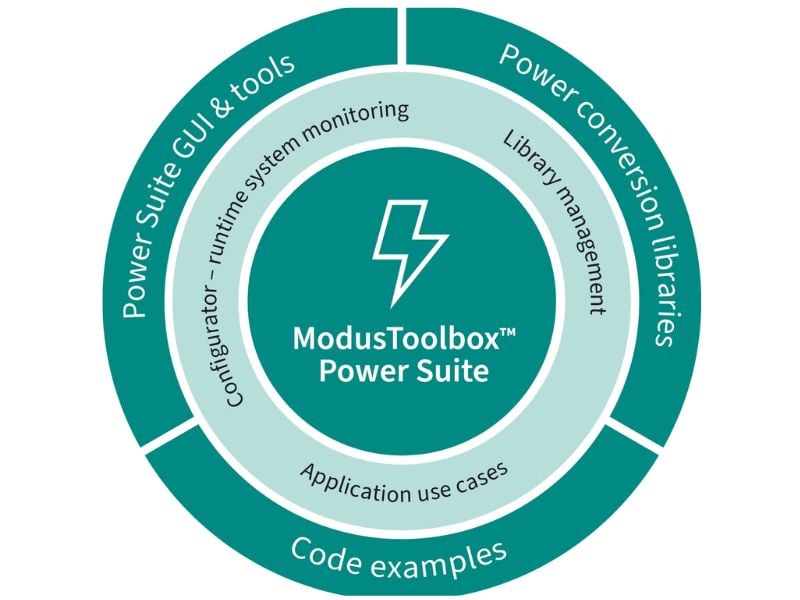
Overview of the PowerSuite for ModusToolbox. Image used courtesy of Infineon
The suite supports three PFC topologies (totem-pole, standard boost, and CCM) and three LLC topologies (half-bridge, full-bridge, and multi-phase). It’s available now directly from Infineon, with new PFC and LLC reference boards arriving in spring 2026 and pairing with PSOC Control C3 control cards.
A Trainer Board That Won't Bite
Infineon’s Embedded World booth demos focused on a low-voltage Totem-Pole PFC interleaved board that Massimo Paglia walked through during the interview. The board runs from a transformer that scales a real PFC down by a factor of ten, taking 23 V RMS at the input and boosting to 40 V at the output, with a maximum output of 100 W. In a production single-phase application, those numbers would correspond to roughly 400 V on the output rail.
"This is a training kit for our customer users that want to learn the features of the microcontroller without harming themselves," Paglia told EEPower.
The trainer eliminates exposed mains potential while preserving the control-loop behavior of a real PFC, allowing engineers to experiment with switching frequency, control timing, and peripheral allocation without the risk profile of a benchtop high-voltage rig.
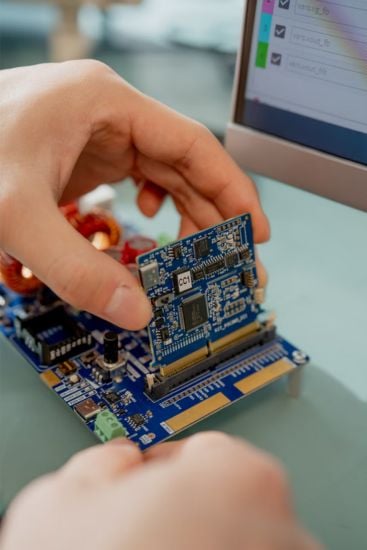
The ModusToolbox includes hardware and software. Image used courtesy of Infineon
The Case for Autonomous Control Loops
Higher up the PSOC Control C3 stack, Infineon has built a dual-core subsystem called PPCA into the Performance Line parts. PPCA dedicates one core to voltage regulation and another to current regulation, each with its own ADCs and timers, and runs the control loop independently of the main Cortex-M33. The main CPU is left free for telemetry, security, and system-level housekeeping while the control loop runs uninterrupted.
That separation is important as data center power supplies climb past 5 kW, 8 kW, and 12 kW ratings driven by AI rack densities, where a 1% efficiency improvement can convert into meaningful savings at scale. Tighter, faster control loops are one of the few remaining levers once wide-bandgap switches like GaN and SiC have already pushed switching frequencies up.
Infineon isn’t alone in building application-specific developer ecosystems around its MCUs. Texas Instruments has its C2000-based digital power SDK, and STMicroelectronics offers the STM32 D-Power platform. With Power Suite, Infineon is building a similar vertically integrated stack around PSOC Control C3, betting that engineers buying its silicon increasingly want libraries, GUIs, and reference boards rather than a datasheet and a compiler.
Related Content