Facebook
 Google
 GitHub
 Linkedin
Hitachi Energy Launches AI-Powered Suite for Infrastructure
The HMAX Energy platform combines digital twins, predictive analytics, and expert field support to reduce transformer failures by up to 50%.
Hitachi Energy has launched HMAX Energy, an AI-powered suite of services and solutions designed to protect critical energy infrastructure while improving operational efficiency. The platform targets utilities, renewable energy operators, industrial facilities, and data center operators managing aging grid assets that operate beyond their original design specifications.
The launch comes at a time when grid operators worldwide face compounding pressure from industrial electrification and the rapid expansion of power-hungry data center facilities. Much installed energy infrastructure was designed for a different era of demand, and the cost of unplanned downtime, both financial and operational, continues to rise.
Utilities are dealing with transformers, switchgear, and substations that are operating well past their intended service life, often under load conditions their designers never anticipated. HMAX Energy is Hitachi Energy's answer to that challenge, packaging capabilities proven in individual deployments into a unified, scalable service platform delivered through long-term customer partnerships.
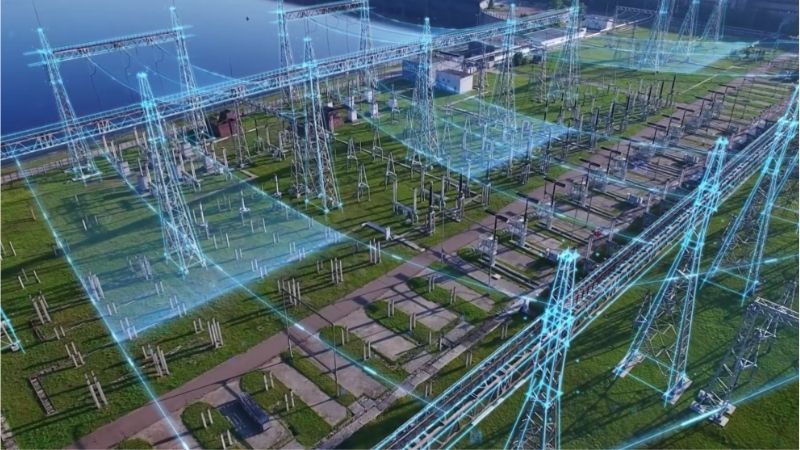
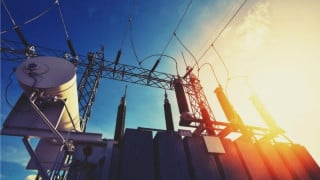
Energy infrastructure. Image used courtesy of Hitachi Energy
Plan, Predict, Prevent
HMAX Energy is built around three integrated pillars. The first, Plan, uses AI-powered recommendations to help operations teams make data-driven decisions about asset lifecycle management and operational spending. Rather than relying on fixed maintenance schedules, operators can allocate resources based on actual equipment condition and predicted degradation trajectories.
The second pillar, Predict, draws on connected asset monitoring and environmental data to detect early signs of equipment deterioration. The system analyzes sensor readings, weather patterns, and historical performance to flag anomalous behavior before it escalates into a failure event.
The third pillar, Prevent, translates those insights into action through regular health assessments, AI-enhanced performance models, and on-site expert support designed to extend equipment lifespan and reduce unplanned outages.
Underpinning the platform are digital twins, along with performance simulation models, real-time data analytics, and visualization tools.
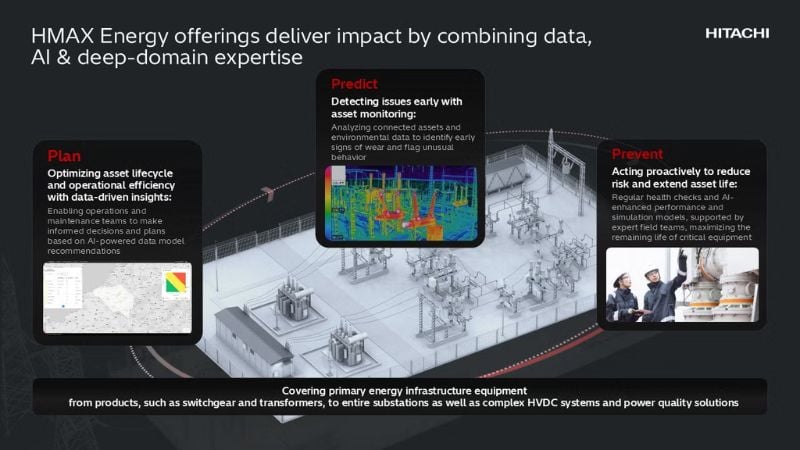
The three-pillar plan. Image used courtesy of Hitachi Energy
The platform is delivered through customer partnerships that combine Hitachi Energy's digital tools with its field engineering teams, providing both the software intelligence and the hands-on expertise needed to act on its recommendations. The approach reflects a broader industry shift away from reactive, schedule-based maintenance toward condition-based strategies that treat each piece of equipment as an individual asset.
Real-World Deployments and Results
Hitachi Energy is backing the launch with performance data from reference deployments. In real-world applications, HMAX Energy has demonstrated a 60% reduction in revenue loss from equipment breakdowns through rapid emergency response and failure prevention. Transformer failures have been cut by 50% using early detection capabilities, while repair costs have dropped by up to 75% through proactive problem identification.
For HVDC systems, Hitachi claims that using IdentiQ digital twins has reduced incident response times by up to 90%. One highlighted deployment involves Baltic Cable, where a digital twin platform monitors subsea HVDC infrastructure in real time, giving operators visibility into equipment health previously unavailable without physical inspection.
In Italy, energy company ERG achieved a 35% reduction in on-site inspection time through switchgear monitoring delivered via the platform, freeing field crews to focus on higher-priority maintenance tasks.
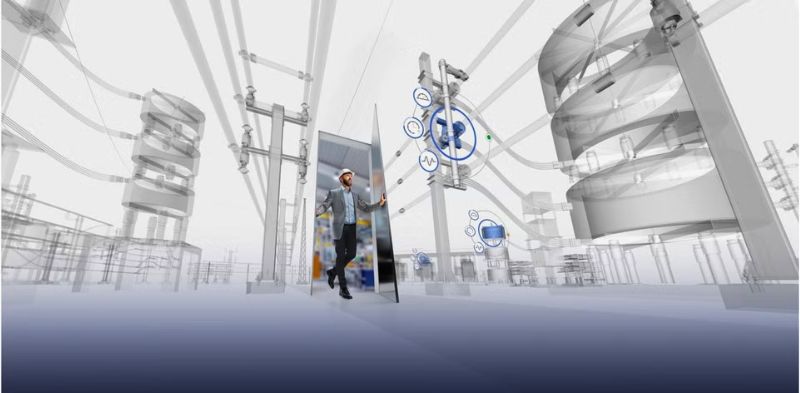
Concept of IdentiQ digital twin. Image used courtesy of Hitachi Energy
HMAX Energy is the latest addition to the broader HMAX by Hitachi portfolio, which spans energy, mobility, and industry verticals and was expanded at CES 2026 alongside collaborations with Nvidia, Google Cloud, and Nozomi Networks.
The launch aligns with Hitachi's Lumada 3.0 strategy, which emphasizes AI-driven solutions for social infrastructure. As grid demand grows and existing assets continue to age, tools that extend equipment lifecycles, reduce unplanned downtime, and lower maintenance costs are becoming a commercial necessity for energy operators at every scale.